Words used to describe someone’s body can seem simple, but body descriptors such as “thick,” “fat,” and “chubby” can communicate very different meanings depending on context, tone, culture, age, and personal preference.
For example, someone might use “thick” as a positive description of a curvier body, while another person may hear “fat” as blunt or insulting. “Chubby,” meanwhile, is often associated with softness or extra body fat, but it can sound patronizing when used for adults.
Understanding these differences helps you communicate more accurately and respectfully. In this guide, we will explain what thick, fat, and chubby mean, how they differ, when they may be appropriate, and which alternatives work better in sensitive situations.
What Do “Thick,” “Fat,” and “Chubby” Mean?
The three words can overlap when describing body size, but they are not interchangeable.
What Does “Thick” Mean?
“Thick” is an informal body descriptor commonly used for a body with noticeable curves, especially around the hips, thighs, buttocks, or chest.
It does not necessarily mean that someone has a high amount of body fat. A person can be described as thick because of their body proportions or muscular build.
Examples:
- “She has a thick, athletic build.”
- “The character was designed with a thick waist and strong legs.”
- “That jacket is designed for a thick, curvy figure.”
In modern informal English, “thick” can be complimentary, particularly in conversations about fashion or body positivity. However, it remains subjective.
What Does “Fat” Mean?
“Fat” can function as a straightforward adjective describing body size, but its social meaning is more complicated.
Some people use fat as a neutral self-description or identity term. Others experience it as insulting or stigmatizing. Therefore, it is important not to assume that everyone is comfortable with the word.
For general writing, especially professional or sensitive communication, neutral descriptions such as higher-weight, larger-bodied, or a more specific physical description may be preferable.
What Does “Chubby” Mean?
“Chubby” generally describes someone who has a soft, rounded appearance or more body fat than what the speaker considers slim.
The word is often associated with children, babies, or affection:
- “The baby has chubby cheeks.”
- “The puppy has chubby little paws.”
When applied to adults, however, “chubby” can sound childish or condescending depending on the relationship and tone.
Thick vs. Fat vs. Chubby: The Main Difference
The simplest way to distinguish these descriptors is to consider what the word emphasizes.
| Descriptor | Common meaning | Typical tone | Important consideration |
|---|---|---|---|
| Thick | Curvy, substantial, or fuller proportions | Often positive or informal | May emphasize shape rather than weight |
| Fat | Having a larger amount of body fat or a larger body | Can be neutral, blunt, or offensive | Highly dependent on personal preference and context |
| Chubby | Soft, rounded, somewhat plump | Often playful or affectionate | Can sound childish or patronizing for adults |
| Curvy | Noticeable curves in the body | Usually neutral or positive | Focuses more on shape than body size |
| Higher-weight | Greater body weight relative to a reference | Neutral/formal | More suitable for some professional contexts |
| Larger-bodied | Having a larger body size | Neutral | Useful when a nonjudgmental description is needed |
The key point is that these words describe different aspects of appearance. “Thick” often focuses on proportions, “fat” can refer directly to body size or fatness, and “chubby” suggests softness or roundness.
How Context Changes the Meaning of Body Descriptors
A body descriptor does not have one universal emotional meaning. The same word can be positive in one situation and hurtful in another.
Social and Casual Conversations
In casual conversations, words such as “thick” and “curvy” may be used positively.
For example:
“She looks amazing in that outfit. It really suits her thick, curvy figure.”
Here, the speaker is focusing on appearance and style.
However, describing someone’s body without knowing whether they welcome the comment can still create discomfort.
Professional and Educational Writing
Professional writing requires more care.
For example, instead of writing:
“The study examined fat people and their eating habits.”
A more precise version might be:
“The study examined people with higher body weight and their eating behaviors.”
In healthcare contexts, current guidance increasingly emphasizes respectful, person-centered language and recommends asking people what terminology they prefer. The 2025 Standards of Care in Overweight and Obesity specifically recommends person-centered, nonjudgmental language and shared decision-making.
Describing Fictional Characters
Authors sometimes need body descriptors to establish a character’s appearance.
Instead of repeatedly labeling a character as “fat” or “chubby,” writers can describe specific physical characteristics:
- broad shoulders
- rounded cheeks
- strong thighs
- a soft midsection
- a curvy silhouette
- a larger frame
This creates a more vivid description without reducing the character to body size.
Which Body Descriptor Is More Respectful?
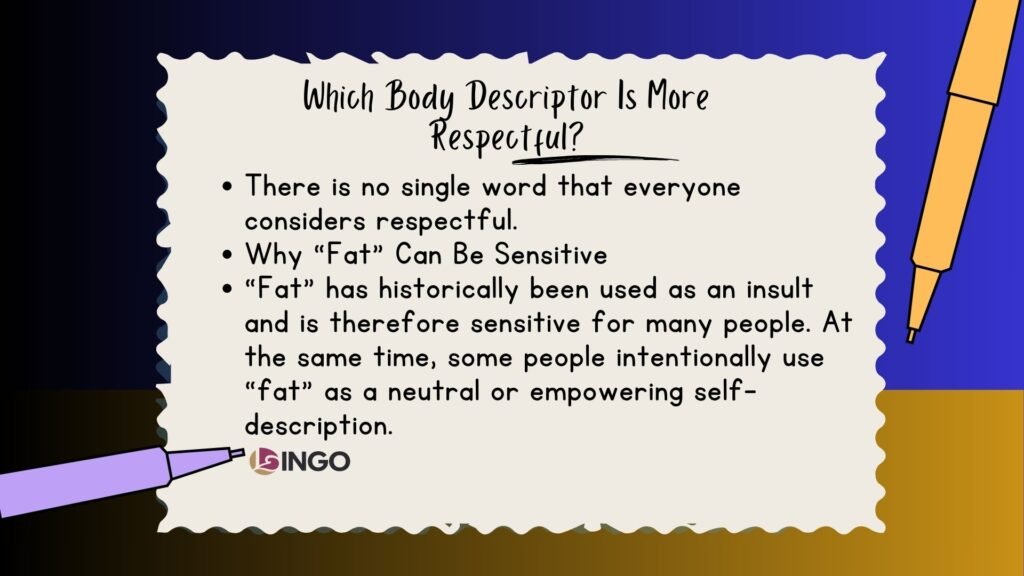
There is no single word that everyone considers respectful.
Why “Fat” Can Be Sensitive
“Fat” has historically been used as an insult and is therefore sensitive for many people. At the same time, some people intentionally use “fat” as a neutral or empowering self-description.
That distinction matters.
A person may say:
“I describe myself as fat, and I don’t consider it an insult.”
That does not automatically mean another person will appreciate being called fat.
Why “Chubby” Can Feel Patronizing
“Chubby” often has a softer sound than “fat,” but softer does not always mean more respectful.
For an adult, “chubby” may feel infantilizing because the word is frequently associated with babies and children.
For example:
“The toddler has chubby cheeks.”
sounds affectionate.
But:
“You’re getting chubby.”
can easily sound judgmental when directed at an adult.
Why “Thick” Is Not Always a Safe Alternative
“Thick” is often used positively in contemporary informal English, especially when discussing curvier bodies. However, it still draws attention to someone’s appearance.
Therefore, if body size is irrelevant to the conversation, the most respectful choice may simply be not to mention it.
A Practical Guide to Choosing the Right Body Descriptor
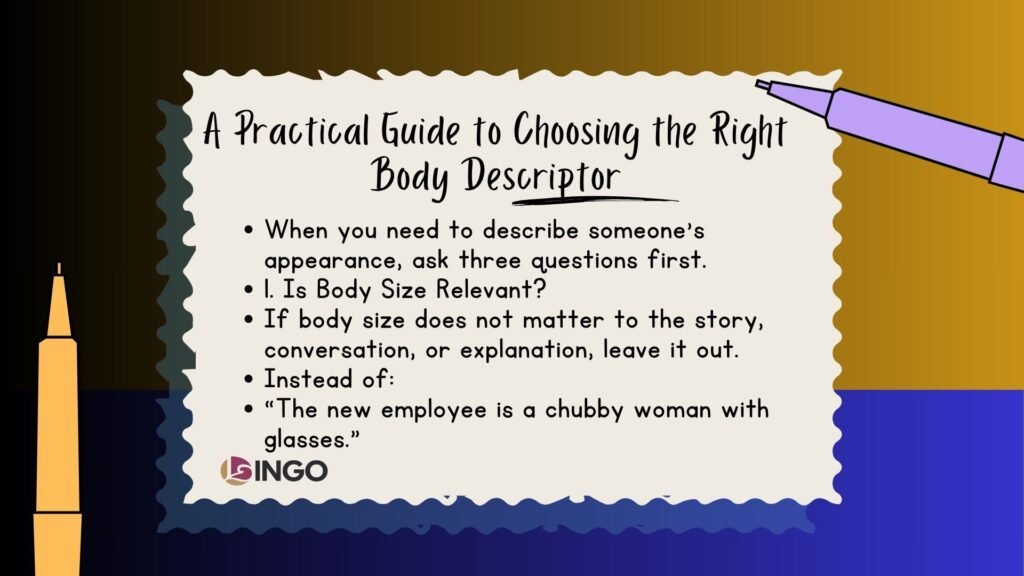
When you need to describe someone’s appearance, ask three questions first.
1. Is Body Size Relevant?
If body size does not matter to the story, conversation, or explanation, leave it out.
Instead of:
“The new employee is a chubby woman with glasses.”
You could write:
“The new employee is a woman with glasses.”
The second sentence communicates the relevant identifying detail without introducing an unnecessary judgment about body size.
2. Are You Describing Shape or Size?
If you mean body proportions, “curvy” or “thick” may communicate something different from “fat.”
For example:
- Curvy → emphasizes curves.
- Thick → often emphasizes fuller proportions.
- Fat → directly identifies fatness or larger body size.
- Chubby → suggests softness and roundness.
Choosing the most precise word prevents unintended meaning.
3. Does the Person Have a Known Preference?
Language preferences vary significantly.
The American Psychological Association’s Inclusive Language Guide recommends neutral terminology around body size and notes that weight stigma can affect people regardless of their actual weight.
Therefore, when the subject is sensitive, asking is often better than assuming:
“What term do you prefer?”
That small question can make communication considerably more respectful.
Case Study: How One Description Can Change the Tone
Imagine a fashion writer reviewing clothing designed for different body shapes.
The writer initially says:
“This dress is for chubby women who want to hide their fat.”
Although the sentence may be intended to describe a particular audience, its wording sounds judgmental. It also assumes that people with larger bodies want to hide them.
The writer revises the sentence:
“This dress is designed for people with fuller or curvier figures, with a cut that creates a comfortable and flattering silhouette.”
The factual purpose remains similar: the writer is discussing clothing designed for a particular body shape. However, the revised version focuses on fit, comfort, and design rather than presenting body size as a problem.
Now consider another situation. A novelist is introducing a character who is intentionally described as fat because body acceptance is an important part of the story. In that case, repeatedly avoiding the word may actually make the writing less authentic. If the character uses “fat” as a neutral self-description, the author may reasonably use it within the narrative.
This illustrates an important principle: respectful language is not simply about banning particular words. It is about understanding meaning, context, audience, and personal preference.
The same word can function as a neutral descriptor, an affectionate expression, an identity term, or an insult depending on how and why it is used.
2025–2026 Data: Why Body-Related Language Matters
Body-size terminology matters partly because conversations about weight occur against a significant global health and social context.
According to the World Health Organization’s December 2025 fact sheet, 2.5 billion adults worldwide were overweight in 2022, including more than 890 million adults living with obesity. WHO reported that 43% of adults aged 18 and older were overweight and approximately 16% were living with obesity in 2022.
In the United States, CDC data published in 2025 from the 2024 Behavioral Risk Factor Surveillance System showed that every U.S. state and territory had an adult obesity prevalence of at least 25% in 2024.
These statistics do not tell us which words individuals prefer. Instead, they show why discussions about body size are widespread and why accurate, respectful communication matters.
Research published in 2025 also examined whether person-first language changes obesity stigma. A study involving 299 young adults found that the relationship between language and stigma was more complicated than simply assuming that one grammatical structure always eliminates stigma.
The practical lesson is important: word choice matters, but listening to the individual and considering context matter too.
Better Alternatives to Thick, Fat, and Chubby
When a neutral description is appropriate, you have several options.
Neutral Body-Description Alternatives
Depending on what you actually mean, consider:
- curvy
- fuller-figured
- larger-bodied
- higher-weight
- broad
- rounded
- solidly built
- muscular
- plus-size when discussing clothing or fashion
- a specific physical feature rather than overall body size
The best option depends on the situation.
For example:
Fashion:
“a plus-size clothing model”
Body shape:
“a curvy figure”
Physical build:
“a broad-shouldered person”
Healthcare:
“a person with obesity” may be appropriate when obesity is medically relevant.
Current clinical recommendations emphasize person-centered and nonjudgmental language and encourage asking individuals about their preferred terminology.
Common Mistakes When Using Body Descriptors
Mistake 1: Assuming “Chubby” Is Automatically Kinder
“Chubby” may sound softer than “fat,” but it can still be unwanted.
Better approach: Consider whether the description is necessary and whether the person is comfortable with it.
Mistake 2: Treating “Thick” and “Fat” as Synonyms
They can overlap, but they are not identical.
“Thick” often emphasizes curves or proportions, while “fat” directly refers to fatness or a larger body.
Mistake 3: Using Medical Terms as Insults
Medical terminology should not become a casual judgment about someone’s appearance.
For example, “obesity” has a specific clinical meaning and should not be used as a casual synonym for “unattractive” or “large.”
Mistake 4: Assuming Everyone Wants a Body Compliment
Even positive comments can cross boundaries.
Calling someone “thick” may be intended as praise, but the person may not want their body discussed at all.
Mistake 5: Confusing Appearance With Health
A person’s appearance alone cannot tell you their complete health status.
WHO describes obesity as a complex chronic disease involving multiple interacting factors, including genetics, biology, behavior, environment, and broader social conditions.
Therefore, avoid making assumptions such as:
“She looks healthy because she’s thin.”
or:
“He’s unhealthy because he’s fat.”
Appearance is not a complete medical assessment.
Mini Quiz: Thick, Fat, or Chubby
Which word most commonly emphasizes a curvy or fuller body shape?
A) Thick
B) Tiny
C) Narrow
D) Lean
Answer: A) Thick
- Which descriptor often suggests a soft, rounded appearance?
A) Thick
B) Chubby
C) Athletic
D) Slender
Answer: B) Chubby - Which word can function as a direct description of body fat or body size?
A) Fat
B) Curvy
C) Tall
D) Petite
Answer: A) Fat - “The baby has ______ cheeks.” Which word sounds most natural?
A) Fat
B) Thick
C) Chubby
D) Broad
Answer: C) Chubby - Which word often focuses more on body proportions than overall weight?
A) Thick
B) Fat
C) Chubby
D) Heavy
Answer: A) Thick - Which term is commonly associated with curves rather than simply body weight?
A) Thick
B) Skinny
C) Thin
D) Petite
Answer: A) Thick - Why can “chubby” be sensitive when describing an adult?
A) It may sound childish or patronizing.
B) It is always a medical term.
C) It only describes height.
D) It means athletic.
Answer: A) It may sound childish or patronizing. - Which word may be used positively as a self-description by some people but negatively by others?
A) Fat
B) Tall
C) Short
D) Young
Answer: A) Fat - Which phrase is generally more neutral for describing body size?
A) Larger-bodied
B) Super-fat
C) Very chubby
D) Extremely thick
Answer: A) Larger-bodied - “She has a ______ figure with noticeable curves.” Which option best fits?
A) Thick
B) Tiny
C) Skinny
D) Narrow
Answer: A) Thick - Which word is most closely associated with softness and roundness?
A) Chubby
B) Muscular
C) Angular
D) Lean
Answer: A) Chubby - True or False: “Thick” and “fat” always mean exactly the same thing.
Answer: False - True or False: “Chubby” can sound affectionate when describing a baby’s cheeks.
Answer: True - Which term generally emphasizes curves rather than making a direct statement about body fat?
A) Curvy
B) Fat
C) Heavy
D) Obese
Answer: A) Curvy - If someone’s body size is irrelevant to a conversation, what is often the best choice?
A) Avoid mentioning their body size.
B) Call them chubby.
C) Call them fat.
D) Call them thick.
Answer: A) Avoid mentioning their body size. - Which sentence uses “chubby” most naturally?
A) The baby has chubby cheeks.
B) The building has chubby windows.
C) The athlete has chubby speed.
D) The book has chubby pages.
Answer: A) The baby has chubby cheeks. - Which descriptor can have different meanings depending strongly on personal preference and context?
A) Fat
B) Wooden
C) Metallic
D) Circular
Answer: A) Fat - What does “larger-bodied” primarily describe?
A) Body size
B) Hair color
C) Height
D) Age
Answer: A) Body size - Which word is particularly common in informal discussions of curvy body proportions?
A) Thick
B) Narrow
C) Petite
D) Bony
Answer: A) Thick - Which approach is best when you don’t know someone’s preferred body-related terminology?
A) Use a neutral description or avoid the body description.
B) Always use “fat.”
C) Always use “chubby.”
D) Always use “thick.”
Answer: A) Use a neutral description or avoid the body description. - Which word may sound more infantilizing when used for an adult?
A) Chubby
B) Curvy
C) Broad
D) Muscular
Answer: A) Chubby - Which sentence focuses on clothing rather than judging someone’s body?
A) The dress is designed for fuller figures.
B) The dress is designed to hide fat people.
C) The dress is for chubby people only.
D) The dress makes thick people look smaller.
Answer: A) The dress is designed for fuller figures. - Why should writers be careful with body descriptors?
A) They can carry social and emotional meanings beyond their literal definitions.
B) They are always medical terms.
C) They can only be used for children.
D) They have no meaning outside dictionaries.
Answer: A) They can carry social and emotional meanings beyond their literal definitions. - Which statement about “fat” is most accurate?
A) Some people use it neutrally, while others may find it offensive.
B) It is always a compliment.
C) It is always an insult.
D) It only describes body shape.
Answer: A) Some people use it neutrally, while others may find it offensive. - What is the most important factor when choosing among “thick,” “fat,” and “chubby”?
A) Context and the person’s language preference
B) The number of letters in the word
C) How quickly the word can be pronounced
D) Whether the word sounds informal
Answer: A) Context and the person’s language preference
FAQs About Thick, Fat, and Chubby
Q1:Is “thick” the same as “fat”?
No. “Thick” commonly emphasizes fuller or curvier body proportions, while “fat” directly describes fatness or a larger body. However, their meanings can overlap depending on context.
Q2:Is “chubby” a rude word?
Not necessarily. “Chubby” can sound affectionate when describing children or features such as cheeks, but it may feel childish, patronizing, or unwanted when used to describe an adult.
Q3:Is it okay to call someone fat?
It depends on the person and context. Some people use “fat” as a neutral or empowering self-description, while others consider it offensive. When you do not know someone’s preference, a neutral description—or no body description at all—is usually safer.
Q4:Is “thick” a compliment?
“Thick” is often used as a compliment in informal modern English, particularly to describe a curvier body. However, not everyone wants comments about their body, so context and personal preference matter.
Q5:What is a respectful way to describe a larger body?
Depending on context, terms such as “larger-bodied,” “higher-weight,” “curvy,” or “fuller-figured” may work. In healthcare contexts, person-centered wording such as “person with obesity” may be appropriate when medically relevant.
Q6:What is the difference between curvy and thick?
“Curvy” generally focuses on the presence of curves, while “thick” often suggests fuller proportions, particularly around the hips, thighs, buttocks, or chest. Neither term has one universal definition.
Q7:Should writers avoid all body descriptors?
No. Body descriptors can be useful when appearance is relevant to a story, character, fashion description, or educational discussion. The goal is to use precise language without unnecessary judgment or stereotyping.
Q8:Why does body-related language matter?
Words can influence how people feel about themselves and how others perceive them. The APA notes that weight stigma is widespread and can be associated with poorer psychological and physical health outcomes.
Conclusion: Choose Body Descriptors With Context and Care
Understanding body descriptors such as “thick,” “fat,” and “chubby” is less about finding one universally correct word and more about recognizing differences in meaning, tone, and context.
“Thick” often highlights fuller or curvier proportions. “Fat” can be a direct descriptor or a personally embraced identity term, but it can also be experienced as stigmatizing. “Chubby” tends to suggest softness or roundness and may sound affectionate in some contexts but patronizing in others.
The safest approach is simple: be precise, avoid unnecessary comments about someone’s body, and respect individual language preferences.
When body size is relevant, choose the word that accurately communicates what you mean. When it is not relevant, leaving the description out is often the most respectful choice.
For more clear explanations of commonly confused English words and grammar rules, explore the other language guides on Lingorixa.
References
WHO: Obesity and Overweight
CDC: Adult Obesity Prevalence Maps

Maimoona Asghar is a grammar enthusiast and language writer who creates clear, practical content to help learners improve English grammar, writing, punctuation, and communication skills through easy-to-understand explanations and examples.