Have you ever written “to small” and wondered whether it should actually be “too small”? You are not alone. To small or too small is a common English grammar question because to and too sound almost identical when spoken.
The correct expression is “too small” when you mean that something is smaller than necessary, suitable, or wanted.
For example:
This shirt is too small for me.
Here, too means “more than is acceptable” or, in this case, “smaller than is suitable.”
The phrase “to small” is generally incorrect when you are trying to express this meaning. The good news is that the difference between to and too is simple once you understand what each word does.
To Small or Too Small: Which Is Correct?
The correct phrase is “too small” when you want to say that something does not have enough size or space for a particular purpose.
Correct:
The box is too small for these books.
Incorrect:
The box is to small for these books.
Why? Too is an adverb that can come before an adjective to indicate that something exceeds an acceptable limit. Cambridge Dictionary explains that too can mean “more than is allowed, necessary, possible,” and it is used directly before adjectives such as small, large, expensive, and difficult.
Why “Too Small” Is Correct
In too small, small is an adjective describing the size of something.
The word too modifies that adjective.
The basic pattern is:
too + adjective
Examples:
- too small
- too large
- too expensive
- too difficult
- too short
- too cold
- too loud
Therefore:
The room is too small for six people.
The sentence means the room does not have enough space to comfortably accommodate six people.
Why “To Small” Is Usually Incorrect
To has several grammatical functions, but it does not normally modify an adjective such as small to express an excessive degree.
For example:
I want to leave.
Here, to introduces the infinitive leave.
You can also use to to indicate direction:
We walked to school.
But you cannot normally use to before small when you mean “smaller than necessary.”
So:
❌ The shoes are to small.
should be:
✅ The shoes are too small.
What Does “Too Small” Mean?
Too small means that something is smaller than what is needed, suitable, expected, or wanted.
Cambridge Dictionary gives too the meaning of being beyond an appropriate or necessary degree.
Consider these examples:
This jacket is too small for me.
The jacket does not fit because its size is insufficient.
The font is too small to read comfortably.
The letters are smaller than they should be for comfortable reading.
This bag is too small to hold my laptop.
The bag does not have enough space.
The apartment is too small for a family of six.
There is insufficient living space.
Notice that too communicates a problem or limitation. It tells us that the degree of smallness has passed the acceptable point.
“Too Small” vs. “Very Small”
A useful distinction is the difference between too small and very small.
Very small simply describes something as having a small size.
The puppy is very small.
This does not necessarily mean there is a problem.
Too small, however, suggests that the size is inadequate for a particular purpose.
The puppy’s collar is too small.
The collar is not suitable because it does not fit.
Cambridge specifically distinguishes very from too: very intensifies an adjective, while too can indicate that something exceeds an appropriate limit.
How to Use “Too Small” Correctly
Once you remember that too can modify an adjective, using too small becomes straightforward.
Too Small for Something
Use too small for when something is insufficient in size for a particular person, object, or purpose.
Examples:
This desk is too small for my computer.
The room is too small for a large meeting.
These shoes are too small for my feet.
The container is too small for the amount of food.
The structure is:
too + adjective + for + noun/pronoun
Too Small to Do Something
You can also use too small to when the size prevents someone or something from performing an action.
Examples:
The box is too small to hold all the books.
The child is too small to reach the shelf.
The screen is too small to read the text easily.
The bag is too small to carry everything.
The structure is:
too + adjective + to + verb
This distinction is important because both too and to can appear in the same sentence:
The bag is too small to carry all my clothes.
The first too means “more than suitable” or “to an excessive degree,” while the second to introduces the verb carry.
To vs. Too: The Simple Grammar Rule
The easiest way to remember the difference is to focus on the job each word performs.
| Word | Common Function | Example |
|---|---|---|
| to | Shows direction | We went to school. |
| to | Introduces an infinitive | I want to learn. |
| too | Means excessively/more than necessary | It is too small. |
| too | Means also | I want one too. |
A quick memory trick is:
Too has an extra “o” because it often means “more” or “also.”
For example:
The room is too small.
Think: too = more than suitable.
And:
I want to go too.
Think: too = also.
This is not a complete grammar rule for every possible use of too, but it is a useful memory aid for everyday writing.
Common Mistakes With “To Small”
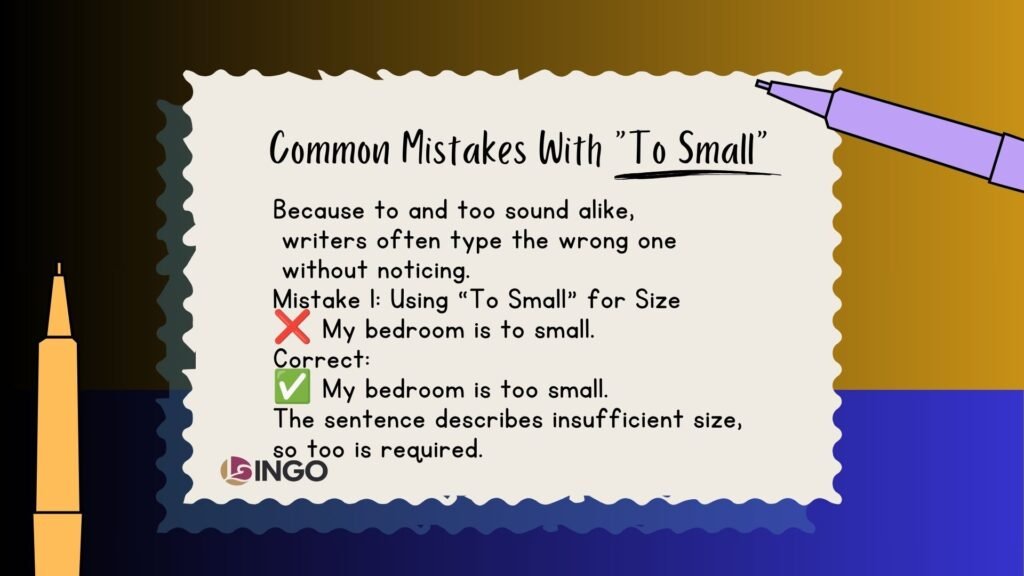
Because to and too sound alike, writers often type the wrong one without noticing.
Mistake 1: Using “To Small” for Size
❌ My bedroom is to small.
Correct:
✅ My bedroom is too small.
The sentence describes insufficient size, so too is required.
Mistake 2: Confusing “Too” With “To” Before a Verb
Remember that to + verb is extremely common:
I want to go.
She needs to study.
We decided to leave.
But before an adjective such as small, large, or expensive, too may be required when you mean “more than suitable.”
The house is too expensive.
The shoes are too small.
The box is too large.
Mistake 3: Assuming “Too Small” Always Means Bad
Too small usually implies that something is insufficient for a particular purpose, but context determines whether that is actually negative.
For example:
The text is too small to read.
Clearly, the size creates a problem.
But:
The flowers are too small to see from the back row.
Again, the issue depends on the intended purpose.
The word too establishes a limit; the surrounding context explains why that limit matters.
A Real-Life Case Study: Choosing the Right Size
Imagine that Sara is shopping online for a backpack. She finds a bag that looks attractive and has a good price. The product description says that the bag has a compact design.
When the backpack arrives, Sara tries to put her laptop inside. The laptop does not fit because the main compartment is not large enough.
She might say:
This backpack is too small for my laptop.
Notice that Sara is not simply saying the backpack is small. She is saying that its size is insufficient for a specific purpose.
Now imagine that Sara buys a second backpack. It is also compact, but it is large enough for her laptop.
She could say:
This backpack is small, but it is large enough for my laptop.
That distinction demonstrates why very small and too small are not interchangeable.
If Sara says:
The backpack is very small.
She is describing its size.
If she says:
The backpack is too small for my laptop.
She is explaining that the size creates a practical problem.
The same principle applies in everyday communication. A cup can be small without being unsuitable. A screen can be small without being unusable. A room can be small without being inadequate. The word too introduces the idea that something has crossed a relevant limit.
This is why too small is the correct phrase when the intended meaning is “not large enough for what is required.”
2025–2026 Data and What It Tells Us About Grammar Learning
There is an important distinction between language-learning data and grammar-error data.
There is no reliable 2025–2026 statistical source that establishes a precise percentage of English users who specifically write “to small” instead of “too small.” Claims assigning an exact percentage to this particular mistake should therefore be treated cautiously.
What authoritative dictionary evidence does establish is that too is an adverb with several common functions, including expressing an excessive degree and meaning “also.” Cambridge’s current grammar guidance explicitly identifies too as an adverb and demonstrates its use before adjectives and adverbs.
Merriam-Webster’s current entry likewise defines too as an adverb that can mean “also” and can indicate an excessive degree, with examples such as something being too large or too hot. Its entry was updated in March 2026.
The practical takeaway is more useful than an unsupported percentage: to and too are distinct words with different grammatical functions, even though they are pronounced alike in many varieties of English.
A Quick Checklist: Should You Write “To” or “Too”?
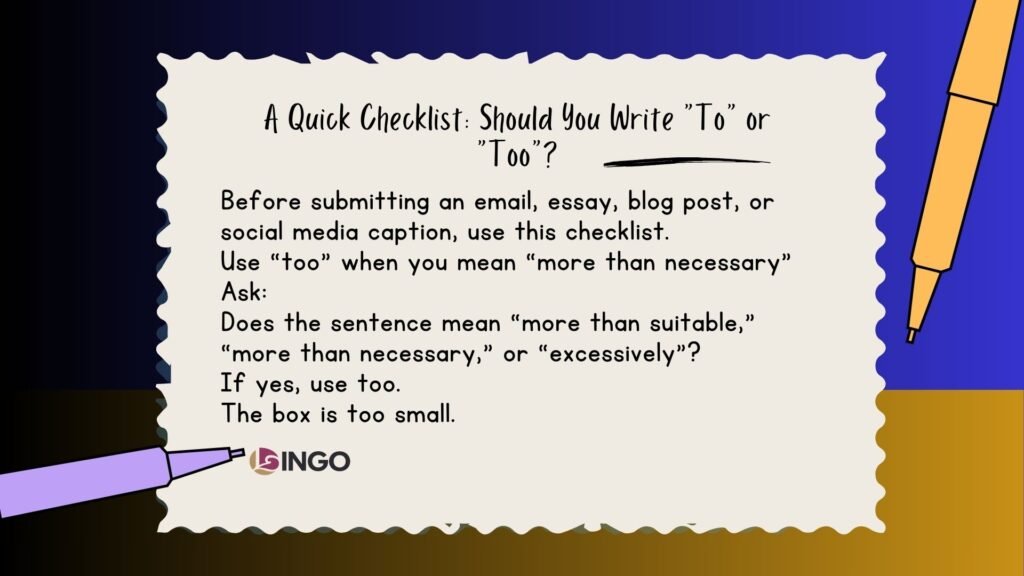
Before submitting an email, essay, blog post, or social media caption, use this checklist.
Use “too” when you mean “more than necessary”
Ask:
Does the sentence mean “more than suitable,” “more than necessary,” or “excessively”?
If yes, use too.
The box is too small.
The coffee is too hot.
The test was too difficult.
Use “too” when you mean “also”
I want to come too.
She likes chocolate too.
He is attending the meeting too.
Use “to” before an infinitive
I want to learn.
She needs to study.
We decided to leave.
Use “to” for direction or connection
We went to the store.
Give the letter to John.
She traveled to London.
The Five-Second Test
If you are unsure about to small or too small, replace too with “more than necessary.”
The shirt is more than necessary small.
That replacement sounds awkward, but the intended meaning is clear: the shirt is smaller than acceptable.
Therefore:
✅ The shirt is too small.
More Examples of “Too Small”
Here are additional examples to make the pattern easy to recognize:
- This room is too small for a large family.
- My shoes are too small.
- The text on this website is too small to read.
- That suitcase is too small for a two-week trip.
- The table is too small for six people.
- This box is too small to hold the equipment.
- The font is too small on my phone.
- The apartment is too small for all our furniture.
- The picture is too small to see clearly.
- That container is too small for the ingredients.
In every example, too modifies an adjective and communicates that the degree of smallness is unsuitable for the stated purpose.
Mini Quiz: To Small or Too Small
1. Choose the correct sentence:
A. The shoes are to small for me.
B. The shoes are too small for me.
C. The shoes are two small for me.
D. The shoes are tow small for me.
Answer: B
2. Which sentence uses “too small” correctly?
A. The box is too small to hold the books.
B. The box is to small to hold the books.
C. The box is two small to hold the books.
D. The box is tow small to hold the books.
Answer: A
3. Complete the sentence:
This room is ___ small for six people.
A. to
B. too
C. two
D. tow
Answer: B
4. Complete the sentence:
I want ___ learn English.
A. too
B. to
C. two
D. tow
Answer: B
5. Choose the correct phrase:
A. to small for my laptop
B. too small for my laptop
C. two small for my laptop
D. tow small for my laptop
Answer: B
6. Which sentence means that a shirt is smaller than suitable?
A. The shirt is very small.
B. The shirt is too small.
C. The shirt is to small.
D. The shirt is two small.
Answer: B
7. Complete the sentence:
The text is ___ small to read comfortably.
A. to
B. too
C. two
D. tow
Answer: B
8. Which sentence uses “to” correctly?
A. The shoes are to small.
B. I need to leave.
C. The room is to small.
D. The box is to small.
Answer: B
9. Choose the correct sentence:
A. My backpack is to small for all my books.
B. My backpack is too small for all my books.
C. My backpack is two small for all my books.
D. My backpack is tow small for all my books.
Answer: B
10. What does “too” mean in “The box is too small”?
A. Also
B. More than suitable
C. Toward a place
D. The number two
Answer: B
11. Complete the sentence:
She went ___ school early.
A. too
B. to
C. two
D. tow
Answer: B
12. Which sentence is grammatically correct?
A. The table is too small for four people.
B. The table is to small for four people.
C. The table is two small for four people.
D. The table is tow small for four people.
Answer: A
13. Complete the phrase:
too small ___ carry
A. to
B. too
C. two
D. tow
Answer: A
14. Which sentence correctly uses both “too” and “to”?
A. The bag is too small to hold my coat.
B. The bag is to small too hold my coat.
C. The bag is two small to hold my coat.
D. The bag is too small too hold my coat.
Answer: A
15. Which sentence uses “too” to mean “also”?
A. The shoes are too small.
B. I want one too.
C. The room is too small.
D. The box is too small to fit.
Answer: B
16. Complete the sentence:
These shoes are ___ small for my feet.
A. to
B. too
C. two
D. tow
Answer: B
17. Which sentence is correct?
A. The font is too small to read.
B. The font is to small too read.
C. The font is two small to read.
D. The font is too small too read.
Answer: A
18. Which statement is accurate?
A. “Very small” and “too small” always mean exactly the same thing.
B. “Very small” always means unsuitable.
C. “Too small” can indicate insufficient size.
D. “Too small” refers to the number two.
Answer: C
19. Complete the sentence:
The apartment is ___ small for our family.
A. to
B. too
C. two
D. tow
Answer: B
20. Which phrase follows the pattern “too + adjective + for + noun”?
A. too small for me
B. to small for me
C. too small to me
D. two small for me
Answer: A
21. Which sentence correctly describes a container that cannot hold enough food?
A. The container is too small for the food.
B. The container is to small for the food.
C. The container is two small for the food.
D. The container is tow small for the food.
Answer: A
22. Complete the sentence:
I am going ___ the store.
A. too
B. to
C. two
D. tow
Answer: B
23. Which sentence correctly expresses insufficient screen size?
A. The screen is to small to view comfortably.
B. The screen is too small to view comfortably.
C. The screen is two small to view comfortably.
D. The screen is tow small to view comfortably.
Answer: B
24. Which sentence correctly uses “to” before an infinitive?
A. She wants to study.
B. She wants too study.
C. She wants two study.
D. She wants tow study.
Answer: A
25. 🏆 Final Challenge — Which sentence is completely correct?
A. The suitcase is too small to carry everything.
B. The suitcase is to small too carry everything.
C. The suitcase is two small to carry everything.
D. The suitcase is too small too carry everything.
Answer: A
Frequently Asked Questions About “To Small or Too Small”
Q1:Is “to small” grammatically correct?
Not when you mean that something is smaller than necessary or suitable. In that situation, the correct expression is “too small.”
Q2:Is “too small” correct English?
Yes. Too small is completely correct English. Too functions as an adverb modifying the adjective small.
The shoes are too small for me.
Q3:What is the difference between “to small” and “too small”?
To is commonly used for direction or before an infinitive, while too can mean “more than necessary” or “also.” Therefore, when describing insufficient size, use too small.
Q4:Can I say “too small to”?
Yes. This is a common grammatical structure:
The box is too small to hold the books.
The pattern is:
too + adjective + to + verb
Q5:Is “too small for” correct?
Yes. Use too small for when comparing the size of something with a person, object, purpose, or situation.
The room is too small for ten people.
Q6:What is the easiest way to remember “too small”?
Remember:
Too = more than necessary or suitable.
If something is not large enough for its intended purpose, write too small, not to small.
Q7:Why do people confuse “to” and “too”?
They are pronounced alike in many forms of English, so they are examples of commonly confused words. Because spelling cannot be heard during conversation, writers have to rely on grammatical context to choose the correct form.
Conclusion: “Too Small” Is the Correct Choice
So, to small or too small? When you mean that something is smaller than necessary, suitable, or wanted, the correct phrase is “too small.”
Remember the simple pattern:
too + adjective
too small
too large
too expensive
too difficult
too short
By contrast, to is commonly used for direction or before a verb:
go to school
want to learn
need to leave
Once you understand what each word does, the confusion becomes much easier to avoid.
The next time you hesitate between “to small” and “too small,” ask yourself whether you mean “more than suitable.” If you do, choose too.
For more clear explanations of commonly confused English words and grammar rules, explore the other language guides on Lingorixa.
References
Cambridge Dictionary — Too
Cambridge Dictionary — Too: Grammar

Maimoona Asghar is a grammar enthusiast and language writer who creates clear, practical content to help learners improve English grammar, writing, punctuation, and communication skills through easy-to-understand explanations and examples.