Have you ever seen dateline vs deadline and wondered whether these two words mean almost the same thing? They look similar, but they serve completely different purposes.
A dateline identifies the date and/or location associated with a news story, report, or document. A deadline, on the other hand, is the time or date by which something must be completed.
In simple terms:
Dateline tells you where or when a story originates. Deadline tells you when something must be finished.
Understanding this difference is especially important for journalists, students, writers, editors, and professionals. In this guide, we’ll explain both terms, compare them side by side, provide practical examples, and show you how to remember the difference easily.
What Is a Dateline?
A dateline is a line of information identifying the place, and often the date, associated with a news report or written publication. It is particularly common in journalism and news writing.
Merriam-Webster defines a dateline as a line in a written document or publication giving the date and place of composition or issue.
For example:
LONDON — The government announced new transportation measures Tuesday.
Here, LONDON functions as the dateline. It tells readers the location connected with the report.
Dateline Meaning in Journalism
In journalism, the dateline gives readers useful context about where information was gathered or where an event took place.
The Associated Press explains that a dateline tells readers where the basic information for a story was obtained. For shorter stories, it generally reflects where the story took place, although the appropriate location can depend on how and where the reporting was conducted.
For example:
PARIS — Leaders met Monday to discuss the proposed agreement.
The word PARIS immediately gives readers geographical context.
Examples of a Dateline
Here are a few simple examples:
- NEW YORK — The company announced a new product Tuesday.
- TOKYO — Officials gathered for an emergency meeting.
- LOS ANGELES — The festival opened Friday evening.
- ISLAMABAD — Authorities introduced new measures on Monday.
A dateline is therefore about the origin or location associated with a report, not about a task that must be completed.
Dateline vs Date
A dateline should not automatically be confused with an ordinary date.
A date simply tells you when something happened or was written:
August 29, 2026
A journalistic dateline can identify a place associated with the report:
KARACHI — Officials announced the new policy Friday.
Depending on the publication’s style, the date may be included separately or omitted from the visible dateline.
What Is a Deadline?
A deadline is a specific time or date by which something must be completed.
Cambridge Dictionary defines a deadline as a time or day by which something must be done.
For example:
The deadline for submitting the application is September 10.
This means the application must be submitted by the specified deadline.
Deadline Meaning in Everyday English
Unlike a dateline, a deadline is not limited to journalism.
You can have deadlines for:
- School assignments
- Job applications
- Tax forms
- Business projects
- Articles
- College applications
- Bills and payments
- Contracts
- Government forms
- Work presentations
For example:
I have a deadline to finish the report by Friday.
Here, deadline means the final time allowed for completing the report.
Examples of a Deadline
Consider these sentences:
The application deadline is October 15.
Our editor gave us a deadline of Friday.
I missed the deadline for submitting my essay.
The team is working under a tight deadline.
Please send your article before the publication deadline.
In every example, deadline refers to a required completion time.
Deadline in Journalism
Journalists and editors also work with deadlines.
For example:
The reporter must submit the article before the 6 p.m. deadline.
In this sentence, deadline has nothing to do with the article’s location. It identifies the final time for submitting the work.
That is the key distinction to remember:
A dateline describes information about a story; a deadline controls when work must be completed.
Dateline vs Deadline: The Real Difference
The easiest way to understand dateline vs deadline is to focus on their purposes.
A dateline provides contextual information about a story, particularly its location or origin. A deadline establishes a time limit for completing an action.
Dateline vs Deadline at a Glance
| Feature | Dateline | Deadline |
|---|---|---|
| Basic meaning | Identifies the place/date associated with a report | Identifies the final time for completing something |
| Common field | Journalism and publishing | Business, education, journalism, applications, everyday life |
| Main purpose | Gives readers context | Sets a time limit |
| Connected with | News story or report | Task or obligation |
| Example | LONDON — Officials met Tuesday. | The report is due Friday. |
| Can you miss it? | Not normally described this way | Yes |
| Common verbs | use, include, write, place | meet, miss, extend, set, move |
The Simplest Memory Trick
Think of the words this way:
Dateline = Where/when the story is connected to.
Deadline = When the task must end.
The shared word line can make the terms confusing, but their functions are completely different.
Dateline vs Deadline Examples
Compare these two sentences:
BERLIN — Officials announced the decision Tuesday.
This contains a dateline because it identifies the location associated with the report.
Now compare:
The journalist had until Tuesday to submit the article.
This contains a deadline because Tuesday is the final time for completing the task.
You can even use both in the same situation:
BERLIN — The reporter interviewed officials before the 5 p.m. deadline.
Here, BERLIN is the dateline, while 5 p.m. is the deadline.
How to Use Dateline and Deadline Correctly
Knowing the definitions is useful, but using the words correctly in real sentences is even more important.
Use Dateline for Location or Story Origin
Use dateline when discussing the location or origin associated with a news report or similar publication.
Correct:
The story carried a Washington dateline.
Correct:
The reporter filed the story from a London dateline.
Incorrect:
The article has a dateline of Friday because the assignment must be finished Friday.
Why is the last sentence confusing? Because the speaker is describing a completion time. Deadline is the appropriate word.
Use Deadline for a Required Completion Time
Use deadline when someone must finish, submit, apply, pay, or deliver something by a specific time.
Correct:
The deadline for submitting the article is Friday.
Correct:
We asked for a two-day extension to the deadline.
Correct:
She completed the assignment before the deadline.
Incorrect:
She completed the assignment before the dateline.
The word dateline does not normally describe the final time allowed for completing an assignment.
A Quick Test
When you’re unsure which word to use, ask yourself:
Am I talking about where a story comes from or is associated with?
Use dateline.
Am I talking about when something must be finished?
Use deadline.
This simple question solves most cases of confusion.
A Real-Life Journalism Example: How Dateline and Deadline Work Together
Imagine a journalist covering a major international conference.
The reporter travels to Geneva to interview officials and gather information. When the news organization publishes the story, it may use a dateline identifying Geneva or another location appropriate to the reporting circumstances.
For example:
GENEVA International officials met Wednesday to discuss a proposed agreement.
The word GENEVA provides geographical context. It tells readers where the reporting is connected to.
However, the journalist also has an editorial deadline. The newspaper may require the completed article by 4:00 p.m. so editors have enough time to review, edit, and publish it.
The reporter might therefore receive an instruction such as:
“Please file the story by 4 p.m.”
That 4 p.m. requirement is the deadline.
Now imagine that the journalist finishes reporting at 2 p.m., sends the story to the editor at 3:30 p.m., and the article is published with a Geneva dateline. The two terms describe entirely different parts of the process.
The dateline gives readers reporting context. The deadline gives the journalist a production limit.
This distinction becomes even more important in modern digital journalism. A newsroom may publish stories quickly across websites, apps, newsletters, social platforms, and video channels. Reuters Institute’s 2025 Digital News Report found that news consumption is increasingly fragmented across online platforms, with social and video networks becoming increasingly important sources of news.
So while the format of publishing continues to evolve, the practical distinction remains useful: the dateline communicates story context, while the deadline manages the work schedule.
What Recent 2025–2026 Data Tell Us About News Writing
The difference between a dateline and a deadline may seem like a small language issue, but understanding journalistic terminology matters in a media environment that is changing rapidly.
The Reuters Institute Digital News Report 2025 was based on almost 100,000 interviews with online news consumers across 48 markets. The report examined changing news consumption, social platforms, video, podcasts, misinformation, trust, and news avoidance.
Several findings are particularly relevant to the context in which journalistic language is used today:
- Around 36% of the global sample used Facebook for news each week.
- 30% used YouTube for news.
- Instagram and WhatsApp each reached about 19% for weekly news use.
- TikTok reached 16%, while X reached 12%.
- Social video news consumption increased from 52% in 2020 to 65% in 2025.
- Consumption of any online news video increased from 67% to 75% over the same period.
The Reuters Institute’s 2026 Digital News Report also describes a continuing transformation in news consumption, reporting that platforms have become more popular globally than both television and news websites/apps as news sources.
These figures do not change the dictionary meanings of dateline and deadline. Instead, they show why precise communication remains important as journalism expands across websites, social media, video, and other digital formats.
Google likewise emphasizes people-first, helpful, reliable content and recommends creating substantial, accurate information that genuinely serves readers rather than content designed primarily to manipulate rankings.
Common Mistakes With Dateline and Deadline
Because the words look and sound similar, mistakes are easy to make. Fortunately, most can be corrected with a little attention to context.
Mistake 1: Using Dateline for a Submission Time
Incorrect:
The dateline for the essay is Monday.
Better:
The deadline for the essay is Monday.
The sentence refers to the final submission time, so deadline is correct.
Mistake 2: Using Deadline for a Story Location
Incorrect:
The story has a deadline from Paris.
Better:
The story has a Paris dateline.
The intended meaning is the location associated with the report.
Mistake 3: Assuming Dateline Always Means a Date
The word dateline contains “date,” but in journalism it is strongly associated with the place and reporting context of a story. Merriam-Webster describes it as a line giving the date and place of composition or issue, while journalistic style can emphasize the location from which information was obtained.
Therefore, don’t automatically replace dateline with date.
Mistake 4: Thinking Deadline Only Applies to Work
Deadlines are used everywhere.
For example:
The scholarship deadline is December 1.
The visa application deadline is Friday.
The payment deadline is tomorrow.
The project’s deadline was extended.
The common idea is always the same: there is a final time by which something needs to happen.
A Simple Checklist for Choosing the Right Word
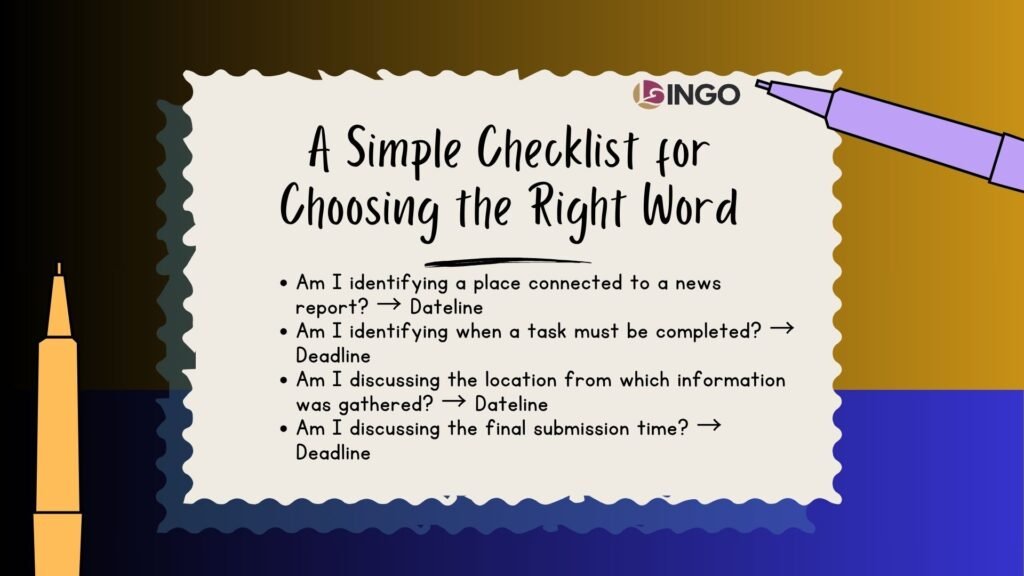
Use this quick checklist whenever you are unsure about dateline vs deadline:
- Am I identifying a place connected to a news report? → Dateline
- Am I identifying when a task must be completed? → Deadline
- Am I discussing the location from which information was gathered? → Dateline
- Am I discussing the final submission time? → Deadline
- Am I talking about a journalist’s filing schedule? → Deadline
- Am I describing the location shown at the beginning of a news story? → Dateline
- Can someone meet, miss, or extend it? → Usually deadline
One-Line Rule to Remember
A dateline gives context; a deadline gives a time limit.
If you remember that sentence, you will rarely confuse the two.
Mini Quiz: Dateline vs Deadline
1. Which word identifies the place associated with a news report?
A) Dateline
B) Deadline
C) Byline
D) Timeline
Answer: A) Dateline
2. Which sentence uses “deadline” correctly?
A) The deadline for the essay is Friday.
B) The deadline of the story was Paris.
C) The deadline showed where the reporter worked.
D) The deadline appeared before the city name.
Answer: A) The deadline for the essay is Friday.
3. Which sentence correctly uses “dateline”?
A) The article carried a London dateline.
B) The article carried a London deadline.
C) The article missed its London dateline.
D) The article extended its London dateline.
Answer: A) The article carried a London dateline.
4. A reporter must submit an article by 5 p.m. What does 5 p.m. represent?
A) A deadline
B) A dateline
C) A byline
D) A headline
Answer: A) A deadline
5. In “PARIS — Officials met Tuesday,” what is “PARIS”?
A) Dateline
B) Deadline
C) Byline
D) Caption
Answer: A) Dateline
6. Which term is most appropriate for a college application’s final submission date?
A) Deadline
B) Dateline
C) Byline
D) Headline
Answer: A) Deadline
7. Which term is commonly associated with news reporting?
A) Dateline
B) Deadline
C) Footnote
D) Index
Answer: A) Dateline
8. Which sentence correctly describes a missed time limit?
A) I missed the deadline.
B) I missed the dateline.
C) I missed the byline.
D) I missed the headline.
Answer: A) I missed the deadline.
9. Which term can be extended when more time is allowed to complete a task?
A) Deadline
B) Dateline
C) Byline
D) Headline
Answer: A) Deadline
10. Complete the sentence: “The editor gave the writer a Friday ______.”
A) Deadline
B) Dateline
C) Byline
D) Headline
Answer: A) Deadline
11. Which word tells readers where a news report is associated with?
A) Dateline
B) Deadline
C) Byline
D) Sidebar
Answer: A) Dateline
12. Which sentence has the correct word?
A) Our project deadline is Monday.
B) Our project dateline is Monday.
C) Our project byline is Monday.
D) Our project headline is Monday.
Answer: A) Our project deadline is Monday.
13. A story begins with “TOKYO —”. What information does this most likely provide?
A) The reporting location
B) The submission time
C) The author’s name
D) The story’s title
Answer: A) The reporting location
14. Which word is correct? “Please submit your report before the ______.”
A) Deadline
B) Dateline
C) Byline
D) Headline
Answer: A) Deadline
15. Which word is correct? “The newspaper story had a Washington ______.”
A) Dateline
B) Deadline
C) Headline
D) Footnote
Answer: A) Dateline
16. Which pair is correctly matched?
A) Dateline — story location
B) Dateline — final submission time
C) Deadline — story location
D) Deadline — writer’s name
Answer: A) Dateline — story location
17. Which pair is correctly matched?
A) Deadline — final completion time
B) Deadline — news location
C) Dateline — writer’s name
D) Dateline — task extension
Answer: A) Deadline — final completion time
18. Which sentence best shows the difference between the two terms?
A) The dateline was London, and the deadline was 6 p.m.
B) The deadline was London, and the dateline was 6 p.m.
C) Both the dateline and deadline meant London.
D) Both the dateline and deadline meant 6 p.m.
Answer: A) The dateline was London, and the deadline was 6 p.m.
19. Which word belongs in this sentence? “The journalist worked late to meet the publication ______.”
A) Deadline
B) Dateline
C) Byline
D) Headline
Answer: A) Deadline
20. Which word belongs in this sentence? “The report opened with a New Delhi ______.”
A) Dateline
B) Deadline
C) Byline
D) Headline
Answer: A) Dateline
21. What does a deadline primarily establish?
A) A final time limit
B) A story location
C) A writer’s identity
D) A story’s main title
Answer: A) A final time limit
22. What does a dateline primarily provide in journalism?
A) Story location or reporting context
B) Final submission time
C) Writer identification
D) Payment due date
Answer: A) Story location or reporting context
23. Which statement is true?
A) A deadline can apply to an assignment.
B) A dateline always means an assignment due date.
C) A deadline identifies the reporter’s city.
D) A dateline means the final hour for submission.
Answer: A) A deadline can apply to an assignment.
24. Which statement is true?
A) A dateline may identify a location in a news story.
B) A dateline is the same as a submission deadline.
C) A dateline tells a writer when to finish an assignment.
D) A dateline always identifies the author.
Answer: A) A dateline may identify a location in a news story.
25. Which memory rule best distinguishes dateline from deadline?
A) Dateline = story context; deadline = final time
B) Dateline = final time; deadline = story context
C) Dateline = writer; deadline = headline
D) Dateline = payment; deadline = location
Answer: A) Dateline = story context; deadline = final time
Frequently Asked Questions About Dateline vs Deadline
Is a dateline the same as a deadline?
No. A dateline identifies the date and/or place associated with a written report, particularly a news story. A deadline is the time or date by which something must be completed.
What is an example of a dateline?
A simple example is:
NEW YORK Officials announced the new policy Tuesday.
NEW YORK is the dateline because it identifies the location associated with the report.
What is an example of a deadline?
An example is:
The deadline for submitting the application is September 30.
Here, September 30 is the final date by which the application must be submitted.
Is a dateline used only in journalism?
No. Datelines are strongly associated with journalism and news reporting, but the term can also describe a line identifying the date and place of composition or issue in other written material.
Can a news story have both a dateline and a deadline?
Yes. A journalist can report from a location represented by a dateline while working under an editorial deadline.
For example:
LONDON Officials released a statement Tuesday.
The story can have a London dateline while the reporter has a 6 p.m. deadline to submit it.
What is the difference between dateline and byline?
A dateline provides information about the location or origin associated with a story. A byline identifies the person or people responsible for writing or reporting it. The Associated Press specifically distinguishes the two concepts in its journalism guidance.
Which word should I use for an assignment due date?
Use deadline.
For example:
The deadline for my assignment is Monday.
Using dateline in this context would be incorrect.
How can I remember the difference between dateline and deadline?
Use this memory trick:
Dateline = story location/context.
Deadline = final time.
If you can meet or miss something, you are probably talking about a deadline.
Conclusion: Dateline vs Deadline Made Simple
The difference between dateline vs deadline is straightforward once you focus on what each word does.
A dateline provides context about a news story, especially its location or reporting origin. A deadline identifies the final time or date by which an action must be completed.
Remember:
Dateline = where/when a story is associated with.
Deadline = when something must be finished.
For journalists, students, writers, editors, and English learners, choosing the correct term makes communication clearer and more professional.
For more clear explanations of commonly confused English words and grammar rules, explore the other language guides on Lingorixa.
References
Merriam-Webster: Dateline
Cambridge Dictionary: Deadline

Maimoona Asghar is a grammar enthusiast and language writer who creates clear, practical content to help learners improve English grammar, writing, punctuation, and communication skills through easy-to-understand explanations and examples.