Introduction
Have you ever wondered whether to write tapping or taping? These words look almost identical, but they have different meanings and uses. Choosing the wrong one can change the meaning of your sentence, especially when describing everyday actions, using a smartphone, or recording a video.
The difference between tapping vs taping is simple: tapping means touching or striking something lightly, usually more than once, while taping means attaching something with adhesive tape or recording audio or video.
In this guide, you’ll learn the meaning of each word, the spelling rules behind them, practical examples, and easy ways to remember which one to use.
What Is the Difference Between Tapping vs Taping?
The main difference between tapping and taping is the action each word describes. Both are correct English words, but they come from different base verbs.
What Does Tapping Mean?
Tapping is the present participle of tap. It means touching, hitting, or striking something lightly, often repeatedly. It can also describe selecting something on a touchscreen or accessing a resource.
Examples:
- She is tapping her fingers on the desk.
- I am tapping the screen to open the app.
- He kept tapping on the window to get my attention.
- The musician is tapping a rhythm on the table.
- The company is tapping into new markets.
What Does Taping Mean?
Taping is the present participle of tape. It generally means attaching, securing, or covering something with adhesive tape. It can also mean recording a television program, interview, or other media.
Examples:
- She is taping the box before shipping it.
- He is taping a note to the door.
- They are taping the interview for later viewing.
- The coach is taping the athlete’s ankle.
- We are taping the cables together to keep them organized.
Tapping vs Taping: Quick Comparison Table
| Feature | Tapping | Taping |
|---|---|---|
| Base verb | Tap | Tape |
| Correct spelling | Tapping | Taping |
| Main meaning | Touching or striking lightly | Attaching with tape or recording |
| Number of p’s | Two | One |
| Phone example | Tapping the screen | Taping a phone or cable to a surface |
| Recording example | Usually not used for recording | Taping an interview |
| Example sentence | She is tapping the desk. | She is taping the package. |
Quick answer: Use tapping for light touches or repeated strikes. Use taping when applying adhesive tape or recording a program.
Tapping vs Taping: Understanding the Spelling Rules
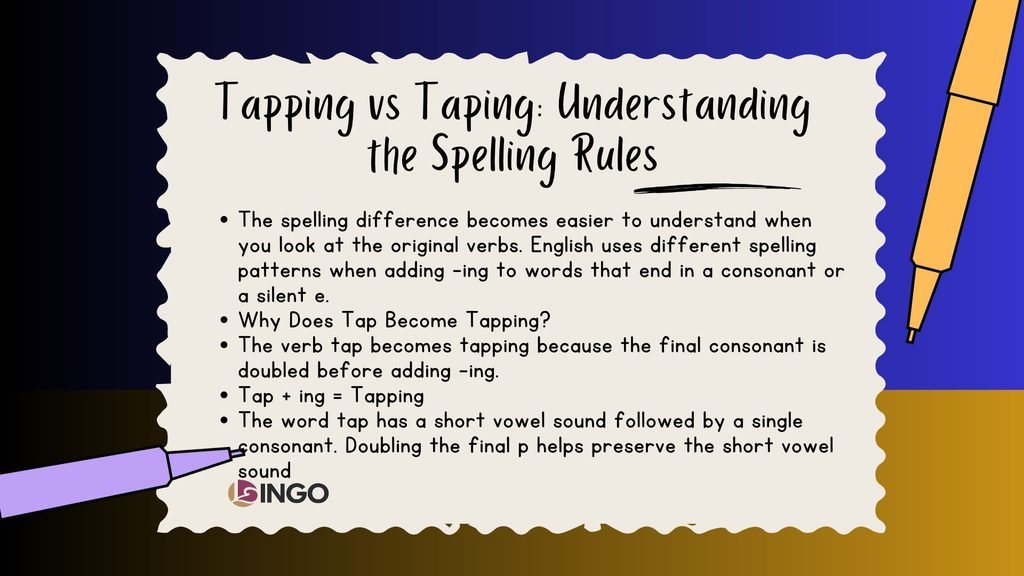
The spelling difference becomes easier to understand when you look at the original verbs. English uses different spelling patterns when adding –ing to words that end in a consonant or a silent e.
Why Does Tap Become Tapping?
The verb tap becomes tapping because the final consonant is doubled before adding -ing.
Tap + ing = Tapping
The word tap has a short vowel sound followed by a single consonant. Doubling the final p helps preserve the short vowel sound.
Other examples include:
- Hop → Hopping
- Run → Running
- Sit → Sitting
- Stop → Stopping
- Clap → Clapping
Therefore, if someone is lightly striking a desk or touching a phone screen, tapping is the correct form.
Why Does Tape Become Taping?
The verb tape ends in a silent e. When adding -ing, the final e is usually dropped.
Tape + ing = Taping
Notice that taping has only one p. Writing tapeing is incorrect in standard English.
Other examples of the same spelling pattern include:
- Make → Making
- Bake → Baking
- Write → Writing
- Hope → Hoping
- Smile → Smiling
How to Remember the Difference
Use this simple memory trick:
- Tapping: Think of a finger tapping a table.
- Taping: Think of tape sealing a box.
Ask yourself what action you want to describe. If it involves light contact, use tapping. If it involves adhesive tape or recording, use taping.
When Should You Use Tapping or Taping?
Although these words differ by only one letter, they appear in different situations. Understanding the context helps you choose the right word in everyday writing.
Using Tapping in Everyday Situations
Use tapping when describing light, repeated contact or an action performed by touching something.
Examples:
- Technology: I am tapping the icon to open the application.
- Communication: She was tapping on the door.
- Music: The drummer was tapping his fingers against the table.
- Movement: He kept tapping his foot while waiting.
- Business: The organization is tapping into its employees’ experience.
Using Taping in Everyday Situations
Use taping when describing an action involving adhesive tape or the recording of media.
Examples:
- Packaging: I am taping the box shut.
- Home repairs: She is taping the broken poster to the wall.
- Sports: The trainer is taping the player’s ankle.
- Media: The television crew is taping an interview.
- Organization: We are taping labels onto the storage containers.
One important distinction is that taping a video traditionally means recording it, while tapping a video might mean touching an option on a screen to play or select it.
Common Mistakes to Avoid
| Incorrect Usage | Correct Usage | Reason |
|---|---|---|
| I am tapeing the box. | I am taping the box. | Drop the silent e. |
| She is taping her fingers on the desk. | She is tapping her fingers on the desk. | The action is light striking. |
| He is tapping the package shut with adhesive tape. | He is taping the package shut. | Adhesive tape is being used. |
| She is taping the screen to open the app. | She is tapping the screen to open the app. | The action is touching the screen. |
Remember that the correct choice depends on the intended action and the context of the sentence.
A Real-Life Example: Tapping vs Taping in Everyday Life
Imagine a student named Sarah who is preparing a school presentation. She needs to organize her notes, record a practice presentation, and submit her work online.
First, Sarah sits at her desk and begins tapping her fingers while thinking about her introduction. When she opens her laptop, she starts tapping the keyboard and tapping the screen of her phone to check her presentation notes. In these situations, tapping is correct because she is touching or striking objects.
Next, Sarah notices that several printed pages have become mixed up. She arranges them in order and begins taping the pages together so they do not get lost. Later, she uses adhesive tape to attach a reminder to the front of her folder. Here, taping is correct because she is using tape to secure physical objects.
Finally, Sarah records a practice presentation for her teacher. She tells her friend, “I am taping my presentation so I can review it later.” This is also a correct use of taping, because the word can mean recording audio or video.
When Sarah writes her report, she checks each sentence by identifying the action first. She asks herself whether she is touching something, using adhesive tape, or recording something. This simple habit helps her avoid spelling mistakes without relying entirely on spell-checking software.
The lesson: A single letter can change the meaning of a word. Sarah can choose the correct spelling by understanding the action rather than memorizing isolated words.
Tapping vs Taping: Language Data and Learning Tips for 2025–2026
There is no reliable, widely cited 2025–2026 statistic specifically measuring how often English writers confuse tapping and taping. It would be misleading to invent a percentage or claim that one spelling error occurs more frequently than the other.
However, language research and digital writing trends offer useful context for people learning English.
Why Accurate Word Choice Matters Online
The World Bank’s Digital Progress and Trends Report 2025 discusses the role of English in online content. Its analysis estimates that English accounts for approximately 45% of global URLs in the dataset presented in the report. This provides context for the importance of clear English communication online, although it does not measure confusion between these two words.
For bloggers, students, and professionals, correct word choice helps readers understand the intended action without having to guess from context.
How to Improve Your Spelling Accuracy
Try these practical habits:
- Identify the base verb. Determine whether the intended word comes from tap or tape.
- Learn spelling patterns. Compare tap → tapping with tape → taping.
- Read the complete sentence. Context often reveals whether the action involves touching, attaching, or recording.
- Use spelling tools carefully. Both tapping and taping are valid words, so a spell-checker may not identify a context-based mistake.
- Practice with examples. Write one sentence using each word to reinforce the difference.
The best approach is to combine spelling knowledge with an understanding of meaning. This is more reliable than memorizing the appearance of each word alone.
Mini Quiz:Tapping vs Taping
1. She is ___ her foot to the music.
Answer: Tapping
2. He is ___ the broken box shut.
Answer: Taping
3. I heard someone ___ on the window.
Answer: Tapping
4. They are ___ the football match for later.
Answer: Taping
5. Stop ___ your fingers on the desk.
Answer: Tapping
6. She is ___ the gift with colorful tape.
Answer: Taping
7. He kept ___ his pen against the table.
Answer: Tapping
8. We are ___ the interview for our records.
Answer: Taping
9. The child is ___ on the door.
Answer: Tapping
10. She is ___ the wires together.
Answer: Taping
11. He is ___ his phone screen to open the app.
Answer: Tapping
12. They finished ___ the package securely.
Answer: Taping
13. I saw him ___ his foot impatiently.
Answer: Tapping
14. The crew is ___ the television program.
Answer: Taping
15. She kept ___ her fingers nervously.
Answer: Tapping
16. He is ___ a note to the wall.
Answer: Taping
17. The student is ___ the screen to select an option.
Answer: Tapping
18. We are ___ the performance for the school website.
Answer: Taping
19. Someone was ___ lightly on the glass.
Answer: Tapping
20. She is ___ the cardboard box closed.
Answer: Taping
21. He started ___ his foot while waiting.
Answer: Tapping
22. They are ___ the conversation for training purposes.
Answer: Taping
23. She is ___ the icon on her tablet.
Answer: Tapping
24. I need to finish ___ the edges of this package.
Answer: Taping
25. He was ___ his fingers on the steering wheel.
Answer: Tapping
Quick Rule to Remember
– Tapping: Hitting or touching something lightly or repeatedly.
Example: She is tapping her fingers.
– Taping: Using tape to attach something or recording audio or video.
Example: He is taping the box shut.
Frequently Asked Questions About Tapping vs Taping
Q1: Is It Tapping or Taping?
Both are correct spellings, but they have different meanings. Tapping means touching or striking something lightly, while taping means attaching something with tape or recording audio or video.
Q2: Is Tapping the Phone Screen Correct?
Yes. Tapping the phone screen is correct when you touch the screen to open an app, select an option, or perform another action.
Example: “I am tapping the screen to answer the call.”
Q3: Is Taping a Package Correct?
Yes. Taping a package means using adhesive tape to close, secure, or reinforce it.
Example: “She is taping the package before sending it.”
Q4: Why Does Tapping Have Two P’s?
The final consonant in tap is doubled before adding -ing. This spelling pattern helps preserve the short vowel sound.
The correct spelling is tapping, not taping, when the intended verb is tap.
Q5: Is Tapeing a Correct Spelling?
No. In standard English, the correct spelling is taping. The silent e at the end of tape is dropped before adding -ing.
Q6: Can Taping Mean Recording a Video?
Yes. Taping can mean recording audio, video, a television program, or an interview. The word remains in use even when the recording is digital rather than made on physical tape.
Example: “The production team is taping the interview today.”
Q7: How Can I Remember Tapping vs Taping?
Remember these two examples:
- Tapping: A finger tapping on a desk.
- Taping: Adhesive tape sealing a box.
Connecting each word with a familiar action makes the spelling difference easier to remember.
Q8: Are Tapping and Taping Pronounced Differently?
Yes. In common English pronunciation, tapping sounds like “TAP-ing,” with a short vowel, while taping sounds like “TAY-ping,” with a long vowel. The difference in spelling reflects this pronunciation distinction.
Conclusion: Choose the Correct Word With Confidence
Understanding tapping vs taping is easier when you focus on the base verb and the action being described.
Use tapping when someone touches or strikes something lightly, taps a phone screen, or accesses a resource. Use taping when someone applies adhesive tape or records a program, interview, or video.
The spelling rules are straightforward: tap becomes tapping by doubling the final consonant, while tape becomes taping by dropping the silent e.
The next time you are unsure which word to use, pause and identify the action. With a little practice, you can use both words accurately in emails, school assignments, blog posts, and everyday conversations.
For more clear explanations of commonly confused English words and grammar rules, explore the other language guides on Lingorixa.
References

Maimoona Asghar is a grammar enthusiast and language writer who creates clear, practical content to help learners improve English grammar, writing, punctuation, and communication skills through easy-to-understand explanations and examples.