
Introduction
Have you ever wondered whether to write swap or swop when talking about exchanging something? Both spellings look correct, and you may have encountered them in books, conversations, websites, or everyday messages.
The good news is that swap and swop have the same meaning. Both words refer to exchanging one thing for another. However, they differ slightly in regional preference and everyday usage.
In this beginner-friendly guide, you’ll learn the meaning of swap and swop, understand their spelling differences, explore practical examples, and discover which version is best for your writing.
What Does Swap Mean?
Swap is a verb and noun that means to exchange one thing for another, usually between two people. It can also describe replacing something or changing positions, responsibilities, or activities.
It is the more widely preferred spelling in modern English, particularly in American English.
Swap as a Verb
As a verb, swap describes the action of giving something and receiving something else in return.
Examples:
- I want to swap my blue shirt for a black one.
- Can we swap seats? I cannot see the board.
- They decided to swap their lunch boxes.
- My brother and I often swap books.
- We agreed to swap our work shifts.
Swap as a Noun
As a noun, swap refers to an exchange or something that has been exchanged.
Examples:
- We made a fair swap.
- That was a great swap between friends.
- The children organized a toy swap.
- I got this book in a swap.
Therefore, swap can describe both the action of exchanging and the exchange itself.
What Does Swop Mean?
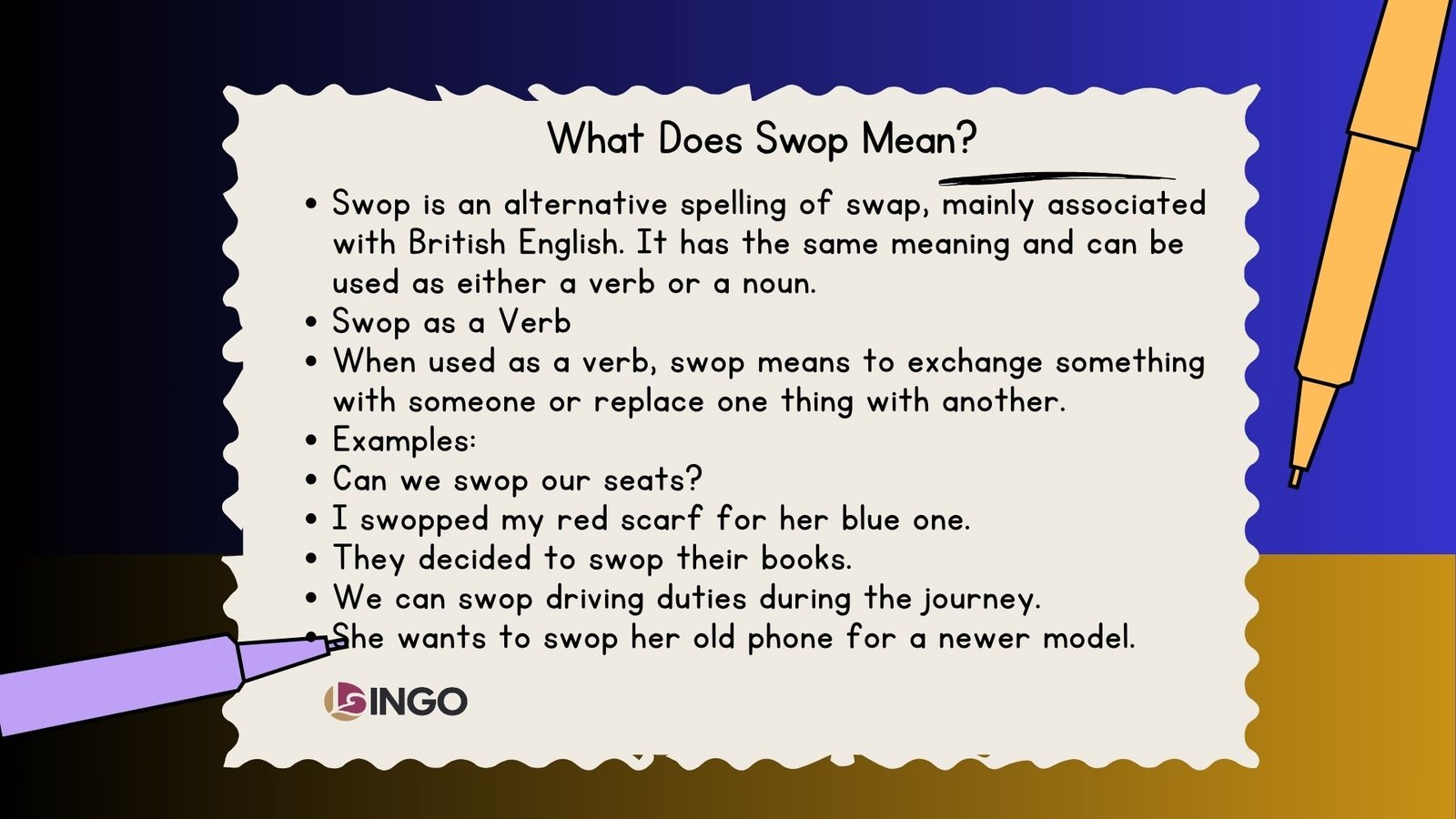
Swop is an alternative spelling of swap, mainly associated with British English. It has the same meaning and can be used as either a verb or a noun.
Swop as a Verb
When used as a verb, swop means to exchange something with someone or replace one thing with another.
Examples:
- Can we swop our seats?
- I swopped my red scarf for her blue one.
- They decided to swop their books.
- We can swop driving duties during the journey.
- She wants to swop her old phone for a newer model.
Swop as a Noun
Swop can also function as a noun to describe an exchange.
Examples:
- Let’s make a swop.
- That was an interesting swop.
- The children arranged a swop of football cards.
- He received the jacket through a swop.
Although swop is correct, it is less common in everyday international writing.
Swap vs Swop: What Is the Difference?
The main difference between swap and swop is their spelling and regional preference, not their meaning.
Both words describe exchanging, trading, or replacing something. However, swap is generally the safer choice for modern writing because it is more widely recognized.
Swap vs Swop: Quick Comparison
| Feature | Swap | Swop |
|---|---|---|
| Meaning | Exchange or trade | Exchange or trade |
| Word type | Verb and noun | Verb and noun |
| Spelling | Standard and widely preferred | Alternative spelling |
| British English | Common | Recognized alternative |
| American English | Preferred | Less common |
| International writing | Recommended | Less widely used |
| Correctness | Correct | Correct |
Which Spelling Should You Use?
Choose swap when writing for a general or international audience.
Choose swop when following a British English style that accepts this alternative spelling or when reproducing someone’s original wording.
Examples:
- International writing: I want to swap my old laptop for a new one.
- Alternative British spelling: I want to swop my old laptop for a new one.
Both sentences are grammatically correct.
Swap vs Swop in Different English Variations
English spelling preferences can vary between countries.
- American English: Swap is the normal choice.
- British English: Swap is widely used, while swop is also recognized.
- Australian English: Swap is generally the more familiar spelling.
- International English: Swap is usually the clearest option.
Remember that regional preference does not make swop incorrect.
Beginner Examples of Swap and Swop in Everyday English
Understanding words becomes easier when you see how people use them in real-life situations.
Since swap and swop have the same meaning, you can generally replace one with the other without changing the message.
Examples About Clothes and Personal Items
- I want to swap my jacket for yours.
- She swopped her black shoes for white ones.
- Can we swap our bags for a moment?
- He made a fair swop with his friend.
Examples About School and Work
- The students decided to swap notebooks.
- Can you swap your seat with mine?
- My colleague agreed to swap shifts with me.
- The teachers arranged a classroom swop.
Examples About Food and Entertainment
- We swapped sandwiches during lunch.
- They decided to swop their movie tickets.
- I made a book swap with my cousin.
- The children organized a toy swop.
Examples About Daily Activities
- We can swap driving duties.
- They swapped houses for the weekend.
- I would love to swap places with you.
- The two friends swopped phone numbers.
These examples demonstrate that both spellings work naturally in everyday communication.
Real-Life Case Study: Choosing Between Swap and Swop
Imagine a student named Daniel who is learning English and preparing an article about exchanging clothes with friends.
While researching the topic, he notices that some websites use the word swap, while others use swop. He becomes confused because both words appear in sentences with the same meaning.
Daniel initially assumes that one spelling must be incorrect. However, after checking reliable English dictionaries, he discovers that swop is an accepted alternative spelling of swap.
He then examines the audience for his article. Because his content is intended for readers from the United States, the United Kingdom, Australia, and other English-speaking regions, he decides to use swap throughout the article.
For example, he writes, “My friends and I decided to swap clothes during the weekend.”
He also learns that consistency matters. Switching between swap and swop unnecessarily within the same article could distract readers, even though both forms are correct.
Later, Daniel encounters the sentence, “We swopped our books after class.” Instead of marking it as incorrect, he recognizes it as an alternative British spelling.
This experience teaches Daniel an important lesson: not every spelling difference represents a grammar mistake. Sometimes, two different spellings are accepted forms of the same word.
The takeaway: Use swap as your default spelling, understand swop as a valid alternative, and always consider your audience when choosing between them.
Swap vs Swop: Common Mistakes and Important Grammar Rules
Although both words are correct, beginners sometimes make mistakes when using their different grammatical forms.
Using the Wrong Past Tense
Both words double the final consonant when forming their past tense and present participle.
| Form | Swap | Swop |
|---|---|---|
| Base form | Swap | Swop |
| Third-person singular | Swaps | Swops |
| Past tense | Swapped | Swopped |
| Present participle | Swapping | Swopping |
| Past participle | Swapped | Swopped |
Examples:
- Correct: We swapped our books yesterday.
- Correct: They swopped their seats.
- Incorrect: We swaped our books yesterday.
- Incorrect: They swoping their seats.
Confusing Swap With Switch

Swap and switch can have similar meanings, but they are not interchangeable in every situation.
Swap generally involves an exchange between people or things.
Example: I swapped my jacket with my brother.
Switch often means changing from one thing to another.
Example: I switched from coffee to tea.
Mixing Both Spellings Without a Reason
Using both spellings in the same article can create unnecessary inconsistency.
For example:
- We swapped our books.
- Later, we swopped our clothes.
Neither sentence is incorrect. However, choosing one spelling throughout your content creates a more polished writing style.
Swap vs Swop: 2025–2026 Dictionary and Usage Evidence
When comparing spellings, reliable dictionaries are more useful than assumptions or personal preferences.
Here are three important findings from established dictionary references.
1. Cambridge Dictionary Recognizes Both Spellings
Cambridge Dictionary identifies swop as a mainly British form of swap. It also provides examples of both words as verbs and nouns.
2. Oxford Recognizes Swop as an Alternative
Oxford Advanced Learner’s Dictionary lists swop as an alternative spelling of swap. It also provides examples involving exchanging clothes, changing places, and sharing responsibilities.
3. Both Spellings Have the Same Meaning
The dictionary definitions agree that both words describe giving something and receiving something else in return.
What do the 2025–2026 figures show?
There is no verified 2025–2026 numerical usage dataset in the cited dictionary entries that establishes an exact percentage difference between swap and swop. Therefore, assigning a popularity percentage or claiming a specific search-volume advantage would be misleading.
The reliable conclusion from the available dictionary evidence is that swap is the more widely suitable spelling, while swop remains a recognized alternative.
Mini Quiz:Swap vs Swop
1. Which spelling is more widely preferred in modern English?
A. Swap
B. Swop
C. Swaap
D. Swope
Answer: A. Swap
2. What does the word swap mean?
A. To destroy something
B. To exchange something
C. To hide something
D. To borrow something
Answer: B. To exchange something
3. Which word is mainly associated with British English as an alternative to swap?
A. Swape
B. Swip
C. Swop
D. Swoop
Answer: C. Swop
4. Do swap and swop have the same basic meaning?
A. True
B. False
Answer: A. True
5. What is the correct past tense of swap?
A. Swaped
B. Swapping
C. Swaps
D. Swapped
Answer: D. Swapped
6. Choose the correct word: “Can we _____ seats?”
A. Swap
B. Swaped
C. Swaping
D. Swape
Answer: A. Swap
7. Which statements about swap and swop are correct?
A. Both can be verbs.
B. Both can be nouns.
C. They always have different meanings.
D. Swap is widely preferred.
Answers: A, B, D
8. Which sentence uses swap correctly?
A. I swaped my book yesterday.
B. I swap my book yesterday.
C. I swapped my book yesterday.
D. I swaping my book yesterday.
Answer: C. I swapped my book yesterday.
9. Is swop an incorrect word that should never appear in English writing?
A. True
B. False
Answer: B. False
10. Which spelling is generally safest for an international audience?
A. Swop
B. Swap
C. Swaap
D. Swappe
Answer: B. Swap
11. What is the correct past tense of swop?
A. Swoped
B. Swopping
C. Swops
D. Swopped
Answer: D. Swopped
12. Which word means to exchange one thing for another?
A. Swap
B. Sleep
C. Smile
D. Shout
Answer: A. Swap
13. Choose the correct spelling: “They are _____ their books.”
A. Swaping
B. Swapping
C. Swaped
D. Swapp
Answer: B. Swapping
14. Which sentence uses swop as a verb?
A. The swop was fair.
B. We made a swop.
C. They swopped their seats.
D. That was a good swop.
Answer: C. They swopped their seats.
15. Which word is the third-person singular form of swap?
A. Swapped
B. Swapping
C. Swops
D. Swaps
Answer: D. Swaps
16. Which examples correctly use swap or swop?
A. We swapped our lunch boxes.
B. She swopped her scarf.
C. They swaped their books.
D. I want to swap seats.
Answers: A, B, D
17. Which word is commonly preferred in American English?
A. Swop
B. Swoop
C. Swap
D. Swape
Answer: C. Swap
18. What is the noun form of swap?
A. Swapping
B. A swap
C. Swapped
D. Swapsing
Answer: B. A swap
19. Choose the correct word: “My brother and I often _____ books.”
A. Swapped
B. Swaping
C. Swap
D. Swaped
Answer: C. Swap
20. Is swapping the correct present participle of swap?
A. True
B. False
Answer: A. True
21. Which sentence uses swap as a noun?
A. We made a fair swap.
B. We swap our clothes.
C. They swapped seats.
D. She is swapping books.
Answer: A. We made a fair swap.
22. What is the main difference between swap and swop?
A. Their pronunciation is always different.
B. Their meanings are opposite.
C. One is a noun and one is a verb.
D. Their spelling and regional preference.
Answer: D. Their spelling and regional preference.
23. Which sentence is correctly written?
A. She is swaping her bag.
B. She is swapping her bag.
C. She is swaped her bag.
D. She is swap her bag.
Answer: B. She is swapping her bag.
24. Which situations can naturally involve a swap?
A. Exchanging books with a friend.
B. Changing work shifts with a colleague.
C. Trading one item for another.
D. Sleeping without interruption.
Answers: A, B, C
25. What is the best spelling choice for a general international blog post?
A. Swop throughout.
B. Swap throughout.
C. Alternate both spellings randomly.
D. Use a nonstandard spelling.
Answer: B. Swap throughout.
Frequently Asked Questions (FAQs)
Q1: Is Swap or Swop Correct?
Both swap and swop are correct English spellings. They have the same meaning and refer to exchanging one thing for another. However, swap is more widely preferred in modern English.
Q2: Is Swop a Real English Word?
Yes, swop is a real English word. It is mainly used in British English as an alternative spelling of swap. It can function as both a noun and a verb.
Q3: What Is the Difference Between Swap and Swop?
There is no difference in meaning. Both words describe exchanging, trading, or replacing something. The main distinction is regional spelling preference.
Q4: Is Swap American or British English?
Swap is used in both American and British English. It is also widely understood internationally and is the preferred spelling in most modern writing.
Q5: Is Swop British English?
Yes, swop is mainly associated with British English. Cambridge Dictionary identifies it as a mainly British form of swap.
Q6: What Is the Past Tense of Swap and Swop?
The past tense of swap is swapped, while the past tense of swop is swopped.
Examples:
- I swapped my book with Sarah.
- I swopped my book with Sarah.
Both sentences are correct.
Q7: Should I Use Swap or Swop in Formal Writing?
Use swap in formal and professional writing because it is more widely recognized. However, swop is not grammatically incorrect when used in an appropriate British English context.
Q8: Can Swap and Swop Be Used Interchangeably?
Yes. Since both words have the same meaning, they can generally be used interchangeably. However, it is best to maintain one spelling consistently throughout a document.
Conclusion: Swap vs Swop – Which One Should You Remember?
Understanding swap vs swop is simple once you know that both words have the same meaning.
Swap is the more widely preferred spelling in modern English, while swop is an accepted alternative mainly associated with British English. Both words can function as nouns and verbs, and their meanings do not change depending on the spelling.
For everyday conversations, school assignments, professional emails, and online articles, swap is the safest choice.
Now that you understand the difference, you can use both spellings confidently without confusing them with spelling or grammar mistakes.
For more clear explanations of commonly confused English words and grammar rules, explore the other language guides on Lingorixa.
References

Maimoona Asghar is a grammar enthusiast and language writer who creates clear, practical content to help learners improve English grammar, writing, punctuation, and communication skills through easy-to-understand explanations and examples.

