Have you ever wondered whether to write prooving or proving? English spelling can be confusing, especially when a word changes form after adding a suffix. If you have encountered both spellings, you might wonder whether they have different meanings or whether one is simply incorrect.
The answer is straightforward: proving is the correct standard spelling, while prooving is a misspelling. The word proving comes from the verb prove and means showing that something is true, correct, or genuine through evidence or reasoning.
In this guide, you will learn the difference between prooving and proving, understand the spelling rule behind the correct form, explore practical examples, and discover how to use proving confidently in everyday writing.
What Is the Difference Between Prooving and Proving?
The difference between prooving and proving is spelling. Proving is the correct form of the verb prove, whereas prooving is a nonstandard misspelling. Both spellings are sometimes confused because the word prove contains the letter combination “ov,” which can make its spelling less intuitive for some learners.
What Does Proving Mean?
Proving is the present participle of the verb prove. It means demonstrating that something is true, valid, or accurate.
For example:
- She is proving her point with reliable evidence.
- The experiment is proving that the theory may be correct.
- He is proving himself to be a capable leader.
The word can also appear after certain verbs and prepositions.
For example:
- Proving your abilities takes time.
- She succeeded by proving her qualifications.
Is Prooving a Correct English Word?
No. In standard modern English, prooving is not the accepted spelling of the word proving.
If you are writing an essay, email, blog post, report, or academic assignment, use proving.
Incorrect: He is prooving that his answer is correct.
Correct: He is proving that his answer is correct.
Why Do People Confuse These Spellings?
People may mistakenly write prooving because they associate the word with proof, which contains two letter o’s. However, related words do not always preserve the same spelling pattern.
Compare these forms:
- Prove
- Proving
- Proved
- Proof
Notice that prove becomes proving, not prooving. Learning the correct word family helps prevent this common spelling error.
Why Is Proving the Correct Spelling?
Understanding the spelling rule makes it easier to remember the correct form instead of memorizing the word in isolation.
The Base Verb Is Prove
The base verb is prove, meaning to demonstrate or establish something as true.
When you add -ing to form the present participle, the final silent e is dropped.
Prove − e + ing = proving
This spelling pattern appears in many English verbs.
| Base verb | Correct -ing form |
|---|---|
| Prove | Proving |
| Write | Writing |
| Make | Making |
| Drive | Driving |
| Believe | Believing |
The pattern is common, although English spelling has exceptions. Learning the rule can help you spell many verbs correctly.
Why Doesn’t Prove Become Prooving?
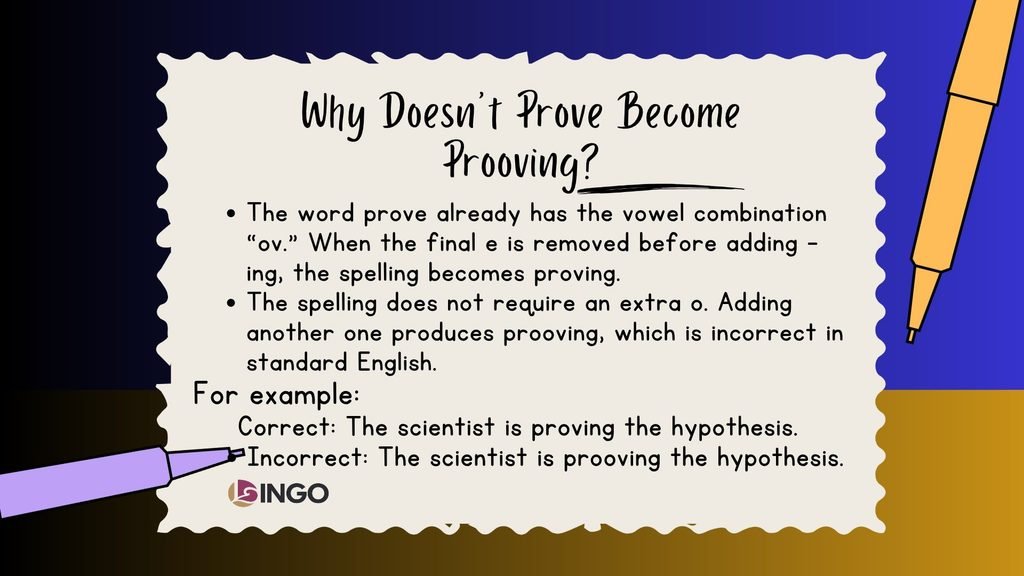
The word prove already has the vowel combination “ov.” When the final e is removed before adding -ing, the spelling becomes proving.
The spelling does not require an extra o. Adding another one produces prooving, which is incorrect in standard English.
For example:
- Correct: The scientist is proving the hypothesis.
- Incorrect: The scientist is prooving the hypothesis.
How Can You Remember the Correct Spelling?
Use this simple memory trick: prove loses its final e before adding -ing.
Remember these three forms together:
- Prove — base form
- Proving — present participle
- Proved — simple past and past participle
Practicing these forms in sentences will make the spelling easier to recall.
Proving Meaning and Usage in Everyday English
The word proving is useful in conversations, education, professional writing, science, mathematics, and everyday situations. Its exact meaning depends on the context.
Proving Something With Evidence
In many situations, proving means providing evidence that supports a claim.
Examples:
- The lawyer is proving that the witness’s statement was inaccurate.
- The documents are proving the company’s ownership of the property.
- She is proving her argument with facts rather than opinions.
In these sentences, proving describes the process of establishing whether a claim is true.
Proving Yourself Through Actions
The word can also describe demonstrating your ability, reliability, or character.
Examples:
- He is proving himself through consistent hard work.
- She kept proving that she could handle difficult responsibilities.
- The new employee is proving to be a valuable team member.
Here, the word focuses on demonstrating qualities through behavior or results.
Proving in Science and Mathematics
In scientific and mathematical contexts, proving can refer to demonstrating a result through evidence, experiments, or logical reasoning.
Examples:
- The students are proving the theorem step by step.
- Researchers are testing the evidence to determine whether it supports their hypothesis.
- The calculation is proving that the two expressions are equivalent.
One important distinction: in science, a single experiment does not necessarily prove a broad hypothesis conclusively. The strength of a conclusion depends on the evidence and the methods used.
Prooving vs Proving: Comparison Table and Real-Life Example
A comparison table makes the spelling difference easy to understand at a glance.
Quick Comparison Table
| Feature | Prooving | Proving |
|---|---|---|
| Standard spelling | Incorrect | Correct |
| Accepted form of prove + -ing | No | Yes |
| Meaning in standard English | Usually a misspelling | Demonstrating or establishing something |
| Suitable for formal writing | No | Yes |
| Example | He is prooving his point. | He is proving his point. |
Real-Life Example: A Student Writing an Assignment
Imagine a student preparing an English assignment about scientific discoveries. While drafting a paragraph, the student writes, “The experiment is prooving that the theory is correct.”
The sentence communicates the intended idea, but the spelling is incorrect. Before submitting the assignment, the student checks a dictionary and discovers that the correct form is proving. The student revises the sentence to read, “The experiment is proving that the theory is correct.”
The student then reviews other verbs in the assignment, including writing, making, and driving. This comparison helps reinforce the rule that many verbs ending in a silent e drop that letter before taking -ing.
The lesson extends beyond one spelling mistake. By understanding how prove changes into proving, the student gains a practical method for checking similar words in future assignments. The student also learns to distinguish spelling accuracy from the strength of an argument: correcting a word makes the writing clearer, but the evidence must still support the conclusion.
This example shows why learning spelling patterns is often more useful than memorizing isolated words. A small correction can improve readability, professionalism, and confidence in written communication.
Proving in a Sentence: Common Examples and Mistakes
The easiest way to learn a spelling difference is to see the correct form used naturally in different situations.
Five Correct Sentences With Proving
- She is proving that practice improves performance.
- The evidence is proving useful in the investigation.
- He is proving his commitment through his actions.
- The researchers are proving the result through additional testing.
- Proving your point requires clear reasoning and reliable evidence.
These examples demonstrate how proving works in different sentence structures.
Common Spelling Mistakes to Avoid
Here are several incorrect and corrected examples:
| Incorrect | Correct |
|---|---|
| She is prooving her theory. | She is proving her theory. |
| He kept prooving his innocence. | He kept proving his innocence. |
| They are prooving their point. | They are proving their point. |
| Prooving a claim requires evidence. | Proving a claim requires evidence. |
| The results are prooving useful. | The results are proving useful. |
The main correction is the same in every example: replace prooving with proving.
A Simple Checklist for Correct Usage
Before publishing or submitting your writing, ask yourself:
- Am I using the base verb prove?
- Do I need its -ing form?
- Have I removed the final e before adding -ing?
- Have I written proving correctly?
- Does the sentence communicate the intended meaning clearly?
This checklist can help you catch the error during proofreading.
Spelling Statistics and Reliable Learning Resources
Spelling questions often arise because English combines historical spellings, pronunciation patterns, and suffix rules. However, it is important to distinguish general language-learning statistics from evidence about a particular spelling.
What Do 2025–2026 Statistics Tell Us?
There is no verified, widely recognized 2025–2026 statistic established here that measures how often English writers misspell proving specifically as prooving. Therefore, assigning a percentage or claiming that a certain number of people make this mistake would be misleading.
Mini Quiz:Prooving vs Proving
1. Which spelling is correct?
A. ProovingB. Proving
2. What is the base verb of “proving”?
A. ProofB. Prove
3. What does “proving” mean?
A. Demonstrating something is trueB. Hiding information
4. Choose the correct sentence.
A. She is prooving her point.B. She is proving her point.
5. What happens to the final e in “prove” when adding -ing?
A. It is droppedB. It is doubled
6. Which is the correct spelling?
A. Prooving a theoryB. Proving a theory
7. What is the simple past tense of “prove”?
A. ProovedB. Proved
8. Which sentence uses “proving” correctly?
A. He is proving his ability.B. He is prooving his ability.
9. Is “prooving” the standard spelling in English?
A. YesB. No
10. Complete the sentence: She is ___ her innocence.
A. proovingB. proving
11. Which word is the present participle of “prove”?
A. ProvingB. Prooved
12. Complete the spelling rule: prove − e + ing = ___.
A. ProovingB. Proving
13. Choose the correct sentence.
A. Proving a claim requires evidence.B. Prooving a claim requires evidence.
14. Which word is related to “prove” but has a different spelling?
A. ProofB. Prooving
15. Complete the sentence: The evidence is ___ useful.
A. proovingB. proving
16. Which is correct for formal writing?
A. The results are proving useful.B. The results are prooving useful.
17. What is the past participle commonly used in “a ___ method”?
A. ProvenB. Prooving
18. Which spelling follows the same silent-e pattern as “proving”?
A. WritingB. Writeing
19. Complete the sentence: ___ your point requires clear reasoning.
A. ProovingB. Proving
20. Which sentence is spelled correctly?
A. The scientist is proving the theory.B. The scientist is prooving the theory.
21. What is the correct -ing form of “make”?
A. MakeingB. Making
22. Which word should replace “prooving” in an edited essay?
A. ProvingB. Proove
23. Which sentence is correct?
A. He kept proving his point.B. He kept prooving his point.
24. What helps you remember the spelling of “proving”?
A. Add another o to proveB. Drop the final e before adding -ing
25. Choose the correct sentence.
A. She succeeded by proving her skills.B. She succeeded by prooving her skills.
Frequently Asked Questions (FAQs)
1. Is it prooving or proving?
Proving is the correct spelling. Prooving is a misspelling in standard English.
2. What does proving mean?
Proving means demonstrating that something is true, correct, or valid through evidence, reasoning, or actions.
Example: “She is proving her point with reliable evidence.”
3. Why is proving spelled with one o?
The word comes from prove. When the suffix -ing is added, the final silent e is dropped, producing proving. No extra o is needed.
4. Is prooving ever acceptable?
It is not the standard spelling of the intended word in ordinary modern English. Use proving in academic, professional, and everyday writing.
5. What is the difference between prove and proving?
Prove is the base form of the verb, while proving is its present participle or gerund form.
Examples:
- I need to prove my point.
- I am proving my point.
- Proving your point requires evidence.
6. What is the past tense of prove?
The simple past tense of prove is proved. Proven is also widely used as a past participle, especially in phrases such as “a proven method.”
Examples:
- She proved her argument.
- The method has proven effective.
- The evidence proved important.
7. How can I remember the correct spelling of proving?
Remember the formula prove − e + ing = proving. Practicing related forms such as writing, making, and driving can reinforce the same spelling pattern.
8. Can you use proving at the beginning of a sentence?
Yes. Proving can begin a sentence when it functions as a gerund or part of a participial phrase.
Examples:
- Proving the claim required additional evidence.
- Proving himself took patience and determination.
Conclusion: Prooving vs Proving — Which One Should You Use?
When comparing prooving vs proving, the answer is clear: proving is the correct spelling in standard English. It is the present participle of prove and refers to demonstrating something through evidence, reasoning, or actions. Prooving is an incorrect spelling of the intended word.
Remember the simple rule: remove the final silent e from prove before adding -ing. This gives you proving, just as write becomes writing and make becomes making.
Whether you are writing an assignment, creating a blog post, preparing a report, or sending a professional email, using the correct spelling helps your message appear clear and polished.
For more clear explanations of commonly confused English words and grammar rules, explore the other language guides on Lingorixa.
References

Maimoona Asghar is a grammar enthusiast and language writer who creates clear, practical content to help learners improve English grammar, writing, punctuation, and communication skills through easy-to-understand explanations and examples.