Have you ever heard someone say “kick rocks” during an argument or seen it in a text message and wondered what they meant? This informal expression might sound harmless, but it often communicates frustration, rejection, or a strong desire for someone to leave.
The phrase “kick rocks” means to go away, stop bothering someone, or leave someone alone. It is usually dismissive and can sound rude, especially when spoken angrily. People use it in casual conversations, online discussions, text messages, and arguments.
In this guide, you will learn the meaning of “kick rocks,” explore its possible origins, discover practical examples, and find 25 strong alternatives for different situations. Whether you want a funny comeback, a firm response, or a more professional way to set boundaries, you will find an expression that fits.
What Does “Kick Rocks” Mean?
The phrase “kick rocks” is an informal way of telling someone to go away, stop bothering you, or leave you alone. Depending on the situation, it can express irritation, rejection, sarcasm, or playful annoyance.
For example, if someone repeatedly asks you for a favor after you have already said no, you might tell them to “kick rocks.” In this context, you are making it clear that you do not want to continue the conversation.
The Simple Definition of Kick Rocks
Kick rocks means “go away” or “get lost,” usually in a dismissive or annoyed way.
Here are a few examples:
- “If you don’t respect my boundaries, you can kick rocks.”
- “He wanted to borrow money again, so I told him to kick rocks.”
- “They said my opinion didn’t matter, but I wasn’t going to let them treat me that way. They could kick rocks.”
Each sentence communicates rejection or a refusal to entertain someone’s behavior.
Is Kick Rocks a Rude Expression?
Yes, “kick rocks” can be rude because it dismisses the other person rather than politely explaining a disagreement. However, its intensity depends on tone, context, and the relationship between the speakers.
Among close friends, it might be used jokingly. During a heated argument, it can sound hostile or insulting.
For example:
- Playful: “You ate the last slice of pizza? Kick rocks!”
- Angry: “You lied to me again. Kick rocks and don’t call me.”
- Firm but controlled: “If you can’t respect my decision, please leave me alone.”
The words stay the same, but the context changes how they are understood.
What Does Kick Rocks Mean in Text Messages?
In texting, “kick rocks” usually means that the sender is annoyed, rejecting a request, or telling someone to stop contacting them.
For example:
Person A: “Come on, lend me another $50. I’ll pay you back eventually.”
Person B: “Nope. Kick rocks.”
The reply communicates a firm refusal and suggests that the sender has little patience for the request.
On social media, the phrase can also appear in comments, memes, captions, and arguments when someone wants to dismiss an opinion or criticize another person’s behavior.
Where Did the Phrase “Kick Rocks” Come From?
The exact origin of “kick rocks” is uncertain. It is a colloquial expression associated with English-language slang, particularly American informal speech. Its precise first use and the person or community that popularized it are not firmly established.
The Possible Meaning Behind the Words
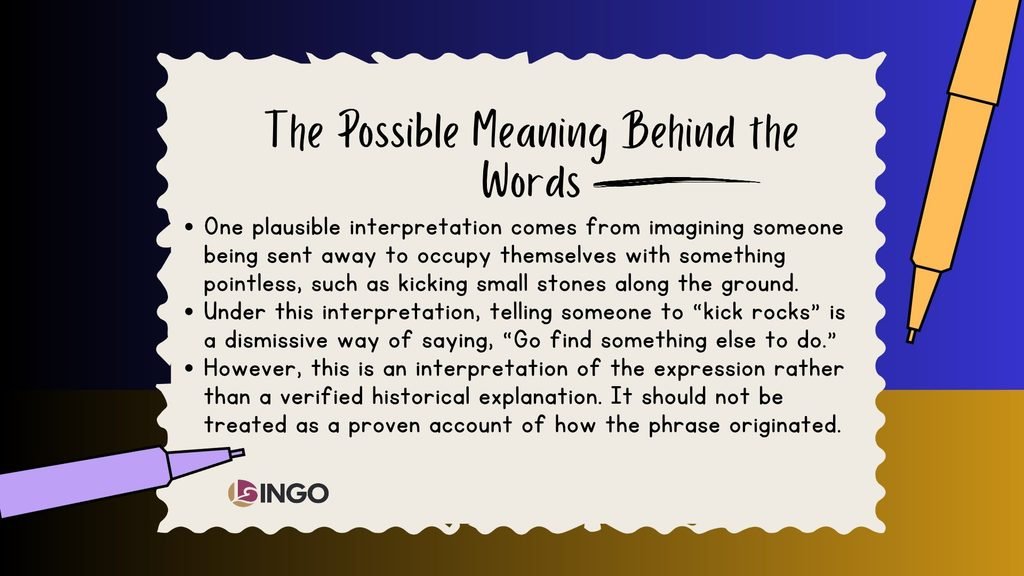
One plausible interpretation comes from imagining someone being sent away to occupy themselves with something pointless, such as kicking small stones along the ground.
Under this interpretation, telling someone to “kick rocks” is a dismissive way of saying, “Go find something else to do.”
However, this is an interpretation of the expression rather than a verified historical explanation. It should not be treated as a proven account of how the phrase originated.
How Kick Rocks Became a Popular Slang Expression
Like many informal expressions, “kick rocks” is useful because it communicates a complete attitude in just two words. It can express rejection without requiring a lengthy explanation.
People may use it in:
- Everyday conversations and arguments.
- Text messages and group chats.
- Social media comments and memes.
- Informal dialogue in entertainment and online content.
- Situations where someone wants to reject an unreasonable demand.
For example, someone might post, “If you only contact me when you need something, kick rocks.” The sentence communicates disappointment and establishes a boundary in a direct, memorable way.
Although the phrase is widely recognizable in some English-speaking communities, familiarity varies by age, location, and cultural background.
Is Kick Rocks an Idiom or Slang?
“Kick rocks” is best described as an informal slang expression that functions idiomatically. Its intended meaning is not simply the literal act of kicking stones.
For example, “He kicked rocks along the sidewalk” describes a physical action. However, “He told the rude customer to kick rocks” uses the expression to mean that the customer should go away.
Understanding this difference helps English learners interpret the phrase correctly in conversations and online messages.
25 Strong Alternatives to “Kick Rocks”
The best alternative depends on how strongly you want to communicate your message. Some expressions are blunt and confrontational, while others help you set boundaries without escalating a disagreement.
Direct and Strong Alternatives
- Get lost — A blunt way to tell someone to go away.
Example: “If you’re here to cause trouble, get lost.” - Get out of here — Tells someone to leave; depending on tone, it can also express disbelief.
Example: “You expect me to believe that? Get out of here!” - Go away — A straightforward request for someone to leave.
Example: “I’m busy right now. Please go away.” - Buzz off — An informal and dismissive way to tell someone to stop bothering you.
Example: “Buzz off and let me finish my work.” - Beat it — A forceful way to tell someone to leave.
Example: “You don’t belong here. Beat it.” - Take a hike — A dismissive expression meaning to go away.
Example: “If you can’t follow the rules, take a hike.” - Get out of my face — Tells someone to stop confronting or bothering you.
Example: “I’m not discussing this anymore. Get out of my face.” - Leave me alone — A clear request to stop interacting with you.
Example: “I’ve explained my decision. Leave me alone.” - Back off — Tells someone to stop pressuring or threatening you.
Example: “Back off. I can make my own decisions.” - Take a hike somewhere else — A more emphatic variation of “take a hike.”
Example: “If you’re going to insult everyone, take a hike somewhere else.”
Funny and Sarcastic Alternatives
- Go kick a can — A playful, dismissive variation that suggests finding something else to do.
Example: “I’ve had enough of this argument. Go kick a can.” - Find something better to do — Suggests that someone is wasting their time bothering you.
Example: “If you’re just here to criticize me, find something better to do.” - Go bother someone else — Tells someone to direct their attention elsewhere.
Example: “I’m not interested in your drama. Go bother someone else.” - Take your nonsense elsewhere — Rejects someone’s disruptive behavior.
Example: “We’re trying to work, so take your nonsense elsewhere.” - Move along — A brief way to tell someone to stop lingering or interfering.
Example: “There’s nothing for you here. Move along.” - Go pound sand — A dismissive idiom similar in spirit to “kick rocks.”
Example: “If you think I’ll do all your work for you, go pound sand.” - Go fly a kite — An old-fashioned expression used to dismiss someone.
Example: “You can complain all day, but I’m not changing my mind. Go fly a kite.” - Dream on — Dismisses an unrealistic demand or expectation rather than literally telling someone to leave.
Example: “You think I’ll give you my entire weekend? Dream on.”
Polite and Professional Alternatives
- Please leave me alone — A respectful but firm request for personal space.
Example: “I’ve made my decision. Please leave me alone.” - I’m not interested — Rejects an offer, request, or unwanted advance.
Example: “Thank you, but I’m not interested.” - I don’t wish to continue this conversation — Ends a discussion without using insulting language.
Example: “We disagree, and I don’t wish to continue this conversation.” - Please respect my boundaries — Makes it clear that certain behavior is unacceptable.
Example: “I’ve asked you not to contact me after work. Please respect my boundaries.” - Let’s end this discussion here — Brings a conversation to a close.
Example: “We’re going in circles, so let’s end this discussion here.” - I won’t entertain that request — Firmly rejects an inappropriate or unreasonable demand.
Example: “I won’t entertain that request because it violates our agreement.” - I think it’s best if we go our separate ways — Communicates a more considered decision to end a relationship or association.
Example: “We’ve tried to resolve this, but I think it’s best if we go our separate ways.”
Which Alternative Should You Choose?
| Situation | Recommended alternative | Tone |
|---|---|---|
| An argument | Get lost | Blunt |
| Someone keeps bothering you | Leave me alone | Direct |
| A friend is joking around | Buzz off | Playful or rude |
| An unreasonable demand | Go pound sand | Dismissive |
| A workplace disagreement | Let’s end this discussion here | Professional |
| An unwanted request | I’m not interested | Polite and firm |
| Someone ignores your limits | Please respect my boundaries | Assertive |
| Ending an association | Go our separate ways | Calm and serious |
The key is to choose language that communicates your intention without creating unnecessary conflict.
Real-Life Example: Using “Kick Rocks” in Everyday Communication
Imagine a person named Alex who has a coworker, Jordan, who repeatedly asks Alex to complete tasks that are not part of Alex’s responsibilities. At first, Alex agrees to help because the requests seem occasional. Over time, however, Jordan begins to expect assistance every day and becomes dismissive when Alex says no.
One afternoon, Jordan sends another message: “Can you finish my report before you leave? I know you’re busy, but it’ll only take you an hour.”
Alex feels frustrated and considers replying, “Kick rocks.” That response would certainly communicate annoyance, but it could also create tension between coworkers and make future collaboration more difficult.
Instead, Alex replies: “I can’t take responsibility for your report. I need to finish my own assignments before the end of the day.”
Jordan pushes again, saying, “Come on, just do me this one favor.”
This time, Alex responds: “I’ve already explained that I can’t help with this. Please respect my decision.”
Alex’s response demonstrates the same basic purpose as “kick rocks”: refusing an unreasonable demand and communicating that the conversation should not continue in the same direction. However, the professional wording avoids an unnecessary insult.
Later, when discussing the situation with a friend, Alex might describe Jordan’s behavior by saying, “I finally told him to kick rocks.” In that casual context, the phrase summarizes Alex’s refusal without necessarily suggesting that those exact words were used.
The lesson: “Kick rocks” is effective when you want a short, forceful dismissal, but a calm boundary-setting statement is often more useful in workplaces, family discussions, and situations where you must maintain an ongoing relationship.
Kick Rocks in 2025–2026: Language Trends and Digital Communication
What Recent Language Trends Tell Us
Slang continues to play an important role in online conversations, text messages, and social media. Short expressions are convenient because they communicate emotion and attitude without requiring a long explanation.
However, it is important to distinguish broad trends in digital communication from statistics about a specific phrase.
As of October 2026, I could not verify a reliable, publicly available 2025–2026 dataset reporting the number of people who use “kick rocks,” its exact search volume, or its percentage growth across social media platforms. Therefore, assigning a numerical popularity figure to this expression would be misleading.
Three Useful Observations About Modern Slang
- Context matters: A short expression can communicate humor, frustration, rejection, or anger depending on the situation.
- Written tone can be ambiguous: Without facial expressions or vocal cues, a message such as “kick rocks” may sound harsher than the sender intended.
- Search interest is not the same as usage: Search data can indicate interest in a phrase, but it does not directly measure how frequently people say it in everyday conversations.
Google Trends is a useful tool for exploring the relative search interest in “kick rocks” over time. Its values are normalized on a scale from 0 to 100, rather than representing absolute search counts.
Common Mistakes to Avoid When Using “Kick Rocks”
Using It in Formal Communication
Although “kick rocks” may be appropriate among friends, it can sound disrespectful in professional settings.
Instead of writing:
“Your proposal is ridiculous. Kick rocks.”
Try:
“Thank you for your proposal, but we will not be moving forward with it.”
The second version communicates rejection without unnecessary hostility.
Assuming Everyone Will Understand It
Slang familiarity varies between generations, regions, and language backgrounds. Someone unfamiliar with American slang may interpret the phrase literally or misunderstand its emotional meaning.
When clarity matters, use a direct expression such as “please leave me alone” or “I’m not interested.”
Confusing It With Literal Rock-Kicking
The phrase can have a literal meaning in the right context. For example, “The child kicked rocks along the path” describes a physical action.
By contrast, “I told him to kick rocks” generally means the speaker dismissed him.
Always examine the complete sentence before deciding which meaning applies.
Choosing an Alternative That Is Too Aggressive
Not every situation requires a sharp comeback. If your goal is to end an uncomfortable conversation, a calm statement may be more effective than an insult.
For example:
- Aggressive: “Get out of my face.”
- Direct: “Please stop bothering me.”
- Professional: “I would prefer to end this discussion now.”
Choose your wording according to your goal, not just your level of frustration.
Mini Quiz:Kick Rocks Meaning
1. What does “kick rocks” usually mean?
A) Go away or stop bothering someone B) Celebrate a success C) Apologize sincerely D) Ask for help Answer: A) Go away or stop bothering someone
2. Is “kick rocks” an informal expression?
A) Yes B) No Answer: A) Yes
3. Which sentence uses “kick rocks” as slang?
A) He kicked rocks along the sidewalk. B) If you keep bothering me, you can kick rocks. C) She collected colorful rocks. D) They painted the rocks. Answer: B) If you keep bothering me, you can kick rocks.
4. Can “kick rocks” sound rude?
A) Yes B) No Answer: A) Yes
5. Which is a polite alternative to “kick rocks”?
A) Get lost B) Beat it C) Please leave me alone D) Go pound sand Answer: C) Please leave me alone
6. What does “get lost” mean in this context?
A) Find a new location B) Go away C) Ask a question D) Return home happily Answer: B) Go away
7. Is the exact origin of “kick rocks” firmly established?
A) Yes B) No Answer: B) No
8. Which expression is similar to “kick rocks”?
A) Go pound sand B) Break the ice C) Hit the books D) Under the weather Answer: A) Go pound sand
9. What does “leave me alone” communicate?
A) A request for personal space B) An invitation to dinner C) A compliment D) An apology Answer: A) A request for personal space
10. Is “kick rocks” generally suitable for formal business emails?
A) Yes B) No Answer: B) No
11. Which expression tells someone to stop pressuring you?
A) Back off B) Keep going C) Well done D) Carry on Answer: A) Back off
12. What does “buzz off” mean?
A) Go away or stop bothering me B) Speak more loudly C) Celebrate a victory D) Ask for directions Answer: A) Go away or stop bothering me
13. Can friends use “kick rocks” jokingly?
A) Yes B) No Answer: A) Yes
14. Which phrase is best for politely declining an offer?
A) Beat it B) Get out of my face C) I’m not interested, thank you D) Go pound sand Answer: C) I’m not interested, thank you
15. What does “take a hike” mean as an expression?
A) Go away B) Start running C) Take a vacation D) Climb a mountain Answer: A) Go away
16. Which phrase is most appropriate for ending an unproductive work discussion?
A) Kick rocks B) Get lost C) Let’s end this discussion here D) Buzz off Answer: C) Let’s end this discussion here
17. What does “kick rocks” communicate in an angry argument?
A) Rejection or frustration B) Gratitude C) Excitement D) Agreement Answer: A) Rejection or frustration
18. Which expression is a more professional way to set a boundary?
A) Go away forever B) Please respect my boundaries C) Get lost D) Beat it Answer: B) Please respect my boundaries
19. What is the literal meaning of “kick rocks”?
A) Physically kick stones B) Write a letter C) End a friendship D) Refuse an invitation Answer: A) Physically kick stones
20. Why might an English learner misunderstand “kick rocks”?
A) It has a figurative slang meaning B) It is a mathematical formula C) It is always a compliment D) It is a formal greeting Answer: A) It has a figurative slang meaning
21. Which expression is a blunt way to tell someone to leave?
A) Get lost B) Thank you C) Well done D) Welcome back Answer: A) Get lost
22. What does “I won’t entertain that request” mean?
A) I will consider it happily B) I refuse to give that request attention or consideration C) I will organize a party D) I will repeat the request Answer: B) I refuse to give that request attention or consideration
23. Which alternative can be playful or dismissive depending on the context?
A) Buzz off B) Thank you very much C) Good morning D) You’re welcome Answer: A) Buzz off
24. What should you consider before using “kick rocks”?
A) The audience, setting, and tone B) Only the length of the sentence C) The weather D) The color of nearby objects Answer: A) The audience, setting, and tone
25. What is the main takeaway about “kick rocks”?
A) It is always polite B) It means to celebrate someone C) It is informal slang used to dismiss someone or tell them to go away D) It is only used in formal writing Answer: C) It is informal slang used to dismiss someone or tell them to go away
Frequently Asked Questions About Kick Rocks
Q1: What does “kick rocks” mean in slang?
“Kick rocks” is an informal slang expression meaning “go away,” “get lost,” or “leave me alone.” It is generally dismissive and is often used when someone is annoyed or wants to reject another person’s request.
Q2: Is “kick rocks” an insult?
It can be considered an insult because it dismisses someone in a rude or disrespectful way. However, close friends may use it playfully. The speaker’s tone and the surrounding conversation determine how offensive it sounds.
Q3: What does “go kick rocks” mean in a text?
In a text message, “go kick rocks” usually means “stop bothering me” or “I don’t want to deal with you.” It may communicate serious frustration or playful rejection, depending on the relationship and context.
Q4: Where did the phrase “kick rocks” originate?
The exact origin is uncertain. The expression is associated with informal American English, and its imagery suggests sending someone away to occupy themselves elsewhere. However, a precise first-use date or definitive origin story has not been firmly established.
Q5: Is “kick rocks” appropriate for work?
Generally, no. It can sound disrespectful in emails, meetings, or professional discussions. Better alternatives include “I’m unable to help with that request,” “Let’s end this discussion here,” and “I don’t think this arrangement will work.”
Q6: What is a polite alternative to “kick rocks”?
“Please leave me alone,” “I’m not interested,” and “I don’t wish to continue this conversation” are useful alternatives. They communicate a clear boundary without relying on a dismissive slang expression.
Q7: What is a stronger alternative to “kick rocks”?
“Get lost,” “beat it,” “go pound sand,” and “get out of my face” are strong alternatives. Their intensity varies, and some may sound more confrontational than “kick rocks.”
Q8: Can “kick rocks” be used jokingly?
Yes. Friends sometimes use it as playful teasing. For example, if someone claims they make the best pizza, a friend might respond, “Oh, please. Kick rocks!” In this situation, the phrase may express humorous disagreement rather than genuine hostility.
Conclusion: Understand the Meaning of Kick Rocks Before Using It
The expression “kick rocks” means to go away, leave someone alone, or stop bothering them. It is an informal slang phrase that can communicate frustration, rejection, sarcasm, or playful annoyance.
Although its exact origin remains uncertain, its modern meaning is clear in most casual contexts. The phrase is common enough to recognize in conversations and online messages, but its dismissive tone makes it unsuitable for many professional situations.
You also have plenty of alternatives to choose from. Expressions such as “get lost” and “go pound sand” are more confrontational, while “please respect my boundaries” and “I’m not interested” provide clearer, more controlled ways to communicate.
The best expression depends on your audience, your relationship with the other person, and the message you want to convey.
For more clear explanations of commonly confused English words and grammar rules, explore the other language guides on Lingorixa.
References
Reddit — Discussion About “Kick Rocks”

Maimoona Asghar is a grammar enthusiast and language writer who creates clear, practical content to help learners improve English grammar, writing, punctuation, and communication skills through easy-to-understand explanations and examples.