Have you ever typed visiter and wondered whether it should actually be visitor? You are not alone. Because many English nouns use the ending -er, such as teacher, worker, and driver, visiter can look perfectly reasonable at first glance.
However, if you are writing modern English, the spelling you normally want is visitor.
A visitor is a person who visits another person, place, or website. Major English dictionaries, including Cambridge and Oxford, list visitor as the standard noun.
So, in 30 seconds:
Visitor = standard modern English spelling
Visiter = uncommon/archaic form and should generally be avoided in ordinary modern writing
Let’s look at the difference, the reason for the confusion, pronunciation, examples, and a simple trick that will help you remember the correct spelling.
Is It Visiter or Visitor?
Visitor Is the Standard Spelling
Visitor is the standard spelling used in contemporary English.
It refers to someone who goes to see a person or goes to a particular place. Cambridge defines a visitor as someone who visits a person or place and also uses the word for someone who goes to a website.
For example:
- We have a visitor at the door.
- The museum welcomes thousands of visitors every year.
- She is a regular visitor to the library.
- The website attracts many visitors each month.
Oxford also lists visitor as a noun for someone who visits a person or place and, in computing, someone who looks at a website.
Is “Visiter” a Correct Word?
Visiter can be encountered as an older or variant form, but it is not the spelling you should normally choose in contemporary English.
Historical English sources contain visiter, while modern dictionaries and usage overwhelmingly present visitor as the ordinary form. Wiktionary, for example, describes the English noun visiter as an archaic form of visitor and also notes that it can occur as a misspelling.
Therefore, if you are writing an email, school assignment, article, report, sign, or social media post, use visitor.
Quick Answer
| Word | Modern standard usage | Meaning |
|---|---|---|
| Visitor | Yes | A person who visits |
| Visiter | Rare/archaic | Historical or uncommon form of visitor |
Correct: We are expecting a visitor.
Avoid in ordinary modern writing: We are expecting a visiter.
Why Is “Visitor” Spelled With -or?
The Confusing -er Pattern
The confusion happens because English commonly creates nouns for people by adding -er to verbs.
For example:
- teach → teacher
- work → worker
- drive → driver
- play → player
- run → runner
Because the verb is visit, it may seem logical to write:
visit + er = visiter
That reasoning is understandable, but English does not follow one universal rule for forming nouns that describe people.
Some Words Use -or Instead
English also has many nouns ending in -or:
- act → actor
- invent → inventor
- supervise → supervisor
- operate → operator
- educate → educator
Visit → visitor belongs to this group.
The important point is that you cannot always predict the spelling simply by attaching -er to a verb. Established English vocabulary often reflects historical word formation and borrowing.
Oxford traces visitor through Middle English and Anglo-Norman French, ultimately connecting it with Latin visitare.
A Simple Memory Trick
Remember this:
You visit a place, and the person who visits is a visitor.
Think:
visit → visitor
not:
visit → visiter
If you remember the phrase “a visitor visits,” the spelling becomes much easier to recall.
What Does “Visitor” Mean?
Visitor Meaning
A visitor is someone who goes to see another person or spends time at a particular place.
For example:
My aunt is a visitor at our house today.
Here, visitor means someone who has come to your home.
The word can also describe someone who goes to a physical location:
The museum receives thousands of visitors each year.
Cambridge gives both people and places as contexts for visitor.
Visitor in Website and Internet English
Visitor also has an important meaning in online contexts.
A website visitor is someone who accesses or looks at a website.
For example:
Our website had 5,000 visitors last month.
Oxford specifically lists this computing meaning for visitor, while Cambridge also defines a visitor as someone who goes to a website on the internet.
This makes visitor useful in both everyday English and digital communication.
Visitor vs Visit
It is also helpful to distinguish the noun visitor from the verb visit.
- Visit = the action
- Visitor = the person who visits
Examples:
I will visit my friend tomorrow.
My friend will be a visitor tomorrow.
Visitor vs Visiter: Examples You Can Use
The verb visit can refer to going somewhere, seeing someone, or accessing a website.
Correct Examples With “Visitor”
Here are some natural examples:
- We have a visitor waiting outside.
- The hotel welcomes every visitor warmly.
- She is a frequent visitor to the city.
- The museum attracts international visitors.
- Please ask every visitor to sign the guest book.
- The website received thousands of visitors this week.
- An unexpected visitor arrived at the office.
- The park is popular with local and international visitors.
Incorrect or Nonstandard Modern Usage
In ordinary contemporary writing, avoid:
- We have a visiter.
- The museum welcomes many visiters.
- Every visiter must sign in.
- Website visiters increased last month.
Replace them with:
- We have a visitor.
- The museum welcomes many visitors.
- Every visitor must sign in.
- Website visitors increased last month.
Visitor in Different Contexts
| Context | Correct Example |
|---|---|
| Home | We have a visitor. |
| Office | The visitor is waiting in reception. |
| Museum | The museum attracts many visitors. |
| Hotel | Visitors must check in at the desk. |
| School | All visitors must report to the office. |
| Website | Our site received 10,000 visitors. |
| Tourism | The city welcomes international visitors. |
Visiter or Visitor: What Does Current Usage Show?
A 2025–2026 Reference Snapshot
For spelling questions, dictionary evidence is more useful than trying to manufacture a popularity statistic. Current major dictionary references consistently document visitor as the standard modern noun.
Cambridge currently classifies visitor as an A2 noun and gives meanings covering people who visit places or people as well as website users.
Oxford likewise provides two major senses for visitor: a person who visits someone or somewhere and, in computing, someone who looks at a website.
A current 2026 spelling reference based on Wiktionary data also identifies visitor as an English headword and places it within its frequency data, while separately treating visiter as an archaic form or misspelling.
The practical takeaway from these current sources is straightforward:
- Visitor is the established modern spelling.
- Visitor has both everyday and computing uses.
- Visiter is not the normal spelling for contemporary English.
- There is no need to use visiter simply because many English agent nouns end in -er.
Google’s current Search Essentials also emphasizes creating helpful, reliable, people-first content and using the words people actually use when searching for information.
Why This Matters for Writers
Choosing the standard spelling matters in contexts where clarity and consistency are important.
If you write:
Please ask every visitor to sign in.
your reader immediately recognizes the intended word.
If you write:
Please ask every visiter to sign in.
the meaning may still be understood, but the spelling can distract the reader and make the sentence look incorrect or outdated.
For professional communication, visitor is therefore the practical choice.
A Real-Life Example: Choosing the Correct Spelling
The Office Sign Example
Imagine that an office manager is preparing a sign for the reception desk. The sign needs to tell people what to do when they arrive.
The manager first writes:
All visiters must report to reception.
The sentence looks almost correct. The word visiters seems logical because the verb is visit and English frequently uses -er to create nouns such as worker and teacher.
Before printing the sign, however, the manager checks a reliable English dictionary. The dictionary entry is visitor, not visiter, and defines the word as someone who visits a person or place. Cambridge and Oxford both support this standard form.
The sign is therefore changed to:
All visitors must report to reception.
This small correction makes the notice look natural and professional.
The same issue could appear in a website article, school assignment, business email, hotel policy, or museum notice. A writer might understand the meaning perfectly but still choose visiter because the spelling seems to follow the familiar -er pattern.
The lesson is simple: English word formation is not always completely predictable. When a spelling looks logical but unfamiliar, checking a trusted dictionary is better than relying entirely on a spelling pattern. In this case, visitor is the established modern choice.
How to Remember “Visitor” Every Time
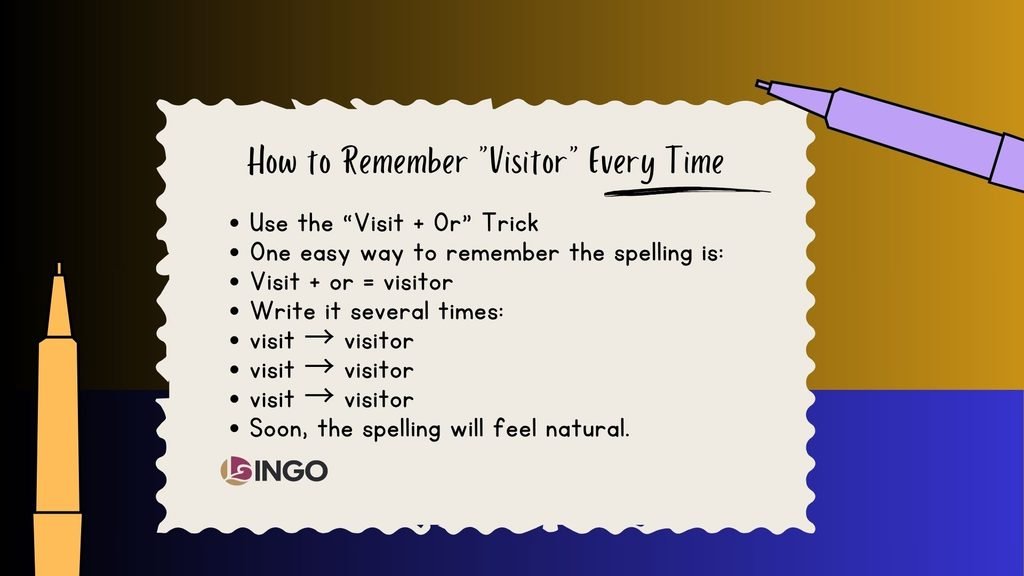
Use the “Visit + Or” Trick
One easy way to remember the spelling is:
Visit + or = visitor
Although this is a memory trick rather than a universal English spelling rule, it can help you recall the correct form.
Write it several times:
visit → visitor
visit → visitor
visit → visitor
Soon, the spelling will feel natural.
Remember the Related Forms
You can also memorize this small word family:
- visit
- visited
- visiting
- visitor
- visitors
Examples:
I visit my grandparents every summer.
I visited them last weekend.
I am visiting them tomorrow.
They are expecting a visitor.
Several visitors arrived early.
This pattern helps separate the verb forms from the noun visitor.
Use a Dictionary When in Doubt
If you are unsure about an unfamiliar spelling, checking a reliable dictionary is usually faster than guessing.
Cambridge and Oxford both provide definitions, pronunciation, examples, and usage information for visitor.
Mini Quiz: Visiter or Visitor
1. Which spelling is the standard modern English form?
A. visitor
B. visiter
C. visittor
D. visetor
Answer: A. visitor
2. Choose the correct word: “We have a _____ at the door.”
A. visiter
B. visitor
C. visetor
D. visittor
Answer: B. visitor
3. What does “visitor” generally mean?
A. A person who teaches
B. A person who drives
C. A person who visits
D. A person who works
Answer: C. A person who visits
4. Which sentence uses “visitor” correctly?
A. The visiter arrived early.
B. The visitor arrived early.
C. The visittor arrived early.
D. The visetor arrived early.
Answer: B. The visitor arrived early.
5. What is the plural of “visitor”?
A. visiters
B. visitory
C. visitors
D. visitorz
Answer: C. visitors
6. Which sentence is correctly spelled?
A. The museum welcomes many visiters.
B. The museum welcomes many visetors.
C. The museum welcomes many visitors.
D. The museum welcomes many visittors.
Answer: C. The museum welcomes many visitors.
7. Which word is the standard noun for someone who visits?
A. visitor
B. visiter
C. visitment
D. visetory
Answer: A. visitor
8. Which sentence is correct for a website?
A. Our website has many visiters.
B. Our website has many visitors.
C. Our website has many visetors.
D. Our website has many visittors.
Answer: B. Our website has many visitors.
9. Which spelling should normally be used in a school assignment?
A. visiter
B. visitor
C. visetor
D. visittor
Answer: B. visitor
10. Which sentence is correct?
A. Every visiter must sign in.
B. Every visetor must sign in.
C. Every visitor must sign in.
D. Every visittor must sign in.
Answer: C. Every visitor must sign in.
11. Which spelling is most appropriate for a business sign?
A. Visiters must report to reception.
B. Visitors must report to reception.
C. Visetors must report to reception.
D. Visittors must report to reception.
Answer: B. Visitors must report to reception.
12. Complete the sentence: “She is a frequent _____ to the library.”
A. visiter
B. visitor
C. visetor
D. visitator
Answer: B. visitor
13. Which statement about “visiter” is most accurate?
A. It is always the preferred modern spelling.
B. It can occur as an archaic or uncommon form.
C. It is the plural of visitor.
D. It means someone who teaches.
Answer: B. It can occur as an archaic or uncommon form.
14. Which pair is correctly matched?
A. visit — visitor
B. visit — visiter
C. visitor — visited
D. visitor — visiting
Answer: A. visit — visitor
15. Which sentence is correct in a tourism context?
A. The city welcomes international visiters.
B. The city welcomes international visetors.
C. The city welcomes international visitors.
D. The city welcomes international visittors.
Answer: C. The city welcomes international visitors.
16. Which pronunciation is closest to the common pronunciation of “visitor”?
A. VIS-it-er
B. VEE-see-tor
C. VIS-tor-ee
D. VIE-zor
Answer: A. VIS-it-er
17. Which word should replace “visiter” in this sentence?
“The visiter signed the guest book.”
A. visitor
B. visitorly
C. visitation
D. visited
Answer: A. visitor
18. Which sentence is correct in an office setting?
A. The visiter is waiting in reception.
B. The visitor is waiting in reception.
C. The visetor is waiting in reception.
D. The visittor is waiting in reception.
Answer: B. The visitor is waiting in reception.
19. Which memory trick can help you remember the spelling?
A. visit → visiter
B. visit → visetor
C. visit → visitor
D. visit → visittor
Answer: C. visit → visitor
20. Which word completes the sentence?
“The hotel welcomes every _____ warmly.”
A. visiter
B. visitor
C. visetor
D. visittor
Answer: B. visitor
21. Which form is the standard plural of “visitor”?
A. visiters
B. visitor’s
C. visitors
D. visitorz
Answer: C. visitors
22. Which sentence is best for a website analytics report?
A. The site received 10,000 visiters.
B. The site received 10,000 visitors.
C. The site received 10,000 visetors.
D. The site received 10,000 visittors.
Answer: B. The site received 10,000 visitors.
23. Which word is misspelled in this sentence?
“The visitors arrived before noon.”
A. visitors
B. arrived
C. before
D. None of them
Answer: D. None of them
24. Which statement is true about “visitor”?
A. It can refer to a person who visits a website.
B. It only refers to a hotel employee.
C. It is only used for children.
D. It is the past tense of visit.
Answer: A. It can refer to a person who visits a website.
25. Complete the rule:
“For ordinary modern English, choose _____.”
A. visiter
B. visetor
C. visittor
D. visitor
Answer: D. visitor
Frequently Asked Questions About Visiter and Visitor
Q1:Is “visitor” or “visiter” correct?
Visitor is the standard spelling in modern English. It means someone who visits a person, place, or website. Visiter is an uncommon historical or variant form and should generally be avoided in ordinary contemporary writing.
Q2:Is “visiter” a real word?
Visiter has existed in English, particularly as an older form of visitor. However, it is not the normal modern spelling. For contemporary writing, use visitor.
Q3:Why is visitor spelled with “or”?
The spelling reflects the established history of the word rather than a simple rule that every person noun must end in -er. English has many nouns ending in -or, including actor, inventor, and operator. Oxford traces visitor through Middle English and Anglo-Norman French.
Q4:What is the plural of visitor?
The plural of visitor is visitors.
Example:
Hundreds of visitors attended the event.
Q5:How do you pronounce visitor?
Cambridge gives the British pronunciation approximately as /ˈvɪz.ɪ.tə(r)/ and the American pronunciation as /ˈvɪz.ɪ.t̬ɚ/.
A simple pronunciation guide is:
VIS-it-er
Q6:Can visitor refer to someone using a website?
Yes. In internet terminology, a visitor can mean someone who accesses or looks at a website. Both Cambridge and Oxford include this computing-related meaning.
Q7:What is the difference between visitor and guest?
A visitor is generally someone who comes to see a person or place. A guest often emphasizes that someone has been invited or is staying somewhere. The words can overlap depending on context.
For example:
We have a visitor at the office.
We have a guest staying with us this weekend.
Q8:What is an easy way to remember visitor?
Remember:
Visit → Visitor
Think of the sentence:
A visitor comes to visit.
This connects the noun with the verb and helps you avoid the tempting spelling visiter.
Conclusion: Visitor or Visiter?
If you are wondering whether visiter or visitor is correct, the answer is simple: visitor is the standard spelling for modern English.
Use visitor when referring to someone who visits a person, place, or website:
The visitor arrived at noon.
The museum welcomes thousands of visitors.
Our website has many visitors every day.
Although visiter can appear in historical or unusual contexts, it is not the spelling you normally want in modern everyday, academic, professional, or online writing. Current Cambridge and Oxford references list visitor as the established noun.
The easiest trick is simply:
visit → visitor
So next time you hesitate between visiter and visitor, choose visitor.
For more clear explanations of commonly confused English words and grammar rules, explore the other language guides on Lingorixa.
References
Cambridge Dictionary: Visitor
Oxford Learner’s Dictionaries: Visitor

Maimoona Asghar is a grammar enthusiast and language writer who creates clear, practical content to help learners improve English grammar, writing, punctuation, and communication skills through easy-to-understand explanations and examples.