It’s called vs it called is a common English grammar confusion. Although these expressions look almost identical, they do not have the same meaning or grammatical function. “It’s called” usually means “it is called” and is used when giving the name or description of something. “It called,” on the other hand, normally describes an action that happened in the past.
For example, you can say, “It’s called a smartphone” when identifying something. But you can say, “It called me yesterday” when an object, system, or other “it” performed the action of calling.
Understanding this small difference can make your writing more accurate and natural.
What Does “It’s Called” Mean?
“It’s Called” Means “It Is Called”
“It’s called” is the contracted form of “it is called.” The contraction “it’s” can represent “it is” or “it has,” depending on the sentence.
When followed by “called,” the intended meaning is normally:
It’s called = It is called
For example:
It’s called a dictionary.
The expanded version is:
It is called a dictionary.
Both sentences have the same meaning.
Examples of “It’s Called”
Here are several natural examples:
- It’s called a keyboard.
- It’s called a shortcut.
- It’s called a compound sentence.
- It’s called the Pacific Ocean.
- It’s called a smartphone.
- The dish is called paella.
- The technique is called active listening.
In each example, the speaker is identifying a name, term, label, or description.
Why “It’s Called” Is So Common
English speakers frequently use this expression when answering questions such as:
What is this called?
A natural response is:
It’s called a telescope.
Similarly:
What is that type of sentence called?
It’s called a conditional sentence.
Therefore, when the purpose of the sentence is to identify what something is named or known as, “it’s called” is usually the structure you need.
It’s Called vs It Called: What Is the Difference?
The easiest way to understand it’s called vs it called is to look at the grammatical role of called.
“It’s Called” Identifies a Name
When you write:
It’s called a laptop.
you are saying:
It is called a laptop.
The phrase identifies what something is named or known as.
This is a passive construction because the subject receives the action associated with the verb call.
For example:
People call this device a tablet.
can be expressed as:
This device is called a tablet.
In conversational English:
It’s called a tablet.
“It Called” Describes a Past Action
“It called” has a different structure.
Here, called is the simple past form of call.
For example:
It called me yesterday.
This means that something represented by it made a call to the speaker.
Another example:
The automated system called me.
can become:
It called me.
The meaning is about an action, not a name.
Quick Comparison
| Expression | Meaning | Example |
|---|---|---|
| It’s called | It is called; identifies a name or label | It’s called a telescope. |
| It is called | Full form of “it’s called” | It is called a telescope. |
| It called | It performed the action of calling in the past | It called me yesterday. |
When Should You Use “It’s Called”?
Use “It’s Called” to Give a Name
The most common use is to tell someone what something is called.
For example:
What is this tool?
It’s called a wrench.
Or:
What is that animal?
It’s called a capybara.
The expression is useful for names of objects, animals, places, concepts, techniques, foods, and other things.
Use “It’s Called” for Terms and Concepts
You can also introduce a specific term.
For example:
When two words have similar meanings, it’s called synonymy.
More naturally, when the subject is plural:
When two words have similar meanings, this relationship is called synonymy.
Another example:
The process of shortening a word or phrase is called abbreviation.
Use “It Is Called” for More Formal Writing
“It is called” and “it’s called” are grammatically equivalent in meaning.
Compare:
It’s called a compound sentence.
and:
It is called a compound sentence.
The second version may sound more formal because it avoids the contraction.
In academic or formal writing, writers may prefer the full form depending on their style guide and context.
Is “It Called” Ever Correct?
Yes, “It Called” Can Be Correct
It would be incorrect to say that “it called” is always wrong.
It is grammatically correct when it is the subject performing the action of calling in the past.
For example:
The machine called my number.
Replace “the machine” with “it”:
It called my number.
That sentence is perfectly grammatical.
Examples of Correct “It Called”
- It called me last night.
- It called several times.
- The automated system called again.
- It called the wrong number.
- The device called the emergency contact.
- It called my phone unexpectedly.
In these sentences, called means an action happened in the past.
A Simple Meaning Test
Ask yourself:
Am I giving something’s name?
Use:
It’s called…
For example:
It’s called a dictionary.
Or ask:
Am I saying that something made a call?
Use:
It called…
For example:
It called me yesterday.
This simple test solves most it’s called vs it called questions.
It’s Called vs It Called: Real-Life Example
A Restaurant Conversation
Imagine that a friend has discovered a new restaurant and wants to tell you about it.
They might say:
“There’s a new restaurant near my house. It’s called Green Garden.”
That sentence is correct because the speaker is giving the restaurant’s name. “It’s called” means “it is called.”
Now imagine that the restaurant has an automated reservation system. The next day, your friend tells you:
“The reservation system called me yesterday.”
They could shorten the subject if the context is already clear:
“It called me yesterday.”
That sentence is also correct, but the meaning has completely changed.
In the first sentence, “it’s called” identifies a name:
It’s called Green Garden.
In the second sentence, “it called” describes a past action:
It called me yesterday.
This distinction is important because English uses called in both constructions, but the surrounding grammar tells the reader what the word means. In “it’s called,” the word called forms part of a passive construction. In “it called,” the word called functions as the main past-tense verb.
This is why replacing one expression with the other can produce an entirely different sentence. If you are telling someone the name of a person, object, place, food, concept, or product, use “it’s called.” If you are reporting that something made a phone call or otherwise performed the action of calling, “it called” may be correct.
How to Choose the Correct Expression
Step 1: Identify Your Intended Meaning
First, ask what you are trying to communicate.
If you mean:
“Its name is…”
use:
It’s called…
If you mean:
“It made a call…”
use:
It called…
Step 2: Expand “It’s”
Try replacing “it’s” with “it is.”
For example:
It’s called a smartphone.
becomes:
It is called a smartphone.
The sentence still works, so “it’s” is appropriate.
This works because it’s is a contraction of it is or it has.
Step 3: Check Whether “Called” Is the Main Verb
Consider:
It called me.
Here, called is the main verb and describes an action completed in the past.
Compare that with:
It’s called a smartphone.
Here, is is the auxiliary verb and called is part of the passive construction.
Step 4: Read the Sentence Naturally
Finally, read the sentence aloud.
If you’re naming something, sentences such as these will usually sound natural:
It’s called a laptop.
It’s called a shortcut.
It’s called a comma splice.
If you’re describing an action:
It called me.
It called again.
It called the wrong number.
Common Mistakes With “It’s Called” and “It Called”
Mistake 1: Using “It Called” for a Name
Incorrect:
This animal it called a panda.
Correct:
This animal is called a panda.
Or:
It’s called a panda.
The problem is that it called does not mean it is called.
Mistake 2: Treating “It’s” as a Possessive
Remember that “it’s” means “it is” or “it has.” “Its” without an apostrophe indicates possession.
For example:
It’s called a computer.
but:
The computer lost its connection.
Mistake 3: Using “It’s Called” for a Past Phone Call
Incorrect:
It’s called me yesterday.
Correct:
It called me yesterday.
Because the sentence describes a completed action in the past, called should function as the main verb.
Mistake 4: Confusing the Passive and Active Structures
Compare:
People call it a classic.
and:
It is called a classic.
The second sentence uses passive voice.
A contracted version is:
It’s called a classic.
But:
It called a classic.
has a different grammatical structure and would normally suggest that “it” itself called something a classic.
Data & Grammar Guidance for 2025–2026
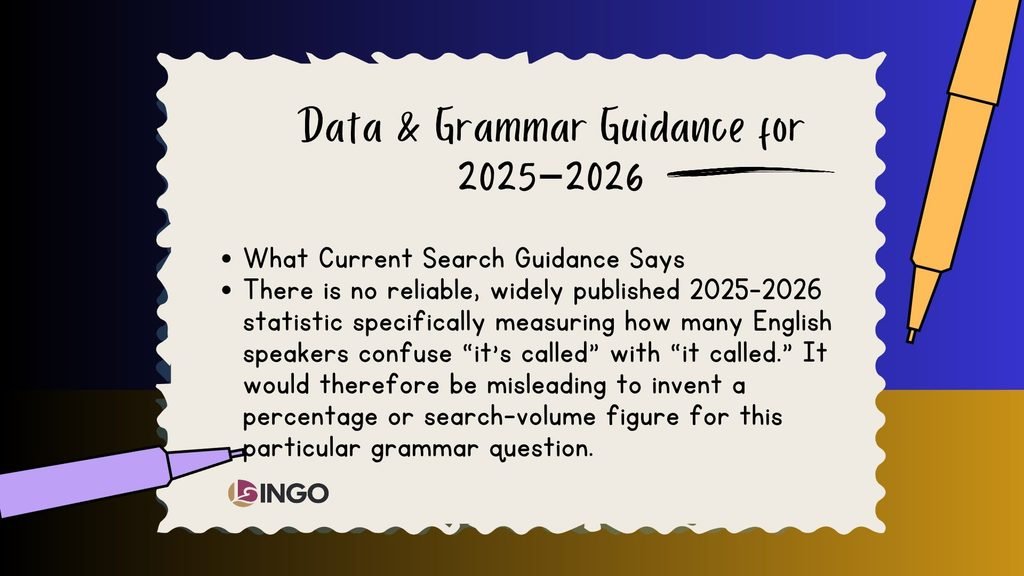
What Current Search Guidance Says
There is no reliable, widely published 2025–2026 statistic specifically measuring how many English speakers confuse “it’s called” with “it called.” It would therefore be misleading to invent a percentage or search-volume figure for this particular grammar question.
What can be documented is the current direction of Google’s search guidance. Google says its systems prioritize helpful, reliable, people-first content, and its guidance encourages content that provides substantial value rather than content created primarily to attract search traffic.
Google’s current Search Essentials also recommends using words people are likely to search for in prominent locations such as titles and headings, while emphasizing helpful and reliable content.
In a 2025 Google Search Central discussion of AI search experiences, Google likewise emphasized useful, unique content and noted that users increasingly ask longer and more specific questions.
For a grammar article, the practical takeaway is straightforward: answer the wording question directly, explain the underlying rule, and provide examples that readers can apply in real situations.
Why Reliable Grammar Sources Matter
Cambridge Dictionary confirms that “it’s” is the short form of “it is” or “it has,” while “its” without an apostrophe expresses possession.
That distinction provides the grammatical foundation for understanding why:
It’s called…
can mean:
It is called…
while:
It called…
uses called as a past-tense verb.
It’s Called vs It Called: Quick Reference Table
| Situation | Correct Form | Example |
|---|---|---|
| Giving a name | It’s called | It’s called a dictionary. |
| Identifying a term | It’s called | It’s called passive voice. |
| Giving a title | It’s called | It’s called The Great Gatsby. |
| Describing a past call | It called | It called me yesterday. |
| Describing repeated calling | It called | It called three times. |
| Formal version of “it’s called” | It is called | It is called a telescope. |
Mini Quiz: “It’s Called” vs “It Called”
- Choose the correct sentence:
A. It’s called a sunflower.
B. It called a sunflower.
C. Its called a sunflower.
D. It call a sunflower.
Answer: A - Choose the sentence that describes a completed calling action:
A. It’s called a computer.
B. It called me yesterday.
C. It’s called a laptop.
D. It’s called a printer.
Answer: B - What does “It’s called a dictionary” mean?
A. It called a dictionary.
B. It owns a dictionary.
C. It is called a dictionary.
D. It will call a dictionary.
Answer: C - Which sentence correctly uses “its” to show possession?
A. The cat cleaned it’s paws.
B. The cat cleaned its paws.
C. The cat it’s called a pet.
D. The cat called its paws.
Answer: B - Complete the sentence correctly: “What is this object called?” — “_____ called a compass.”
A. It
B. Its
C. It’s
D. It called
Answer: C
Frequently Asked Questions
Q1:Is “it’s called” correct English?
Yes. “It’s called” is correct English when “it’s” means “it is.” It is commonly used to identify the name, title, label, or description of something.
Q2:Is “it called” grammatically correct?
Yes. “It called” can be grammatically correct when called is the simple past tense of call.
For example:
It called me yesterday.
Q3:QWhich is correct: “it’s called” or “it called”?
Both can be correct, but they mean different things. Use “it’s called” when identifying a name or label. Use “it called” when describing an action performed by “it” in the past.
Q4:What does “it’s called” mean?
“It’s called” normally means “it is called.” For example:
It’s called a laptop.
This tells the reader the name or category of the object.
Q5:Can I replace “it’s called” with “it is called”?
Yes. “It is called” is the expanded form of “it’s called.” The meaning is essentially the same.
Q6:What is the difference between “its” and “it’s”?
“It’s” is a contraction of “it is” or “it has.” “Its” is a possessive form.
For example:
It’s called a tablet.
The tablet has its own charger.
Q7:How do I know whether to use “it’s”?
Use the expansion test. Replace “it’s” with “it is.”
If the sentence remains grammatical and keeps the intended meaning, “it’s” may be correct.
For example:
It’s called a notebook.
becomes:
It is called a notebook.
Q8:Is “it’s called” formal English?
Yes. “It’s called” is standard English. In especially formal writing, you may choose “it is called” instead, but the contraction itself is not grammatically incorrect.
Conclusion
The difference between it’s called vs it called is mainly a difference in grammatical structure and meaning.
Use “it’s called” when you are identifying what something is named or known as:
It’s called a smartphone.
Here, “it’s” = “it is.”
Use “it called” when it performs the action of calling in the past:
It called me yesterday.
A quick way to remember the rule is:
Name or label → “It’s called.”
Past calling action → “It called.”
Once you recognize whether called is part of a passive naming construction or the main past-tense verb, the distinction becomes much easier.
For more clear explanations of commonly confused English words and grammar rules, explore the other language guides on Lingorixa.
References
- Google Search Central — Creating Helpful, Reliable, People-First Content
- Cambridge Dictionary — “It’s” and “Its” Grammar Guidance

Maimoona Asghar is a grammar enthusiast and language writer who creates clear, practical content to help learners improve English grammar, writing, punctuation, and communication skills through easy-to-understand explanations and examples.