Have you ever written “time flies” and suddenly wondered whether it should be “time flys” instead? You are not alone. These two forms look similar, but only one is correct in standard English.
The correct expression is “time flies.” The spelling “time flys” is incorrect when you mean that time seems to pass quickly.
The reason is simple: time is a singular subject, and flies is the third-person singular present-tense form of the verb fly. English spelling rules also require a change from y to ies in this situation.
In this guide, you will learn exactly why time flies is correct, what the expression means, how to use it naturally, and how to avoid the common time flys mistake.
Time Flies or Time Flys: The Quick Answer
If you only need the answer, remember this:
| Phrase | Correct? | Explanation |
|---|---|---|
| Time flies | ✅ Correct | Standard English |
| Time flys | ❌ Incorrect | Incorrect spelling |
| Time flies by | ✅ Correct | Common expression |
| Time flew by | ✅ Correct | Past-tense form |
| Time has flown by | ✅ Correct | Present perfect |
So, when you want to say that time seems to pass quickly, write:
Time flies.
Not:
Time flys.
The phrase “time flies” is an established English expression. Cambridge Dictionary also lists “time flies” among the idioms associated with fly.
Why Is “Time Flies” Correct?
Time Is a Singular Subject
The most important part of the explanation is the subject time.
In the sentence:
Time flies.
Time is a singular noun. Therefore, the verb must agree with a singular third-person subject.
Compare:
- I fly.
- You fly.
- We fly.
- They fly.
- He flies.
- She flies.
- It flies.
- Time flies.
The same grammatical pattern appears in:
- She tries.
- He cries.
- It carries.
- The machine works.
- Time flies.
Cambridge Dictionary gives flew as the past form of fly and identifies fly as a verb meaning, among other things, to move through the air or move quickly.
The Y Changes to IES
Here is the spelling rule that causes the confusion.
When a verb ends in a consonant + y, the y generally changes to i and -es is added when forming the third-person singular present tense.
For example:
| Base Verb | Third-Person Singular |
|---|---|
| fly | flies |
| try | tries |
| cry | cries |
| carry | carries |
| study | studies |
| worry | worries |
Therefore:
fly → flies
not:
fly → flys
That gives us:
Time flies. ✅
rather than:
Time flys. ❌
What Does “Time Flies” Mean?
The Meaning of the Expression
“Time flies” means that time seems to pass very quickly.
It is not meant literally. Time does not actually grow wings and fly through the air. Instead, the expression describes how quickly a period of time appears to pass.
For example:
I can’t believe the vacation is already over. Time flies!
The speaker is expressing surprise that the vacation ended so quickly.
Another example is:
Time flies when you’re having fun.
This means enjoyable experiences often seem to pass more quickly than expected.
Cambridge Dictionary also gives fly the sense of moving or going quickly, including the example that a summer can have “flown by,” which reflects the same idea behind the expression.
Common Expressions With “Time Flies”
You will often see time flies in expressions such as:
- Time flies.
- Time flies by.
- Time flies when you’re having fun.
- How time flies!
- Time really flies.
- I can’t believe how quickly time flies.
- Time flies so fast.
For example:
How time flies! My son is already ten years old.
Here, the speaker is surprised by how quickly the years have passed.
Why Do People Write “Time Flys”?
The Pronunciation Causes Confusion
One reason people make this mistake is that flies and flys would look similar when spoken quickly.
The spelling cannot be determined simply from pronunciation. English has many words whose spelling must be learned alongside their grammatical forms.
A person may think:
fly + s = flys
That reasoning works for some verbs:
- walk → walks
- play → plays
- jump → jumps
- work → works
However, fly follows a different spelling pattern:
fly → flies
The Same Pattern Appears in Other Words
A useful way to remember the spelling is to connect flies with other verbs ending in consonant + y:
- fly → flies
- try → tries
- cry → cries
- reply → replies
- apply → applies
So if you remember try → tries, you can use the same pattern for fly → flies.
Time Flies vs. Time Flys: A Simple Comparison
The Correct Form
Time flies is the standard form when you mean that time passes quickly.
Examples:
Time flies when you’re having fun.
I can’t believe we’ve been friends for ten years. Time flies!
Time flies by when I’m working on an interesting project.
The Incorrect Form
Time flys is not the standard spelling for this expression.
For example:
❌ Time flys when you’re having fun.
Correct it to:
✅ Time flies when you’re having fun.
The error is caused by treating fly as though the normal -s ending could simply be added without changing the spelling.
What About “Flys”?
In ordinary modern English, flys should not be used as the spelling of the verb in this expression. The standard form is flies.
The word flies can also be the plural of the noun fly, such as:
There are flies near the window.
Cambridge Dictionary lists flies as the plural of the noun fly.
Examples of “Time Flies” in Everyday English
In Casual Conversation
Time flies! We should catch up more often.
It feels like yesterday, but time flies.
Time flies when you’re with good friends.
In Writing
The school year went by quickly. Time flies when you’re busy learning.
I can’t believe this project is already finished. Time flies.
In Social Media Captions
Another birthday already? Time flies!
Five years of memories. Time flies.
In Professional Communication
The expression can also appear in professional writing when the tone is conversational:
It’s hard to believe our company has been serving customers for ten years. Time flies!
For more formal writing, you can replace it with:
Ten years have passed quickly.
or:
It is remarkable how quickly the years have passed.
Time Flies, Time Flew, or Time Has Flown?
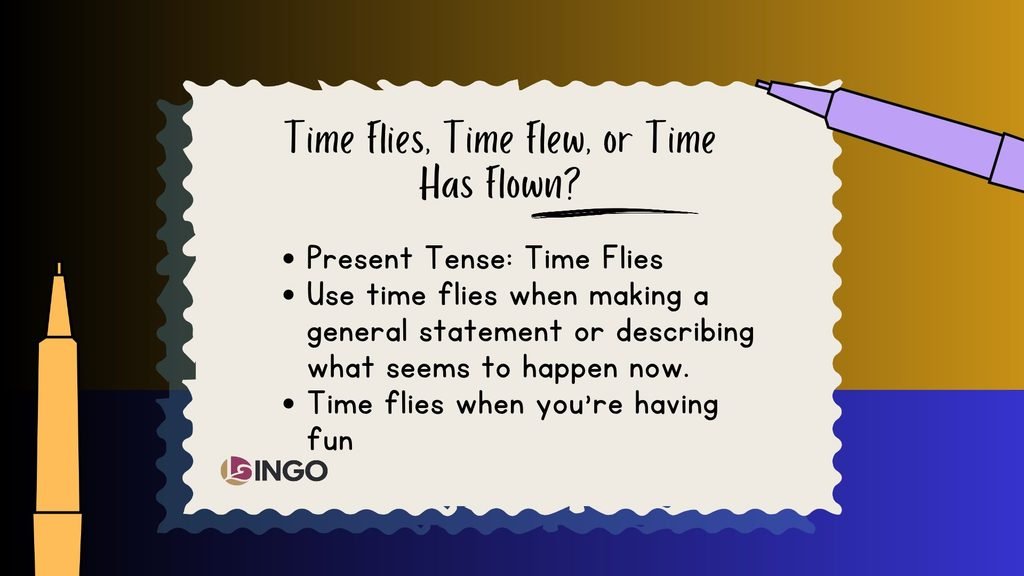
Present Tense: Time Flies
Use time flies when making a general statement or describing what seems to happen now.
Time flies when you’re having fun.
Past Tense: Time Flew
Use flew when talking about a completed period in the past.
The weekend flew by.
The summer flew by.
Cambridge identifies flew as the past simple form of fly.
Present Perfect: Time Has Flown
Use has flown when connecting a past period with the present.
Time has flown since we first met.
The years have flown by.
Remember:
fly → flies → flew → flown
These are different forms used in different grammatical contexts.
A Real-Life Example: Why “Time Flies” Feels So Natural
Imagine someone starts a new job in January. On the first day, everything feels unfamiliar. They meet new colleagues, learn new software, attend training sessions, and gradually become comfortable with the workplace.
At first, the days may seem long because there is so much to learn. Then, after several months, the person suddenly realizes that summer has arrived. They look at the calendar and notice that six months have passed.
A colleague might say:
“I can’t believe it’s been six months already. Time flies!”
The colleague is not suggesting that time literally moves through the air. The expression communicates a feeling of surprise about how quickly a period seems to have passed.
This is why “time flies” works so well in everyday English. It expresses a familiar human experience in just two words. The phrase can be used when talking about birthdays, holidays, school years, friendships, careers, family milestones, vacations, and many other situations.
For example, a parent might say “Time flies” when looking at photographs of a child who has grown older. A student might use the same phrase after realizing that an entire semester has ended. Someone returning from vacation might say “Time flies when you’re having fun.”
The situation changes, but the grammatical structure remains the same: time is the singular subject, so the correct verb form is flies.
Data & Evidence Snapshot: What Current English Resources Show
Current Dictionary Evidence
As of 2026, major English dictionary resources continue to recognize fly as a verb with forms including flew and flown, while flies is an established form associated with the word fly. Cambridge Dictionary also lists “time flies” as an idiomatic expression.
What This Tells Us
There is no meaningful American-versus-British spelling split for this phrase.
The standard form is:
Time flies.
The nonstandard form is:
Time flys.
This is therefore not a case like color/colour or favorite/favourite, where regional spelling conventions can differ.
Instead, it is a matter of standard English verb formation.
A Useful Grammar Data Pattern
The spelling pattern can be summarized as:
consonant + y → ies
Examples include:
| Base Form | Correct Singular Form |
|---|---|
| fly | flies |
| try | tries |
| cry | cries |
| study | studies |
| carry | carries |
| reply | replies |
This pattern makes flies predictable once the underlying grammar rule is understood.
How to Remember “Time Flies” Forever
Use the “Try” Trick
If you can remember:
Try → tries
you can remember:
Fly → flies
Both words end with a consonant followed by y, so the y changes to i before -es is added.
Think “He, She, It”
Ask yourself:
Would I write he flys?
No.
You write:
He flies.
Now replace he with time:
Time flies.
This is one of the easiest ways to remember the correct form.
Remember the Four Forms
Keep this sequence in mind:
Fly → flies → flew → flown
Examples:
- Birds fly.
- The bird flies.
- The bird flew away.
- The bird has flown away.
For the expression about passing time:
- Time flies.
- Time flew by.
- Time has flown by.
Mini Quiz: Is “Time Flies” Correct?
Before publishing or sending your sentence, use this checklist:
- The subject is time.
- Time is singular.
- The verb is fly.
- The third-person singular form is flies.
- The y changes to ie.
- The correct expression is time flies.
- Do not write time flys in standard English.
1. Which spelling is correct when saying that time passes quickly?
A. Time flies
B. Time flys
C. Time flyes
D. Time fliez
Answer: A. Time flies
2. Why does “fly” become “flies” in “Time flies”?
A. Because time is plural
B. Because it is a noun
C. Because time is singular
D. Because the sentence is past tense
Answer: C. Because time is singular
3. Which sentence is grammatically correct?
A. Time flys when you’re happy.
B. Time flies when you’re happy.
C. Time flyes when you’re happy.
D. Time fliez when you’re happy.
Answer: B. Time flies when you’re happy.
4. What does “Time flies” mean?
A. Time moves very slowly
B. Time seems to pass quickly
C. Time stops suddenly
D. Time moves backward
Answer: B. Time seems to pass quickly
5. Which is the correct third-person singular form of “fly”?
A. Flys
B. Flyes
C. Flies
D. Flew
Answer: C. Flies
6. Complete the sentence: “I can’t believe how quickly ______.”
A. time flies
B. time flys
C. time flew
D. time flyes
Answer: A. time flies
7. Which sentence correctly uses the common expression?
A. Time flys when you’re having fun.
B. Time flies when you’re having fun.
C. Time flyes when you’re having fun.
D. Time flew when you’re having fun.
Answer: B. Time flies when you’re having fun.
8. Which word completes the sentence: “Time ___ by so quickly”?
A. flys
B. flies
C. flyes
D. fly
Answer: B. flies
9. Which pair shows the correct spelling change?
A. fly → flys
B. fly → flyes
C. fly → flies
D. fly → fliez
Answer: C. fly → flies
10. Which sentence is correct in standard English?
A. Time flys by.
B. Time flies by.
C. Time flyes by.
D. Time fliez by.
Answer: B. Time flies by.
11. Which verb form is correct in “Time ___ when you’re busy”?
A. flies
B. flys
C. flyes
D. flew
Answer: A. flies
12. Which sentence correctly uses the past tense of “fly”?
A. Time flys by yesterday.
B. Time flies by yesterday.
C. Time flew by yesterday.
D. Time flyes by yesterday.
Answer: C. Time flew by yesterday.
13. Which sentence correctly uses the present perfect form?
A. Time has flown by.
B. Time has flies by.
C. Time has flys by.
D. Time has flew by.
Answer: A. Time has flown by.
14. Which verb sequence is correct?
A. fly → flies → flew → flown
B. fly → flys → flew → flown
C. fly → flyes → flew → flown
D. fly → flies → flyed → flown
Answer: A. fly → flies → flew → flown
15. Which sentence best expresses surprise that years have passed quickly?
A. Time flies!
B. Time flys!
C. Time flyes!
D. Time fliez!
Answer: A. Time flies!
16. Which spelling is NOT standard English in the expression about time passing quickly?
A. Time flies
B. Time flies by
C. Time flys
D. How time flies
Answer: C. Time flys
17. Which verb follows the same spelling pattern as “fly → flies”?
A. Try → tries
B. Play → plays
C. Enjoy → enjoys
D. Stay → stays
Answer: A. Try → tries
18. What type of word is “flies” in “Time flies”?
A. Adjective
B. Verb
C. Pronoun
D. Preposition
Answer: B. Verb
19. What is the subject in “Time flies”?
A. Flies
B. Time
C. By
D. Quickly
Answer: B. Time
20. Which sentence correctly uses “flies” with a singular subject?
A. The bird flies.
B. The bird fly.
C. The bird flys.
D. The bird flyes.
Answer: A. The bird flies.
21. Which sentence correctly uses the base form “fly”?
A. Birds fly.
B. Birds flies.
C. Birds flys.
D. Birds flyes.
Answer: A. Birds fly.
22. Which sentence has correct subject-verb agreement?
A. Time fly every day.
B. Time flies every day.
C. Time flys every day.
D. Time flyes every day.
Answer: B. Time flies every day.
23. Which sentence is appropriate for a general statement about enjoyable experiences?
A. Time flies when you’re having fun.
B. Time flys when you’re having fun.
C. Time flyes when you’re having fun.
D. Time flew when you’re having fun.
Answer: A. Time flies when you’re having fun.
24. Which correction fixes “Time flys so fast”?
A. Time flies so fast.
B. Time flyes so fast.
C. Time flew so fast.
D. Time fly so fast.
Answer: A. Time flies so fast.
25. Which statement about “time flies” is accurate?
A. It uses the verb “fly” in its singular present form.
B. It uses “flys” as a standard spelling.
C. It is written in the past tense.
D. It means that time literally has wings.
Answer: A. It uses the verb “fly” in its singular present form.
Frequently Asked Questions
Q1:Is it “time flies” or “time flys”?
Time flies is correct. Time flys is an incorrect spelling when you mean that time passes quickly.
Q2:Why is “time flies” correct?
Because time is a singular subject. The third-person singular present-tense form of fly is flies, not flys.
Q3:What does “time flies” mean?
Time flies means that time seems to pass very quickly. It is commonly used when someone is surprised by how quickly days, weeks, months, or years have passed.
Q4:Is “time flys” ever correct?
Not as the standard spelling of the verb in the expression “time flies.” In ordinary English writing, use flies.
Q5:Is “time flies by” correct?
Yes. “Time flies by” is a common and natural expression.
For example:
Time flies by when you’re having fun.
Q6:Is “time flew by” correct?
Yes. Flew is the past-tense form of fly.
For example:
The weekend flew by.
Q7:Is “time has flown by” correct?
Yes. Flown is the past participle of fly, so “time has flown by” is grammatically correct.
For example:
Time has flown by since we started this project.
Q8:Does British English use “time flys”?
No. Time flies is the standard spelling in both British and American English. There is no regional spelling variation here.
Conclusion: Time Flies or Time Flys?
If you have been wondering whether to write “time flies” or “time flys,” the answer is clear: time flies is the correct form.
The reason comes down to a simple grammar and spelling rule. Time is a singular subject, so the verb fly takes its third-person singular form. Because fly ends in a consonant + y, the y changes to i and -es is added:
fly → flies
Therefore:
Time flies. ✅
Time flys. ❌
Once you connect fly → flies with similar forms such as try → tries and cry → cries, the spelling becomes much easier to remember.
So the next time you write a message, article, email, caption, or school assignment, choose “time flies.”
Time flies and now you know exactly why.
For more clear explanations of commonly confused English words and grammar rules, explore the other language guides on Lingorixa.
References
Cambridge Dictionary: Fly
Cambridge Learner’s Dictionary: Fly

Maimoona Asghar is a grammar enthusiast and language writer who creates clear, practical content to help learners improve English grammar, writing, punctuation, and communication skills through easy-to-understand explanations and examples.