Have you ever stopped while writing and wondered, “Is it nosy or nosey?” You are not alone. Both spellings appear in English, which can make this seemingly simple word surprisingly confusing.
The good news is that both “nosy” and “nosey” are recognized spellings. However, nosy is generally the preferred form, while nosey is an accepted variant. Cambridge Dictionary lists nosey alongside nosy, with the same basic meaning.
In this guide, you’ll learn exactly what nosy or nosey means, whether there is a difference between them, which spelling is better for formal writing, and how to use each one correctly in real sentences.
What Is the Correct Spelling: Nosy or Nosey?
Nosy or nosey: the quick answer
Nosy is the preferred spelling, but nosey is also correct.
Cambridge Dictionary lists nosy as an adjective meaning too interested in what other people are doing or wanting to discover too much about them. It also explicitly gives nosey as another spelling.
So, the choice can be summarized simply:
| Spelling | Correct? | Meaning | Recommended use |
|---|---|---|---|
| Nosy | Yes | Too interested in other people’s affairs | Preferred |
| Nosey | Yes | Same meaning | Accepted variant |
For example:
- My neighbor is very nosy.
- My neighbor is very nosey.
Both sentences communicate essentially the same idea.
If you are writing an essay, article, professional email, or website content and want the safest conventional choice, nosy is the better option.
Is nosey a spelling mistake?
No.
It would be inaccurate to say that nosey is simply wrong. Cambridge identifies it as an alternative spelling, and its dictionary examples use both forms.
Therefore, if you encounter nosey in a book, article, conversation, or online post, you should not automatically assume that the writer has made a spelling error.
What Does Nosy Mean?
Nosy meaning and definition
Nosy1 is an adjective describing someone who is excessively interested in other people’s personal affairs.
It usually carries a negative or disapproving tone.
For example:
My nosy neighbor keeps asking about my personal life.
The sentence suggests that the neighbor’s curiosity has gone beyond what is considered appropriate.
Cambridge defines nosy as being too interested in what other people are doing and wanting to discover too much about them.
Examples of nosy in sentences
Here are some natural examples:
- My nosy coworker kept asking about my salary.
- Don’t be nosy; that’s a private conversation.
- She asked a very nosy question.
- Our nosy neighbor always wants to know who visits us.
- He can be quite nosy about other people’s relationships.
- I don’t want to sound nosy, but why are you leaving?
- The reporter was accused of being nosy about the actor’s private life.
In each example, nosy suggests unwanted or excessive curiosity.
Nosy vs. curious
One of the easiest ways to understand nosy is to compare it with curious.
Curious usually means wanting to know or learn something.
I am curious about how this machine works.
This is normally neutral or positive.
Nosy, however, usually suggests that someone’s curiosity is intrusive.
She is nosy about her coworker’s personal life.
Therefore, being curious is not necessarily a bad thing, while being nosy usually carries a negative implication.
Nosy vs. Nosey: Is There Any Difference?
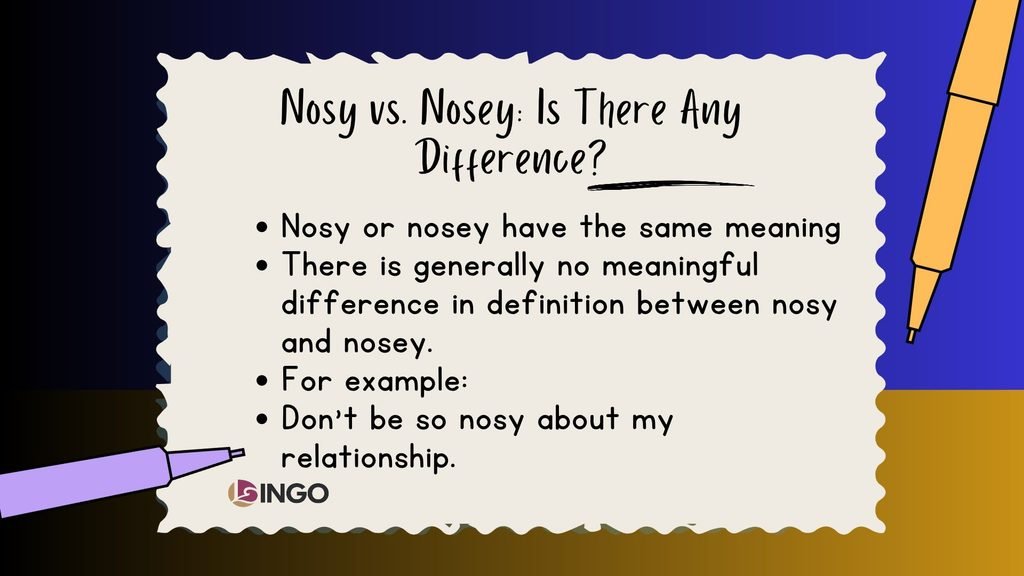
Nosy or nosey have the same meaning
There is generally no meaningful difference in definition between nosy and nosey.
Cambridge gives nosey as another spelling of nosy, and both are pronounced the same way in the dictionary entries.
For example:
Don’t be so nosy about my relationship.
and:
Don’t be so nosey about my relationship.
The meaning remains the same.
Why does nosey exist?
The spelling nosey may feel intuitive because the word is associated with the idea of “sticking your nose” into someone else’s business.
English has many words in which spelling variants develop through usage, pronunciation, regional preferences, and historical patterns. As a result, the existence of nosey alongside nosy is not unusual.
The important point for modern writers is that major dictionary sources recognize both spellings.
Which one should you use?
When you need one spelling, use:
Nosy
It is the simpler and more conventional choice.
Nosey is still acceptable, but nosy is generally the safer spelling for polished writing.
How to Use Nosy Correctly
Use “nosy” for excessive curiosity
Use nosy when someone is asking questions, observing behavior, or seeking information that is considered too personal or private.
For example:
My aunt is always nosy about my dating life.
Here, the adjective communicates unwanted curiosity.
Use “curious” for neutral interest
If the person’s interest is not intrusive, curious may be better.
Compare:
I’m curious about your new job.
with:
I’m nosy about your new job.
The first sounds like a normal request for information. The second suggests that the speaker may be asking questions that are too personal.
Use “prying” when the intrusion is stronger
Prying is another useful synonym, especially when someone deliberately tries to discover private information.
For example:
The journalist asked several prying questions.
Other related words include:
- inquisitive
- intrusive
- meddlesome
- snooping
- curious
However, these words are not perfect substitutes in every sentence. Their tone and strength can differ.
Real-Life Example: Choosing Between Nosy and Curious
Imagine that a new employee joins a company. During her first week, she asks her manager several questions about working hours, office procedures, and the responsibilities of her position.
Would you call her nosy?
Probably not.
Her questions are directly related to her work, so describing her as curious, interested, or inquisitive would be more natural.
Now imagine that the same employee starts asking coworkers how much they earn, why one colleague is getting divorced, how much another person paid for a house, and what someone discussed privately with the manager.
The situation has changed.
Those questions concern other people’s private affairs. Calling her nosy would now make sense.
This distinction is important because nosy does not simply mean “interested.” It usually suggests that curiosity has crossed a social boundary.
For example:
Sarah was curious about the company’s new project.
This sounds neutral.
But:
Sarah was nosy about her coworker’s personal finances.
This sounds critical because financial information is generally private.
The same principle applies to everyday conversations. Asking a friend, “How was your vacation?” is normally friendly curiosity. Asking repeatedly about their exact expenses, relationship problems, or private family disagreements may be considered nosy.
Therefore, when choosing between curious and nosy, consider the subject, the relationship between the people involved, and whether the question respects personal boundaries.
2025–2026 Evidence and Usage Snapshot
What current dictionary evidence shows
Current dictionary evidence available in 2026 supports the following:
- Cambridge Dictionary lists “nosy” as the main adjective entry and “nosey” as another spelling.
- Cambridge gives the same basic definition for the two forms: excessive interest in what other people are doing.
- Cambridge also records nosy/nosey as a noun in UK informal usage, referring to looking around because of interest.
- Google’s current Search guidance emphasizes helpful, reliable, people-first content rather than content created primarily to manipulate rankings.
- Google’s 2026 Search guidance also says that there is no preferred word count that guarantees better rankings, reinforcing the importance of useful content rather than artificially hitting a particular length.
An important note about “2025–2026 statistics”
There is no authoritative 2025–2026 statistic from the dictionary sources reviewed that establishes an exact percentage split between “nosy” and “nosey.”
Rather than inventing a search-volume percentage or unsupported usage statistic, the strongest evidence is the current dictionary treatment: nosy is the main form, while nosey is recognized as a variant.
That distinction gives writers a reliable answer without presenting made-up numbers as language data.
Nosy vs. Nosey: Quick Comparison Checklist
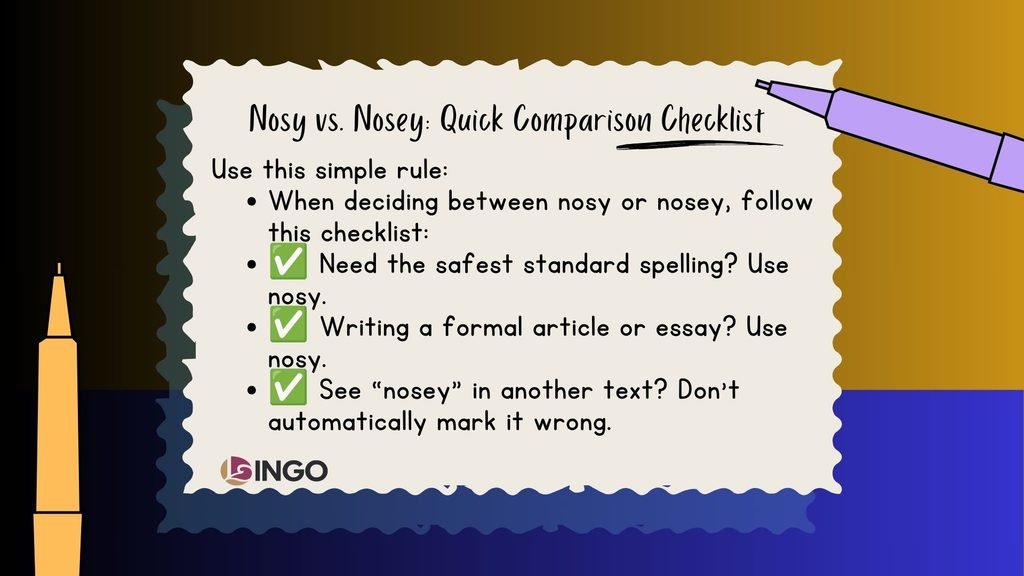
Use this simple rule
When deciding between nosy or nosey, follow this checklist:
- ✅ Need the safest standard spelling? Use nosy.
- ✅ Writing a formal article or essay? Use nosy.
- ✅ See “nosey” in another text? Don’t automatically mark it wrong.
- ✅ Talking about excessive curiosity? Nosy/nosey can describe it.
- ✅ Talking about normal interest? Curious may be better.
- ✅ Talking about intrusive questioning? Prying may be appropriate.
Examples at a glance
| Meaning | Example |
|---|---|
| Normal interest | She is curious about the new project. |
| Excessive interest | She is nosy about everyone’s personal life. |
| Accepted variant | She is nosey about everyone’s personal life. |
| Strong intrusion | He asked several prying questions. |
Common Mistakes to Avoid
Mistake 1: Saying “nosey” is always wrong
This is the most common misconception.
Nosey is recognized as a variant spelling of nosy, so it should not automatically be treated as incorrect.
Mistake 2: Confusing nosy with noisy
These are completely different words.
Nosy = excessively curious about other people’s affairs.
Noisy = making or involving a lot of sound.
Compare:
My nosy neighbor asks too many personal questions.
My noisy neighbor plays loud music.
One letter changes the meaning completely.
Mistake 3: Calling every curious person nosy
Someone who wants to learn something is not necessarily nosy.
She was curious about the results.
This is neutral.
She was nosy about her friend’s private medical information.
This suggests inappropriate curiosity.
Mistake 4: Assuming the spelling changes the meaning
In ordinary usage, nosy and nosey mean the same thing. The difference is primarily spelling preference, not definition.
Mini Quiz:Nosy or Nosey
1. Which spelling is generally preferred in standard English?
A. Nosy
B. Nosey
C. Noisy
D. Nossy
Answer: A. Nosy
2. Is “nosey” a recognized English spelling?
A. Yes, as a variant of nosy
B. No, it is always incorrect
C. Yes, but it means noisy
D. No, it is only a typo
Answer: A. Yes, as a variant of nosy
3. What does “nosy” usually mean?
A. Excessively curious about others
B. Very loud
C. Extremely tired
D. Highly organized
Answer: A. Excessively curious about others
4. Which sentence uses “nosy” correctly?
A. My neighbor is nosy about my private life.
B. The concert was nosy and loud.
C. I felt nosy after running five miles.
D. The room became nosy after the lights went out.
Answer: A. My neighbor is nosy about my private life.
5. Which spelling is an accepted variant of “nosy”?
A. Nosey
B. Noisy
C. Nossy
D. Nosee
Answer: A. Nosey
6. Which word is usually more neutral than “nosy”?
A. Curious
B. Intrusive
C. Prying
D. Meddlesome
Answer: A. Curious
7. Which sentence best demonstrates the negative sense of “nosy”?
A. She kept asking about her coworker’s private finances.
B. She asked how the machine worked.
C. She studied for her exam.
D. She read the instructions carefully.
Answer: A. She kept asking about her coworker’s private finances.
8. What is the main difference between “nosy” and “nosey”?
A. Spelling preference
B. Completely different meanings
C. Different parts of speech
D. Different pronunciations
Answer: A. Spelling preference
9. Which sentence uses “nosey” correctly?
A. Don’t be so nosey about their relationship.
B. The dog was nosey because it barked loudly.
C. The soup tasted nosey.
D. The car became nosey on the highway.
Answer: A. Don’t be so nosey about their relationship.
10. Which word means “making a lot of sound”?
A. Noisy
B. Nosy
C. Nosey
D. Curious
Answer: A. Noisy
11. Which sentence is correct?
A. My aunt is very nosy about my dating life.
B. My aunt is very noisy about my dating life.
C. My aunt is very nossee about my dating life.
D. My aunt is very nossy about my dating life.
Answer: A. My aunt is very nosy about my dating life.
12. Which word is closest in meaning to “nosy”?
A. Prying
B. Silent
C. Generous
D. Careful
Answer: A. Prying
13. Which sentence uses “curious” appropriately?
A. I am curious about how this device works.
B. I am curious about my neighbor’s private divorce papers.
C. I am curious about my coworker’s confidential salary records.
D. I am curious about a stranger’s private medical information.
Answer: A. I am curious about how this device works.
14. If you are writing a formal article and want the preferred spelling, which should you choose?
A. Nosy
B. Nosey
C. Nossy
D. Noisey
Answer: A. Nosy
15. Which phrase is grammatically natural?
A. A nosy neighbor
B. A nosy loudly
C. A nosy quickly
D. A nosy yesterday
Answer: A. A nosy neighbor
16. Which statement about “nosy” is accurate?
A. It usually has a negative tone.
B. It always expresses praise.
C. It means physically exhausted.
D. It describes loud music.
Answer: A. It usually has a negative tone.
17. Which statement correctly contrasts “curious” and “nosy”?
A. Curious can be neutral, while nosy often suggests intrusion.
B. Curious always means intrusive, while nosy is always positive.
C. Curious and nosy always have opposite meanings.
D. Curious only describes sound, while nosy describes volume.
Answer: A. Curious can be neutral, while nosy often suggests intrusion.
18. Which spelling is safest to remember when unsure?
A. Nosy
B. Nosey
C. Noisy
D. Nossie
Answer: A. Nosy
19. Which sentence correctly uses “noisy”?
A. The noisy children were shouting in the hallway.
B. The noisy neighbor asked about my salary.
C. She was noisy about my private relationship.
D. He asked a noisy question about my family.
Answer: A. The noisy children were shouting in the hallway.
20. Complete the sentence: “I don’t want to sound ______, but why are you leaving?”
A. Nosy
B. Noisy
C. Sleepy
D. Tidy
Answer: A. Nosy
21. What is true about the meanings of “nosy” and “nosey”?
A. They generally have the same meaning.
B. They have completely opposite meanings.
C. Nosey means loud, while nosy means quiet.
D. Nosy means generous, while nosey means selfish.
Answer: A. They generally have the same meaning.
22. Which sentence naturally describes someone who asks too many personal questions?
A. He is being nosy.
B. He is being noisy.
C. He is being sleepy.
D. He is being narrow.
Answer: A. He is being nosy.
23. Which spelling contains the extra letter found in the accepted variant?
A. Nosey
B. Noisy
C. Nossy
D. Nosie
Answer: A. Nosey
24. Which option is most appropriate for polished writing?
A. Please don’t be nosy about my personal affairs.
B. Please don’t be noisy about my personal affairs.
C. Please don’t be nossy about my personal affairs.
D. Please don’t be nosee about my personal affairs.
Answer: A. Please don’t be nosy about my personal affairs.
25. What is the best overall rule for “nosy or nosey”?
A. Use nosy as the preferred form; nosey is an accepted variant.
B. Use nosey only because nosy is incorrect.
C. Use noisy for both meanings.
D. Use nosy only when describing loud sounds.
Answer: A. Use nosy as the preferred form; nosey is an accepted variant.
Frequently Asked Questions
Q1:Is “nosy” or “nosey” correct?
Both are correct. Nosy is the preferred/main spelling, while nosey is an accepted variant recognized by major dictionaries.
Q2:Is “nosey” a real word?
Yes. Nosey is a recognized spelling variant of nosy. It describes someone who is excessively interested in other people’s affairs.
Q3:Is “nosy” more common than “nosey”?
Nosy is generally the preferred form. Cambridge presents nosy as the main dictionary entry and identifies nosey as another spelling.
Q4:What does nosy mean?
Nosy means being too interested in what other people are doing or wanting to know too much about their private affairs.
Q5:Is nosy a negative word?
Usually, yes. Nosy generally has a disapproving tone because it suggests that someone’s curiosity is excessive or intrusive.
Q6:What is the difference between nosy and curious?
Curious usually means wanting to learn or know something, while nosy suggests excessive interest in another person’s private affairs.
Q7:Can I use nosey in formal writing?
You can, because nosey is recognized as a spelling variant. However, if you want the safest and most conventional choice for formal writing, nosy is preferable.
Q8:What is the opposite of nosy?
Depending on context, possible opposites include discreet, respectful, private, reserved, and unobtrusive.
Conclusion: Nosy or Nosey?
So, nosy or nosey which spelling should you use?
The simplest answer is: use “nosy” when you want the preferred standard spelling. However, “nosey” is also a legitimate variant, so it is not automatically a spelling mistake. Cambridge Dictionary explicitly recognizes both forms.
Both words describe someone who is excessively interested in other people’s affairs. The main difference is the spelling, not the meaning.
Remember this simple rule:
Nosy = preferred spelling
Nosey = accepted variant
And don’t confuse nosy with noisy: a nosy person asks too many personal questions, while a noisy person makes too much sound.
For more clear explanations of commonly confused English words and grammar rules, explore the other language guides on Lingorixa.
References

Maimoona Asghar is a grammar enthusiast and language writer who creates clear, practical content to help learners improve English grammar, writing, punctuation, and communication skills through easy-to-understand explanations and examples.