Introduction
Have you ever wondered whether you should say “in the morning” or “on the morning”? You’re not alone. These two expressions look almost identical, but they are not normally interchangeable.
The good news is that the rule is straightforward: “in the morning” is used for a general part of the day, while “on the morning” is normally used when referring to a specific morning connected to a particular day, date, or event.
For example:
- I exercise in the morning.
- She called me in the morning.
- On the morning of Monday, June 8, the office opened early.
- He felt nervous on the morning of his exam.
This guide explains in the morning vs on the morning, shows you exactly when each phrase works, and gives you practical examples so you can choose the correct preposition confidently.
In the Morning vs On the Morning: The Quick Answer
If you’re talking about mornings generally, use “in the morning.”
If you’re identifying one particular morning, especially by a date, day, or event, “on” can be correct.
The simple rule
General morning → in the morning
Specific morning → on the morning of + date/event
Cambridge Dictionary’s English Grammar Today gives the same basic distinction: in is used with parts of the day, while on can be used for a specific morning, afternoon, or evening.
Quick examples
| Situation | Correct expression | Example |
|---|---|---|
| General routine | in the morning | I read in the morning. |
| Habit | in the morning | She runs in the morning. |
| General preference | in the morning | I work better in the morning. |
| Specific date | on the morning of | On the morning of July 4, it rained. |
| Specific event | on the morning of | He was nervous on the morning of the exam. |
| Particular occasion | on the morning | On the morning we left, the weather changed. |
When to Use “In the Morning”
“In the morning” is the standard expression for talking about the morning as a general period of the day.
It is especially common when describing habits, routines, preferences, repeated activities, or an unspecified time during the morning.
The British Council similarly teaches that in is used with parts of the day, including “in the morning,” “in the afternoon,” and “in the evening.”
For daily routines
Use in the morning when something regularly happens during the morning.
Examples:
- I drink coffee in the morning.
- She checks her email in the morning.
- We usually walk the dog in the morning.
- He studies English in the morning.
- They exercise in the morning before work.
These sentences do not point to one particular morning. They describe a routine or general pattern.
For general statements
You can also use in the morning when talking about how someone usually feels or behaves.
Examples:
- I’m more productive in the morning.
- She isn’t very talkative in the morning.
- Some people find it difficult to concentrate in the morning.
- My children are usually energetic in the morning.
Here, “morning” represents a general part of the day rather than a specific date.
For future plans
“In the morning” is also perfectly natural when talking about an upcoming but unspecified morning.
Examples:
- I’ll call you in the morning.
- We can finish the project in the morning.
- I’ll send the documents in the morning.
- Let’s discuss it in the morning.
Notice that none of these sentences tells us exactly which date or event the morning belongs to.
In the Morning: A Useful Grammar Pattern
A simple way to remember the structure is:
Subject + verb + in the morning
For example:
- I work in the morning.
- She studies in the morning.
- We travel in the morning.
You can also place the phrase at the beginning:
- In the morning, I usually exercise.
- In the morning, she prepares breakfast.
- In the morning, the streets are quieter.
When to Use “On the Morning”
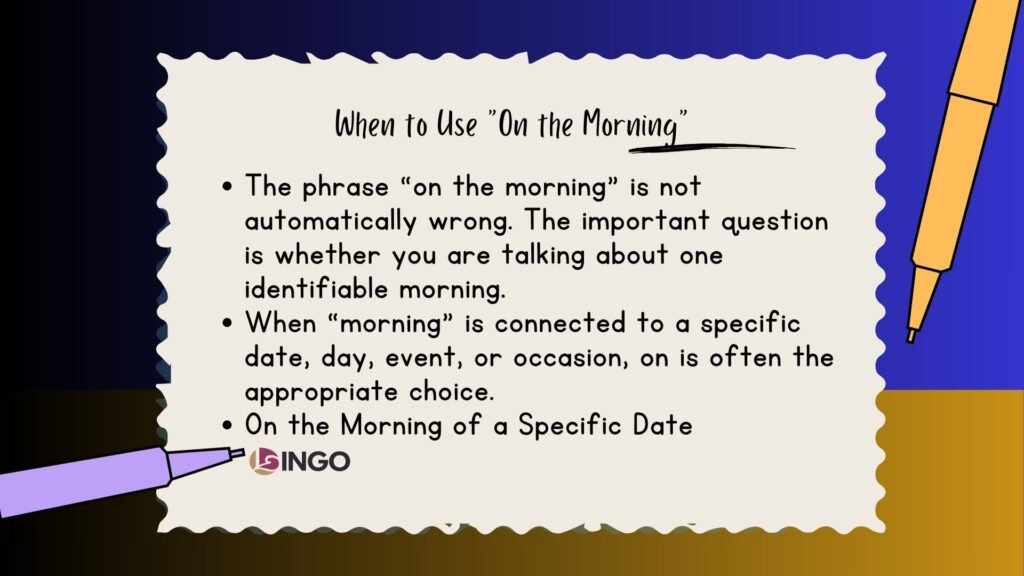
The phrase “on the morning” is not automatically wrong. The important question is whether you are talking about one identifiable morning.
When “morning” is connected to a specific date, day, event, or occasion, on is often the appropriate choice.
On the Morning of a Specific Date
Use:
on the morning of + date
Examples:
- On the morning of July 4, the streets were crowded.
- On the morning of March 12, the announcement was made.
- On the morning of December 25, the children opened their presents.
- On the morning of May 6, the team left for London.
Here, you’re not discussing mornings in general. You’re identifying one particular morning.
On the Morning of a Specific Event
You can also use on the morning of when the morning is associated with a particular event.
Examples:
- She was nervous on the morning of the exam.
- It started raining on the morning of the wedding.
- He received the news on the morning of the interview.
- Everyone arrived early on the morning of the ceremony.
- They prepared carefully on the morning of the competition.
The event tells the reader which morning you mean.
When “On the Morning” Is Followed by a Clause
Sometimes the specific morning is identified by a clause rather than a noun such as “the exam” or “July 4.”
For example:
- On the morning we left, it started snowing.
- On the morning she arrived, everyone was waiting.
- On the morning the results were announced, students gathered outside.
- On the morning he returned, the office was unusually quiet.
The clause identifies the particular morning.
Is “On the Morning” Correct by Itself?
This is where many learners become confused.
Saying:
I will call you on the morning.
sounds incomplete in ordinary English because the listener naturally expects more information.
Compare:
I will call you in the morning. ✅
with:
I will call you on the morning of the interview. ✅
The second sentence works because “the interview” identifies the particular morning.
Therefore, when “on the morning” appears, look for context that makes the morning specific.
In the Morning vs On the Morning: The Grammar Behind the Difference
The difference becomes easier when you understand how English uses prepositions of time.
In = a period of time
English commonly uses in for broader periods or parts of the day:
- in the morning
- in the afternoon
- in the evening
- in January
- in 2026
- in summer
The British Council’s grammar guidance specifically lists “in the morning,” “in the afternoon,” and “in the evening” under uses of in for parts of the day.
On = a particular day or date
English normally uses on with days and dates:
- on Monday
- on Friday
- on July 4
- on my birthday
- on Christmas Day
Cambridge also explains that on is used with dates and particular days.
When you say “on the morning of July 4,” the preposition is connected to the specific date. The phrase identifies one particular morning on that date.
At = an exact point
For completeness, remember at for particular clock times:
- at 6 a.m.
- at 7:30
- at noon
- at midnight
For example:
I woke up at 6 a.m. on Monday morning.
This sentence combines several time expressions naturally:
- at 6 a.m. → exact time
- on Monday → specific day
- in the morning → part of the day
The British Council and Cambridge both describe this broader at/in/on system for expressing time.
In the Morning vs On the Morning: Real-Life Examples
Example 1: Daily habit
I read the news in the morning.
This is a regular activity. You’re not referring to one particular date.
Example 2: A specific day
On the morning of Monday, September 7, I had an important meeting.
This refers to one particular morning connected to a specific date.
Example 3: A specific event
She felt nervous on the morning of her interview.
The interview identifies which morning you mean.
Example 4: General preference
I prefer studying in the morning.
This describes a general preference.
Example 5: One particular occasion
On the morning of the wedding, everyone was busy.
“The wedding” identifies a particular occasion and therefore a particular morning.
Example 6: An upcoming morning
I’ll finish the report in the morning.
This is natural when the exact date isn’t important or isn’t being emphasized.
Common Mistakes to Avoid
Mistake 1: Using “on” for every morning
Incorrect or unnatural:
I exercise on the morning.
Better:
I exercise in the morning.
If you’re describing a regular habit, use in.
Mistake 2: Using “in” with a specific morning
Less natural:
In the morning of July 10, the plane arrived.
Better:
On the morning of July 10, the plane arrived.
Because the morning is connected to a particular date, on is the better choice.
Mistake 3: Forgetting the identifying information
Consider:
She left on the morning.
This sounds incomplete unless the surrounding context already makes the particular morning obvious.
Better:
She left on the morning of the ceremony.
Or, if the specific morning doesn’t matter:
She left in the morning.
Mistake 4: Thinking “on the morning” is always incorrect
This is also a misconception.
“On the morning” can absolutely be correct. It simply has a more specific function.
For example:
On the morning of the exam, I woke up early.
This is completely natural because “the exam” identifies the morning.
A Simple Step-by-Step Guide to Choosing the Right Phrase
When you’re unsure about in the morning vs on the morning, use this quick test.
Step 1: Ask whether you’re talking about mornings generally
If yes, choose:
in the morning
Example:
I usually work in the morning.
Step 2: Ask whether you’re identifying one particular morning
If yes, consider:
on the morning of…
Example:
On the morning of the meeting, I arrived early.
Step 3: Look for a date
If there’s a specific date, on is usually appropriate.
On the morning of August 15, the store opened at 8 a.m.
Step 4: Look for an event
If a particular event identifies the morning, use on.
On the morning of the wedding, it began to rain.
Step 5: Check whether you mean an exact time
If you’re talking about a clock time, use at.
I woke up at 6 a.m..
You can combine these:
I woke up at 6 a.m. on the morning of the wedding.
Case Study: Choosing the Right Phrase in Everyday Communication
Imagine that Sara is preparing for an important job interview. She normally wakes up early and reviews her notes before starting work. When she describes her usual routine, she says, “I review my interview notes in the morning.” This is correct because she’s describing a general habit.
Now imagine that the interview finally arrives. Sara tells her friend about that particular day: “On the morning of my interview, I woke up at 6:00 a.m.” This time, on is appropriate because “my interview” identifies one specific morning.
Later, Sara explains what happened: “I usually feel calm in the morning, but I was nervous on the morning of the interview.” Both expressions are correct in the same sentence because they communicate two different ideas.
The first phrase describes her normal experience across mornings. The second identifies one particular morning connected to a specific event.
This example shows why memorizing only “in is correct” isn’t enough. The real skill is recognizing whether the morning is general or specific. Once you ask yourself “Which morning?” the correct preposition becomes much easier to choose.
2025–2026 Data: Why Small Grammar Choices Still Matter
There is no reliable 2025–2026 global dataset measuring how often people specifically search for or misuse “in the morning” versus “on the morning.” It would therefore be misleading to invent a phrase-specific percentage.
However, current language-learning data shows why clear explanations of everyday English remain useful.
A 2025 overview of English-language learning reported that roughly 1.5 billion people were learning English worldwide, citing British Council-related estimates. A 2025 academic publication likewise discussed approximately 1.5 billion people using English as a native, second, or foreign language.
The British Council also describes English as the most widely spoken language in the world, with more than 1.5 billion speakers, emphasizing its continuing role in international business and communication.
These figures don’t prove that one preposition is more frequently searched than another. They do demonstrate the enormous global audience for practical English instruction. For learners, mastering small distinctions such as in the morning vs on the morning can improve accuracy in emails, conversations, academic writing, and professional communication.
Quick Comparison: In the Morning vs On the Morning
| Feature | In the Morning | On the Morning |
|---|---|---|
| General meaning | General morning period | Particular morning |
| Daily routines | Yes | Usually no |
| General habits | Yes | Usually no |
| Specific date | Usually not | Yes |
| Specific event | Usually not | Yes |
| Common in conversation | Very common | Less common |
| Example | I exercise in the morning. | On the morning of the exam, I was nervous. |
The easiest memory trick
Think:
IN = general time
ON = specific day/morning
So:
I work in the morning.
But:
I worked on the morning of the conference.
This simple distinction will solve most situations.
Related Time Expressions You Should Know
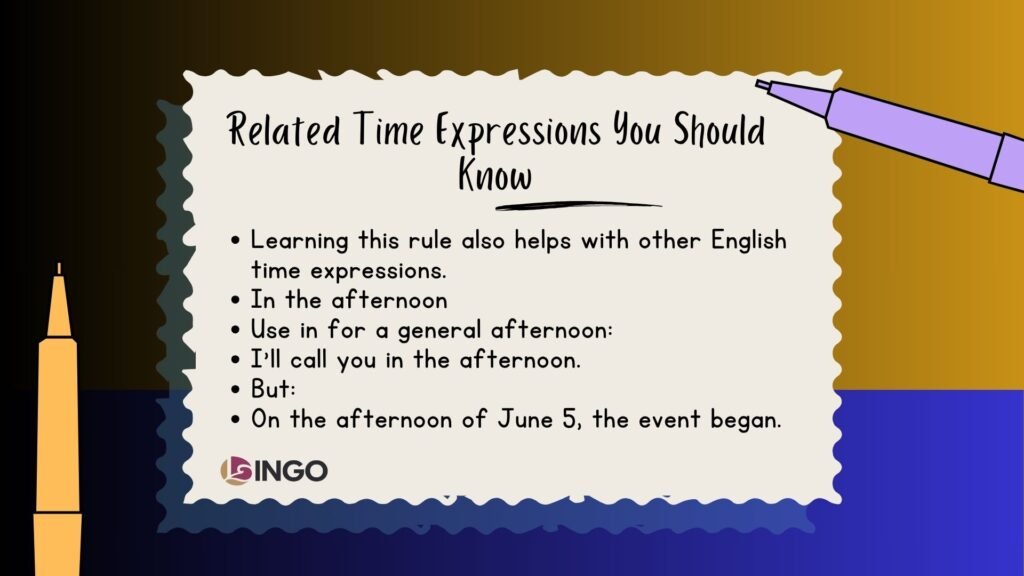
Learning this rule also helps with other English time expressions.
In the afternoon
Use in for a general afternoon:
I’ll call you in the afternoon.
But:
On the afternoon of June 5, the event began.
In the evening
General:
We usually watch television in the evening.
Specific:
On the evening of the ceremony, everyone gathered outside.
Cambridge specifically notes this general-versus-specific distinction for morning, afternoon, evening, and night.
On Monday morning
There’s another useful pattern:
I’ll see you on Monday morning.
Here, on belongs to Monday, the specific day. “Morning” simply describes which part of Monday you mean.
Compare:
I exercise in the morning.
I exercise on Monday morning.
Both are correct, but the second identifies a particular day.
Mini Quiz: In the Morning vs On the Morning
1. I usually drink coffee ____.
A) in the morning
B) on the morning
C) at the morning
D) by the morning
Answer: A) in the morning
2. Which sentence correctly refers to a specific morning connected to an exam?
A) I was nervous in the morning of the exam.
B) I was nervous on the morning of the exam.
C) I was nervous at the morning of the exam.
D) I was nervous by the morning of the exam.
Answer: B) on the morning of the exam
3. Choose the natural sentence for a general statement about productivity.
A) I am productive on the morning.
B) I am productive at the morning.
C) I am productive in the morning.
D) I am productive by the morning.
Answer: C) I am productive in the morning.
4. Which phrase correctly completes the sentence?
“____ of July 15, the roads were empty.”
A) In the morning
B) On the morning
C) At the morning
D) By the morning
Answer: B) On the morning
5. Which sentence describes a repeated morning routine?
A) She exercises in the morning.
B) She exercises on the morning.
C) She exercises at the morning.
D) She exercises by the morning.
Answer: A) She exercises in the morning.
6. Choose the correct sentence about one particular wedding day.
A) On the morning of the wedding, it rained.
B) In the morning of the wedding, it rained.
C) At the morning of the wedding, it rained.
D) By the morning of the wedding, it rained.
Answer: A) On the morning of the wedding, it rained.
7. Which sentence is most natural when the exact date is unimportant?
A) I’ll call you in the morning.
B) I’ll call you on the morning.
C) I’ll call you at the morning.
D) I’ll call you by the morning.
Answer: A) I’ll call you in the morning.
8. Which phrase correctly identifies the morning of a meeting?
A) in the morning of the meeting
B) on the morning of the meeting
C) at the morning of the meeting
D) by the morning of the meeting
Answer: B) on the morning of the meeting
9. Complete the sentence naturally:
“My children are usually energetic ____.”
A) in the morning
B) on the morning
C) at the morning
D) by the morning
Answer: A) in the morning
10. Which sentence correctly refers to a particular morning when someone arrived?
A) In the morning she arrived, everyone cheered.
B) On the morning she arrived, everyone cheered.
C) At the morning she arrived, everyone cheered.
D) By the morning she arrived, everyone cheered.
Answer: B) On the morning she arrived, everyone cheered.
11. Which sentence uses “in the morning” correctly?
A) We usually walk in the morning.
B) We usually walk on the morning.
C) We usually walk at the morning.
D) We usually walk by the morning.
Answer: A) We usually walk in the morning.
12. Which sentence is correct for a specific date?
A) In the morning of May 6, the team left.
B) On the morning of May 6, the team left.
C) At the morning of May 6, the team left.
D) By the morning of May 6, the team left.
Answer: B) On the morning of May 6, the team left.
13. Which expression is best for a general preference?
A) I prefer studying in the morning.
B) I prefer studying on the morning.
C) I prefer studying at the morning.
D) I prefer studying by the morning.
Answer: A) I prefer studying in the morning.
14. Which sentence correctly refers to the morning of a particular interview?
A) I felt nervous in the morning of my interview.
B) I felt nervous on the morning of my interview.
C) I felt nervous at the morning of my interview.
D) I felt nervous by the morning of my interview.
Answer: B) I felt nervous on the morning of my interview.
15. Choose the correct phrase:
“____, I usually check my email.”
A) In the morning
B) On the morning
C) At the morning
D) By the morning
Answer: A) In the morning
16. Which sentence correctly uses a day plus morning?
A) I’ll see you in Monday morning.
B) I’ll see you on Monday morning.
C) I’ll see you at Monday morning.
D) I’ll see you by Monday morning.
Answer: B) I’ll see you on Monday morning.
17. Which sentence describes a general morning condition?
A) The streets are quieter in the morning.
B) The streets are quieter on the morning.
C) The streets are quieter at the morning.
D) The streets are quieter by the morning.
Answer: A) The streets are quieter in the morning.
18. Which phrase is correct for a specific ceremony?
A) in the morning of the ceremony
B) on the morning of the ceremony
C) at the morning of the ceremony
D) by the morning of the ceremony
Answer: B) on the morning of the ceremony
19. Which sentence is best for a regular study habit?
A) I study English in the morning.
B) I study English on the morning.
C) I study English at the morning.
D) I study English by the morning.
Answer: A) I study English in the morning.
20. Which sentence correctly identifies one morning through a date?
A) In the morning of August 10, the flight departed.
B) On the morning of August 10, the flight departed.
C) At the morning of August 10, the flight departed.
D) By the morning of August 10, the flight departed.
Answer: B) On the morning of August 10, the flight departed.
21. Which sentence sounds most natural in everyday conversation?
A) I’ll see you in the morning.
B) I’ll see you on the morning.
C) I’ll see you at the morning.
D) I’ll see you by the morning.
Answer: A) I’ll see you in the morning.
22. Which sentence correctly contrasts a habit with a specific event?
A) I exercise in the morning, but I was tired on the morning of the race.
B) I exercise on the morning, but I was tired in the morning of the race.
C) I exercise at the morning, but I was tired by the morning of the race.
D) I exercise by the morning, but I was tired at the morning of the race.
Answer: A) I exercise in the morning, but I was tired on the morning of the race.
23. Which option correctly completes the sentence?
“____ of the conference, the speaker arrived early.”
A) In the morning
B) On the morning
C) At the morning
D) By the morning
Answer: B) On the morning
24. Which sentence correctly uses “in the morning” for an unspecified future time?
A) We’ll discuss the issue in the morning.
B) We’ll discuss the issue on the morning.
C) We’ll discuss the issue at the morning.
D) We’ll discuss the issue by the morning.
Answer: A) We’ll discuss the issue in the morning.
25. What is the easiest rule for choosing between the two expressions?
A) Use in for general mornings and on for specific mornings.
B) Use on for all mornings and in only for dates.
C) Use at for general mornings and on for clock times.
D) Use in and on interchangeably in every context.
Answer: A) Use in for general mornings and on for specific mornings.
Frequently Asked Questions
Q1:Is “in the morning” grammatically correct?
Yes. “In the morning” is the standard expression for referring to the morning as a general part of the day.
Q2:Is “on the morning” grammatically correct?
Yes, but it usually requires context identifying a particular morning. For example, “on the morning of the exam” is correct.
Q3:Should I say “in the morning of Monday”?
Generally, use “on the morning of Monday” or, more naturally, “on Monday morning.” When a particular date or day identifies the morning, on is appropriate.
Q4:Which is more common: “in the morning” or “on the morning”?
“In the morning” is much more common in ordinary conversation because people frequently discuss routines and general times of day. “On the morning” is more specific and often appears with a date, event, or identifying clause.
Q5:Can I say “on Monday morning”?
Yes. “On Monday morning” is completely correct. The preposition on refers to the specific day, Monday.
Q6:Can I say “at the morning”?
Normally, no. For a general morning, use “in the morning.” Use at for specific clock times, such as “at 7 a.m.”
Q7:What is the easiest way to remember the rule?
Remember:
General morning = in
Specific morning = on
For example:
I study in the morning.
I studied on the morning of my exam.
Q8:Is “in the morning” used in both American and British English?
Yes. “In the morning” is standard in both major varieties of English. The basic distinction between general parts of the day and specific days or dates is widely recognized.
Conclusion
The difference between in the morning vs on the morning becomes simple once you focus on specificity.
Use “in the morning” when you’re talking about the morning generally, including routines, habits, preferences, and unspecified morning activities:
I exercise in the morning.
Use “on the morning” when you’re identifying one particular morning, especially when it is connected to a date, day, event, or occasion:
On the morning of the exam, I woke up early.
The key question to ask yourself is: “Am I talking about mornings in general, or which particular morning?”
If the meaning is general, choose in. If you’re identifying a specific morning, on is usually the right choice.
For more clear explanations of commonly confused English words and grammar rules, explore the other language guides on Lingorixa.
References
- Cambridge Dictionary — At, on and in (time)
- British Council LearnEnglish — Prepositions of time: at, in, on

Maimoona Asghar is a grammar enthusiast and language writer who creates clear, practical content to help learners improve English grammar, writing, punctuation, and communication skills through easy-to-understand explanations and examples.