Introduction
Hasn’t vs haven’t can look like a tiny grammar question, but choosing the wrong one can make an otherwise good sentence sound incorrect.
Should you say “She hasn’t finished” or “She haven’t finished”? Is it “They haven’t arrived” or “They hasn’t arrived”?
The answer becomes easy once you focus on the subject.
The basic rule is simple:
- Hasn’t = has not → use with he, she, it, and singular third-person nouns
- Haven’t = have not → use with I, you, we, they, and plural nouns
This guide explains hasn’t vs haven’t with straightforward rules, examples, a comparison table, common mistakes, and a practical memory trick.
Hasn’t vs Haven’t: What Is the Difference?
The difference between hasn’t and haven’t is mainly a matter of subject-verb agreement. Both are negative contractions, but they pair with different subjects.
Hasn’t means “has not”
Hasn’t is the contraction of has not.
Use it with:
- He
- She
- It
- Singular third-person nouns
Examples:
- She hasn’t called me yet.
- He hasn’t finished his homework.
- The dog hasn’t eaten its food.
- Maria hasn’t replied to the email.
- The computer hasn’t started.
The important point is that the subject is singular and in the third person.
Haven’t means “have not”
Haven’t is the contraction of have not.
Use it with:
- I
- You
- We
- They
- Plural nouns
Examples:
- I haven’t finished yet.
- You haven’t answered my question.
- We haven’t seen that movie.
- They haven’t arrived.
- The students haven’t completed the assignment.
Cambridge Grammar gives the same basic pattern: have/has changes according to the subject, with haven’t and hasn’t as their negative contractions.
The Easiest Rule for Hasn’t vs Haven’t
If you remember only one thing from this article, remember this:
He, she, it → hasn’t
I, you, we, they → haven’t
Use “hasn’t” with he, she, and it
Think of hasn’t as the “one-person or one-thing” form.
| Subject | Correct form | Example |
|---|---|---|
| He | hasn’t | He hasn’t arrived. |
| She | hasn’t | She hasn’t called. |
| It | hasn’t | It hasn’t stopped raining. |
| Ali | hasn’t | Ali hasn’t replied. |
| The car | hasn’t | The car hasn’t started. |
For example:
Incorrect: She haven’t finished her work.
Correct: She hasn’t finished her work.
Use “haven’t” with I, you, we, and they
Now think of haven’t as the form used with everyone else in the present-tense pattern.
| Subject | Correct form | Example |
|---|---|---|
| I | haven’t | I haven’t eaten. |
| You | haven’t | You haven’t changed. |
| We | haven’t | We haven’t decided. |
| They | haven’t | They haven’t arrived. |
| The boys | haven’t | The boys haven’t left. |
So:
Incorrect: They hasn’t arrived yet.
Correct: They haven’t arrived yet.
A quick memory trick
Try this:
HAS → HE, SHE, IT
HAVE → I, YOU, WE, THEY
Then simply add not:
HAS + NOT = HASN’T
HAVE + NOT = HAVEN’T
This small pattern is enough to solve most hasn’t vs haven’t questions.
When Should You Use Hasn’t or Haven’t in the Present Perfect?
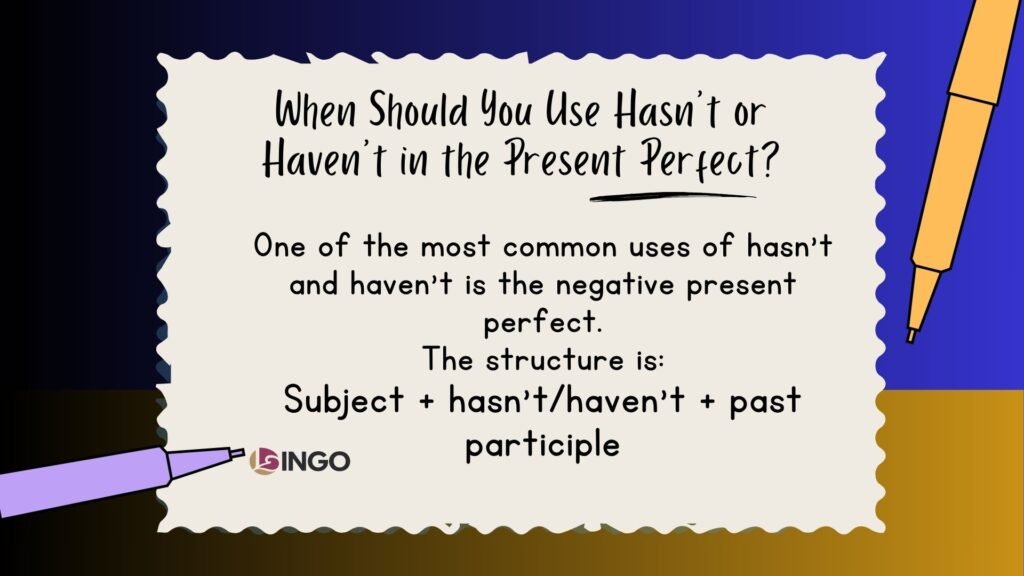
One of the most common uses of hasn’t and haven’t is the negative present perfect.
The structure is:
Subject + hasn’t/haven’t + past participle
For example:
- She hasn’t finished.
- He hasn’t called.
- I haven’t eaten.
- We haven’t decided.
- They haven’t arrived.
The present perfect is commonly used for past actions or states that remain connected to the present. The British Council explains that it can describe experiences, unfinished periods, and past actions with present results.
Hasn’t + past participle
Use:
He/she/it + hasn’t + past participle
Examples:
- She hasn’t seen the message.
- He hasn’t done his work.
- It hasn’t stopped raining.
- My brother hasn’t returned home.
- The teacher hasn’t given us the results.
Notice that the verb after hasn’t is normally in its past participle form.
Haven’t + past participle
Use:
I/you/we/they + haven’t + past participle
Examples:
- I haven’t seen that movie.
- You haven’t finished your work.
- We haven’t received the package.
- They haven’t spoken to the manager.
- The children haven’t eaten lunch.
A common mistake is to use the simple past instead of the past participle:
Incorrect: She hasn’t went home.
Correct: She hasn’t gone home.
Incorrect: They haven’t saw it.
Correct: They haven’t seen it.
“Yet” often appears with hasn’t and haven’t
In negative present perfect sentences, yet is frequently used when something was expected but has not happened up to now.
Examples:
- She hasn’t arrived yet.
- I haven’t finished yet.
- They haven’t called yet.
- We haven’t received the email yet.
The British Council specifically notes the use of the present perfect with words such as yet, already, just, recently, and still.
Hasn’t vs Haven’t: Common Mistakes to Avoid
Understanding the rule is easy. Applying it quickly while speaking or writing is where mistakes often happen.
Mistake 1: Using “haven’t” with he or she
Incorrect: He haven’t finished the report.
Correct: He hasn’t finished the report.
Why? He is third-person singular, so it takes has, not have.
Another example:
Incorrect: Sarah haven’t called yet.
Correct: Sarah hasn’t called yet.
Sarah is one person, so hasn’t is required.
Mistake 2: Using “hasn’t” with they or we
Incorrect: They hasn’t arrived.
Correct: They haven’t arrived.
Incorrect: We hasn’t decided.
Correct: We haven’t decided.
Although we and they can refer to multiple people, the important grammar pattern is that they take have, not has.
Mistake 3: Forgetting that “you” takes “have”
This one surprises some learners because you can refer to one person or several people.
Still, the correct form is always:
You haven’t…
Examples:
- You haven’t told me the truth.
- You haven’t finished your assignment.
- You haven’t seen this before.
Not:
- You hasn’t told me.
- You hasn’t finished.
Mistake 4: Using the wrong verb form afterward
Remember:
hasn’t/haven’t + past participle
Examples:
- She hasn’t gone.
- They haven’t seen it.
- He hasn’t written the letter.
- We haven’t finished.
Avoid forms such as:
- She hasn’t went.
- They haven’t saw.
- He hasn’t wrote.
The problem in those sentences is not the choice between hasn’t and haven’t. The problem is the verb form that follows.
A Real-Life Example: How One Subject Changes the Entire Sentence
Imagine a teacher checking assignments on Monday morning.
First, the teacher looks at Emma’s desk. Emma is one student, so the teacher says:
“Emma hasn’t submitted her assignment.”
Next, the teacher checks the work of several students. Now the subject is plural:
“The students haven’t submitted their assignments.”
Then the teacher talks directly to one student:
“You haven’t submitted your assignment.”
Finally, the teacher talks about herself and another teacher:
“We haven’t received all the assignments.”
Nothing about the basic meaning of “not yet submitted” has changed. What changes is the subject, and the subject determines whether we use hasn’t or haven’t.
This is why trying to memorize dozens of separate sentences is unnecessary. Instead, identify the subject first.
If the subject is he, she, it, or a singular third-person noun, choose hasn’t.
If the subject is I, you, we, they, or a plural noun, choose haven’t.
This approach is particularly useful when sentences become longer:
“The new student from our evening class hasn’t submitted the form yet.”
The subject is the new student, which is singular. Therefore, hasn’t is correct.
Compare that with:
“The new students from our evening class haven’t submitted the forms yet.”
Now the subject is students, which is plural. Therefore, haven’t is correct.
The difference is only one letter in the auxiliary verb, but it changes whether the sentence follows standard subject-verb agreement.
2025–2026 Language-Learning Data: Why Small Grammar Rules Matter
There is no reliable 2025–2026 global dataset that specifically counts how often English learners confuse hasn’t and haven’t. It would be misleading to invent such a statistic.
However, current education data shows why clear English grammar instruction remains important.
English is a major global learning language
The British Council has reported an estimated 1.5 billion English learners worldwide, illustrating the enormous global demand for English learning.
More recent British Council material likewise describes English as having more than 1.5 billion speakers worldwide, emphasizing its role in international communication.
Language remains central to education
UNESCO’s 2025 language-education guidance reports that 40% of people globally lack access to education in a language they speak and understand fluently, with more than a quarter of a billion learners affected. UNESCO also emphasizes the importance of language for learning and educational outcomes.
For English learners, that broader context matters: small grammar distinctions such as hasn’t vs haven’t are building blocks of accurate communication. Mastering them helps learners write clearer sentences, understand English more confidently, and avoid repeated subject-verb agreement errors.
Hasn’t vs Haven’t Comparison Table
The fastest way to review the difference is to compare the forms side by side.
Quick comparison
| Form | Meaning | Use with | Example |
|---|---|---|---|
| hasn’t | has not | he, she, it, singular noun | She hasn’t called. |
| haven’t | have not | I, you, we, they, plural noun | They haven’t called. |
Step-by-step method
When you’re unsure, use these three steps:
Step 1: Find the subject.
Example:
The manager ___ replied.
The subject is manager.
Step 2: Decide whether the subject is singular or plural.
“Manager” means one person, so it is singular.
Step 3: Choose has or have.
Singular third-person → has
Therefore:
The manager hasn’t replied.
Try another:
The managers ___ replied.
The subject is managers, which is plural.
Plural → have
Therefore:
The managers haven’t replied.
This three-step approach works even when the sentence is long.
FAQs About Hasn’t vs Haven’t
Q1:Is “hasn’t” correct?
Yes. Hasn’t is the standard contraction of has not. It is used with he, she, it, and singular third-person nouns.
Example: She hasn’t finished her work.
Q2:Is “haven’t” correct?
Yes. Haven’t is the contraction of have not. It is used with I, you, we, they, and plural nouns.
Example: They haven’t finished their work.
Q3:What is the difference between hasn’t and haven’t?
Both mean “has/have not,” but they take different subjects. Hasn’t goes with he, she, it, and singular third-person nouns. Haven’t goes with I, you, we, they, and plural nouns.
Q4:Is it “he hasn’t” or “he haven’t”?
The correct form is he hasn’t.
Example:
He hasn’t arrived yet.
“He” is third-person singular, so it takes has.
Q5:Is it “they hasn’t” or “they haven’t”?
The correct form is they haven’t.
Example:
They haven’t arrived yet.
“They” takes have, so the negative contraction is haven’t.
Q6:Do you say “I hasn’t” or “I haven’t”?
The correct form is I haven’t.
Example:
I haven’t finished my homework.
Although “I” refers to one person, English uses have with “I.”
Q7:Can hasn’t and haven’t be used with the present perfect?
Yes. They are frequently used to form negative present perfect sentences.
Examples:
- She hasn’t finished.
- He hasn’t called.
- I haven’t finished.
- They haven’t arrived.
The basic pattern is subject + hasn’t/haven’t + past participle.
Q8:What is an easy way to remember hasn’t vs haven’t?
Remember:
He, She, It → HASN’T
I, You, We, They → HAVEN’T
Then check the verb that follows. In present perfect constructions, use the past participle:
She hasn’t gone.
They haven’t gone.
Conclusion
The difference between hasn’t vs haven’t is much simpler than it first appears.
Use hasn’t with he, she, it, and singular third-person nouns:
She hasn’t arrived.
Use haven’t with I, you, we, they, and plural nouns:
They haven’t arrived.
When you’re unsure, don’t guess based on how the sentence sounds. Find the subject first. Then ask whether that subject takes has or have.
Once you remember “He, she, it → hasn’t” and “I, you, we, they → haven’t,” this common grammar problem becomes much easier.
Now try applying the rule to your own writing. Find three sentences you’ve written recently and check every hasn’t and haven’t. That quick habit can make your English more accurate almost immediately.
For more clear explanations of commonly confused English words and grammar rules, explore the other language guides on Lingorixa.
References

Maimoona Asghar is a grammar enthusiast and language writer who creates clear, practical content to help learners improve English grammar, writing, punctuation, and communication skills through easy-to-understand explanations and examples.