
Have you ever wondered whether to say involved with or involved in? Both expressions are grammatically correct, but they communicate slightly different meanings. Choosing the wrong preposition can make your sentence confusing or change the message you want to express.
The difference between involved with and involved in mainly depends on the relationship you want to describe. We generally use involved in when talking about activities, events, situations, responsibilities, or experiences. On the other hand, involved with often describes a connection, association, relationship, or ongoing interaction with a person or organization.
In this guide, you’ll learn what each expression means, when to use it, how the two phrases differ, and how to avoid common grammar mistakes.
What Does Involved In Mean?
Involved in means participating in, taking part in, or being connected to a particular activity, event, situation, process, or experience.
It emphasizes someone’s participation or position within something.
Examples:
- Sarah is involved in a community project.
- He was involved in the investigation.
- My brother is involved in several business activities.
- They are involved in organizing the annual event.
In each sentence, the expression describes participation or connection to an activity or situation.
When to Use Involved In
Use involved in when discussing activities, events, responsibilities, and experiences.
1. Activities and projects
When someone participates in a particular activity or project, involved in is usually appropriate.
Examples:
- She is involved in a research project.
- I’m involved in planning the company event.
- They are involved in developing a new application.
2. Events and situations
Use this expression when someone participates in or becomes connected to an event or situation.
Examples:
- Several employees were involved in the meeting.
- He was involved in a serious accident.
- The students were involved in a school competition.
3. Work and responsibilities
The expression also describes someone’s professional responsibilities or duties.
Examples:
- My manager is involved in the hiring process.
- She is involved in managing daily operations.
- John is involved in preparing financial reports.
More Examples of Involved In
- My parents are involved in local community activities.
- She became involved in volunteer work during college.
- The company is involved in international trade.
- He doesn’t want to get involved in unnecessary arguments.
- Several people were involved in the decision-making process.
Quick tip: If you’re describing participation in an activity, project, event, or situation, involved in is generally the better choice.
What Does Involved With Mean?
Involved with describes having a connection, relationship, association, or ongoing interaction with someone or something.
It can refer to people, organizations, businesses, groups, or professional activities.
Examples:
- She is involved with a local charity.
- He is involved with a successful business.
- I’m involved with several community organizations.
- Sarah is romantically involved with David.
The expression emphasizes the connection or association rather than simply participation in an activity.
When to Use Involved With
Use involved with in these common situations.
1. Relationships with people
This phrase frequently describes personal, emotional, or romantic relationships.
Examples:
- She is involved with someone from her university.
- He became romantically involved with his colleague.
- I don’t want to get involved with people who create unnecessary problems.
2. Organizations and groups
Use involved with when describing an association with an organization, institution, or group.
Examples:
- My sister is involved with a local charity.
- He has been involved with the organization for years.
- They are involved with several educational institutions.
3. Professional connections
The expression can also describe professional relationships or ongoing associations.
Examples:
- Our company is involved with several international partners.
- She is involved with a marketing agency.
- I’m currently involved with a software development team.
More Examples of Involved With
- He has been involved with the organization since 2020.
- Maria is involved with environmental protection groups.
- I’m not involved with that company anymore.
- The teacher is deeply involved with her students.
- They became involved with a community support program.
Quick tip: If your sentence focuses on a relationship, association, or connection with someone or something, involved with is often appropriate.
Involved With or Involved In: What Is the Difference?
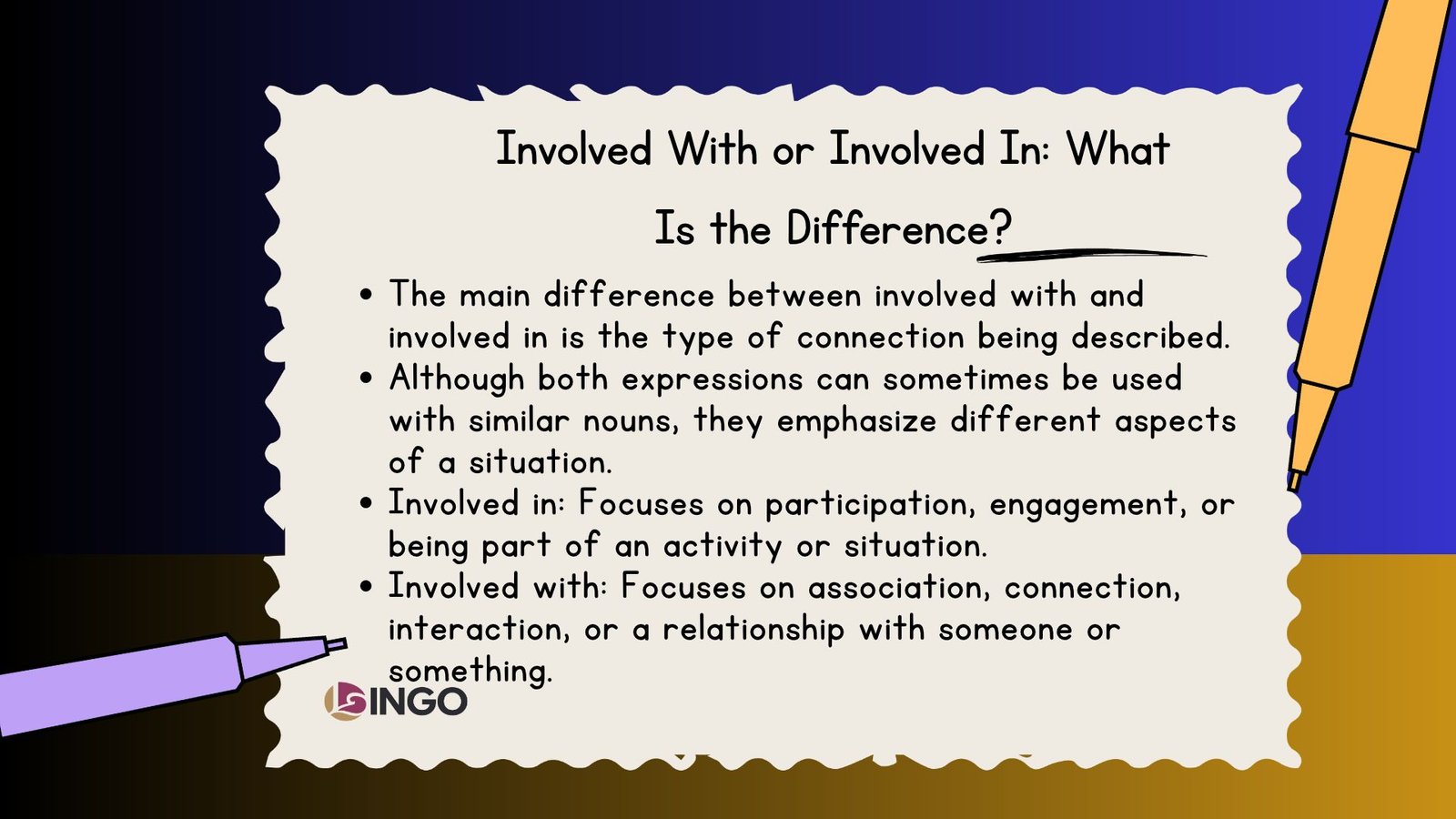
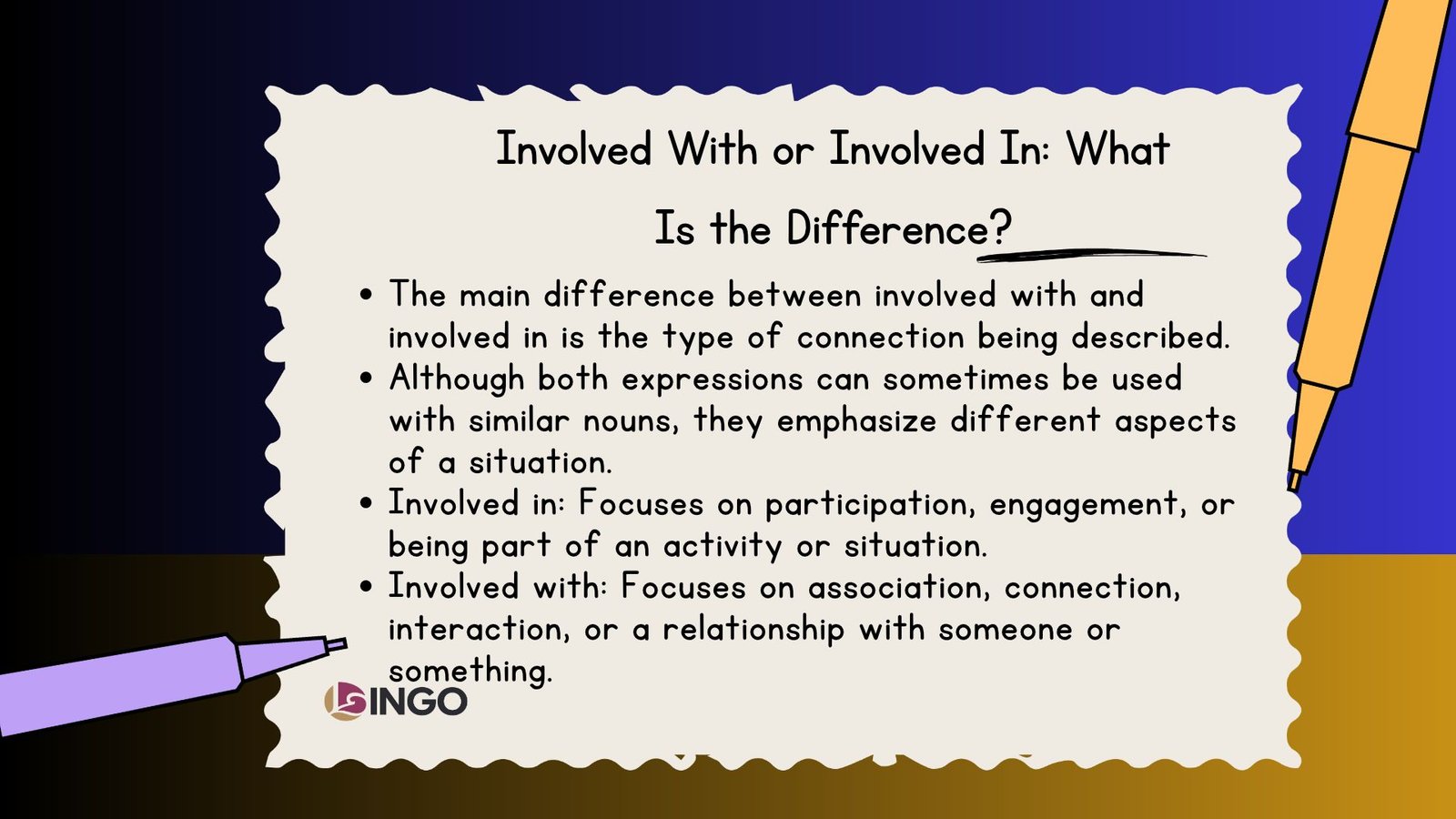
The main difference between involved with and involved in is the type of connection being described.
Although both expressions can sometimes be used with similar nouns, they emphasize different aspects of a situation.
- Involved in: Focuses on participation, engagement, or being part of an activity or situation.
- Involved with: Focuses on association, connection, interaction, or a relationship with someone or something.
For example:
- She is involved in a charity project.
- She is involved with a charity organization.
Both sentences are correct. However, the first emphasizes her participation in a project, while the second emphasizes her association with the organization.
Involved With vs. Involved In Comparison Table
| Feature | Involved In | Involved With |
|---|---|---|
| Main meaning | Participation | Connection or association |
| Common use | Activities and events | People and organizations |
| Focus | Being part of something | Having a relationship with something |
| Work context | Tasks and responsibilities | Professional associations |
| Personal context | Situations or experiences | Personal relationships |
| Example | Involved in research | Involved with a research organization |
Examples That Show the Difference
Example 1: Charity
- She is involved in fundraising activities.
- She is involved with a charity organization.
The first sentence describes participation in fundraising. The second describes her connection with the charity.
Example 2: Business
- He is involved in running the business.
- He is involved with a technology company.
The first sentence highlights his responsibilities. The second highlights his association with the company.
Example 3: Relationships
- She is involved in a complicated situation.
- She is involved with a married man.
The first sentence describes participation in or connection to a situation. The second describes a personal or romantic relationship.
Can You Use Both Expressions With the Same Noun?
Yes. Sometimes both prepositions work with the same noun, but the intended meaning changes.
For example:
- I am involved in the organization.
This suggests that I participate in its activities or operations.
- I am involved with the organization.
This suggests that I have a connection or association with it.
Therefore, don’t choose a preposition based only on the noun. Consider what you want to communicate.
Common Grammar Mistakes With Involved With and Involved In
Even experienced English speakers sometimes confuse these expressions. A few simple rules can help you avoid common mistakes.
Using Involved With for Every Situation
One common mistake is using involved with whenever someone participates in an activity.
Less natural:
- She is involved with organizing the conference.
More natural:
- She is involved in organizing the conference.
When describing participation in an activity, involved in is generally the preferred construction.
Using Involved In for Personal Relationships
Another mistake is using involved in when you want to describe a romantic relationship with someone.
Incorrect:
- She is involved in John.
Correct:
- She is involved with John.
The preposition with is used to identify the person involved in the relationship.
Forgetting the -ing Form After Involved In
When involved in is followed by an action, use the gerund form of the verb.
Correct examples:
- He is involved in writing reports.
- They are involved in organizing events.
- She is involved in managing the project.
Incorrect examples:
- He is involved in write reports.
- They are involved in organize events.
Remember that in is a preposition, so a verb following it normally takes the -ing form.
Confusing Association With Participation
Sometimes writers use involved with when they actually mean participation in a specific task.
Compare:
- I’m involved in developing the website.
- I’m involved with the web development company.
The first sentence describes what you do. The second describes the organization or company with which you have a connection.
Real-Life Example: Choosing the Correct Preposition at Work
Imagine that Emma works for a growing technology company. Her responsibilities include managing projects, communicating with clients, and coordinating a small development team.
One day, she writes a professional introduction for a business meeting:
“I’m involved with developing new software and involved in several technology companies.”
Although readers might understand her intention, the sentence does not communicate her responsibilities and professional relationships clearly.
Let’s improve it.
Situation 1: Describing her responsibilities
Emma wants to explain that she helps develop software.
Better sentence:
“I’m involved in developing new software.”
Here, involved in is appropriate because software development is an activity in which Emma participates.
Situation 2: Describing her professional association
Emma also wants to explain that she has connections with several technology companies.
Better sentence:
“I’m involved with several technology companies.”
In this sentence, involved with describes her professional associations.
Situation 3: Describing a project
Emma is also working on a new application with other developers.
Better sentence:
“I’m involved in a software development project.”
This construction emphasizes her participation in a specific project.
Situation 4: Describing a business relationship
Emma works closely with a company that provides technical support.
Better sentence:
“I’m involved with a company that provides technical support.”
This sentence highlights her connection with the company.
What can we learn from Emma’s example?
The correct preposition depends on the intended meaning, not simply the words that follow it. Involved in emphasizes participation, while involved with emphasizes association or connection.
This distinction is especially useful in professional emails, business introductions, resumes, academic writing, and everyday conversations.
Usage Trends and Grammar Evidence: 2025–2026
When researching English grammar, it’s important to distinguish actual language usage from unsupported statistics.
There is no reliable, universally accepted 2025–2026 statistic establishing a fixed percentage of English speakers who use involved with or involved in. Therefore, assigning numerical popularity percentages to these expressions would be misleading.
However, dictionary evidence provides a reliable way to understand their usage.
What Dictionary Evidence Shows
The Cambridge Dictionary distinguishes several meanings:
- Be involved in something describes participation in an activity or event.
- Be involved with something describes taking part in or being connected with something.
- Be involved with someone can describe a close or romantic relationship.
These distinctions confirm that both expressions are established English constructions with different contextual meanings.
Why Context Matters More Than Popularity
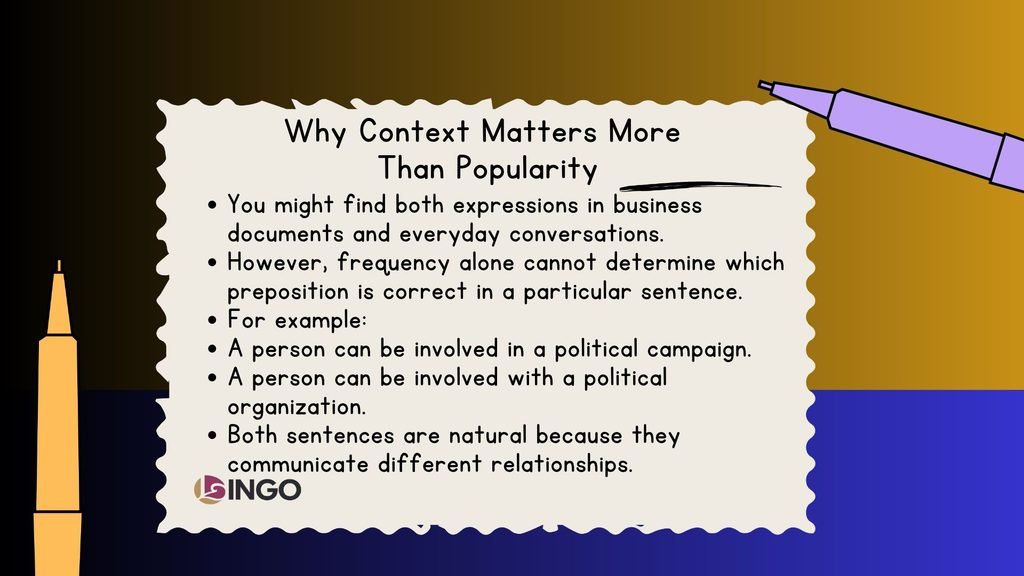
You might find both expressions in business documents, news articles, academic writing, and everyday conversations.
However, frequency alone cannot determine which preposition is correct in a particular sentence.
For example:
- A person can be involved in a political campaign.
- A person can be involved with a political organization.
Both sentences are natural because they communicate different relationships.
For accurate writing in 2025–2026 and beyond, focus on meaning, sentence structure, and established dictionary usage rather than trying to memorize a supposed popularity ranking.
How to Choose Between Involved With and Involved In
If you’re unsure which expression to use, follow these simple steps.
Step 1: Identify What You’re Describing
Ask yourself whether you’re talking about an activity, situation, person, or organization.
- Activity or event: Usually involved in.
- Personal relationship: Usually involved with.
- Organization: Either, depending on meaning.
Step 2: Focus on the Intended Meaning
Think about what you want your reader to understand.
If you mean participation, choose involved in.
If you mean association or a relationship, choose involved with.
Step 3: Check the Sentence Structure
When a verb follows involved in, it generally takes the -ing form.
Examples:
- Correct: She is involved in teaching.
- Correct: He is involved in managing the business.
- Incorrect: She is involved in teach.
Step 4: Read Your Sentence Again
Check whether the preposition communicates your intended meaning.
For example:
- I’m involved in organizing the event.
- I’m involved with the event organizers.
Both sentences are correct, but they describe different connections.
Mini Quiz:Involved With or Involved In
1. She is involved ___ a community project.
A) with
B) in
C) at
D) on
Answer: B) in
2. He is involved ___ a local charity organization.
A) in
B) at
C) with
D) on
Answer: C) with
3. Which sentence is correct?
A) I am involved in a school activity.
B) I am involved at a school activity.
C) I am involved on a school activity.
D) I am involved for a school activity.
Answer: A) I am involved in a school activity.
4. Sarah is involved ___ several business projects.
A) with
B) in
C) at
D) by
Answer: B) in
5. He is romantically involved ___ his colleague.
A) in
B) at
C) with
D) on
Answer: C) with
6. Which phrase describes participation in an activity?
A) Involved with
B) Involved in
C) Involved at
D) Involved on
Answer: B) Involved in
7. I don’t want to get involved ___ their argument.
A) with
B) on
C) in
D) at
Answer: C) in
8. She works with several charities and is involved ___ them.
A) in
B) with
C) at
D) on
Answer: B) with
9. Which sentence is grammatically correct?
A) He involved in the discussion.
B) He is involved in the discussion.
C) He is involved at the discussion.
D) He involving in the discussion.
Answer: B) He is involved in the discussion.
10. They are involved ___ developing a new product.
A) in
B) with
C) at
D) for
Answer: A) in
11. Choose the correct sentence.
A) She is involved with a nonprofit organization.
B) She is involved at a nonprofit organization.
C) She is involved on a nonprofit organization.
D) She is involved by a nonprofit organization.
Answer: A) She is involved with a nonprofit organization.
12. Which preposition usually describes a connection or association?
A) In
B) With
C) At
D) On
Answer: B) With
13. He became involved ___ the investigation.
A) with
B) at
C) in
D) on
Answer: C) in
14. Are you involved ___ any professional groups?
A) in
B) with
C) at
D) by
Answer: B) with
15. Which sentence is incorrect?
A) She is involved in research.
B) He is involved with the company.
C) They are involved in planning the event.
D) She involved with a project.
Answer: D) She involved with a project.
16. I am actively involved ___ organizing the conference.
A) with
B) in
C) at
D) on
Answer: B) in
17. Select the two correct sentences.
A) He is involved in politics.
B) He is involved at politics.
C) She is involved with the organization.
D) She is involved on the organization.
Answer: A and C
18. Which two examples correctly use “involved with”?
A) I am involved with a local business.
B) She is involved with her new partner.
C) He is involved with completing the assignment.
D) They are involved with organizing the event.
Answer: A and B
19. True or False: “Involved in” can describe participation in an activity.
Answer: True
20. True or False: “Involved with” can describe a personal relationship.
Answer: True
21. The students are involved ___ a science competition.
A) with
B) in
C) at
D) on
Answer: B) in
22. She has been involved ___ this organization for five years.
A) with
B) at
C) on
D) by
Answer: A) with
23. Choose the correct sentence.
A) They are involved in making important decisions.
B) They are involved at making important decisions.
C) They are involved on making important decisions.
D) They are involved for making important decisions.
Answer: A) They are involved in making important decisions.
24. What does “involved with a company” usually suggest?
A) Participating in a specific event
B) Having a connection or association with the company
C) Leaving the company
D) Avoiding the company
Answer: B) Having a connection or association with the company
25. Choose the best option: “The police believe he was involved ___ the crime.”
A) with
B) at
C) in
D) on
Answer: C) in
Frequently Asked Questions (FAQs)
Q1: Is It Involved With or Involved In?
Both expressions are grammatically correct. Use involved in when describing participation in an activity, project, or situation. Use involved with when describing a relationship, association, or connection with someone or something.
Q2: Is Involved With a Person or Involved In a Person?
Use involved with a person when describing a personal or romantic relationship.
Example: She is involved with a man from her university.
Involved in a person is generally incorrect for this meaning.
Q3: Can You Say Involved With a Company?
Yes. Involved with a company describes having a professional, business, or other association with that company.
Example: My brother is involved with an international technology company.
Q4: Should I Say Involved in a Project or Involved With a Project?
Both expressions can be correct, depending on context.
- Involved in a project emphasizes active participation.
- Involved with a project emphasizes a connection or association with it.
For example, “She is involved in the project” is a natural choice when describing her participation.
Q5: Is Involved With Always Romantic?
No. Although involved with frequently describes romantic relationships, it also describes professional, social, and organizational connections.
Examples:
- He is involved with a local charity.
- She is involved with a business partner.
- They are involved with a community organization.
Q6: Is It Correct to Say Involved in Doing Something?
Yes. Involved in doing something is grammatically correct because the preposition in is followed by a gerund (the -ing form of a verb).
Examples:
- I’m involved in organizing the event.
- She is involved in preparing the documents.
- They are involved in building a new website.
Q7: What Is the Difference Between Involved In and Associated With?
Involved in generally emphasizes participation in an activity or situation.
Associated with emphasizes a connection or relationship with someone or something.
For example:
- He is involved in the investigation.
- He is associated with the organization.
Q8: Which Expression Is Better for Professional Writing?
Both expressions are suitable for professional writing. Choose involved in when describing responsibilities, projects, or activities. Choose involved with when describing professional relationships, organizations, or business connections.
Conclusion
Understanding the difference between involved with and involved in becomes easier when you focus on the meaning of your sentence.
Use involved in when discussing participation in activities, projects, events, responsibilities, or situations. Use involved with when describing relationships, associations, or connections with people and organizations.
Remember these simple examples:
- I’m involved in managing a project.
- I’m involved with a professional organization.
- She is involved in community activities.
- She is involved with a local charity.
Both expressions are correct, but they aren’t always interchangeable.
The best way to improve your English is to practice using these phrases in everyday conversations and writing. Pay attention to the relationship you’re describing, and you’ll find it much easier to choose the right preposition.
For more clear explanations of commonly confused English words and grammar rules, explore the other language guides on Lingorixa.
References

Maimoona Asghar is a grammar enthusiast and language writer who creates clear, practical content to help learners improve English grammar, writing, punctuation, and communication skills through easy-to-understand explanations and examples.

