Have you ever seen someone share a long, dramatic rant online, only for another person to respond, “Sir, this is a Wendy’s”? If you have, you have encountered one of the internet’s most recognizable sarcastic catchphrases. The “Sir This Is a Wendy’s” meme is a humorous way to point out that someone is saying something strange, irrelevant, overly personal, or completely inappropriate for the situation.
The joke works because it imagines a person delivering an intense speech in an ordinary fast-food restaurant, where an employee simply wants to take an order. Instead of arguing with the person, the employee reminds them that they are in the wrong setting for that conversation.
In this guide, you will discover what the meme means, where it came from, how it became popular, and how to use it naturally in everyday online conversations.
What Does the “Sir This Is a Wendy’s” Meme Mean?
The “Sir This Is a Wendy’s” meme is an internet catchphrase used to respond humorously to comments that seem out of place, excessive, confusing, or irrelevant to the conversation.
Rather than directly telling someone to stop talking, the phrase suggests that their speech is inappropriate for the setting. The humor comes from the contrast between the speaker’s seriousness and the ordinary situation in which they supposedly find themselves.
The Simple Meaning Behind the Phrase
In plain English, the phrase roughly means:
- “This is not the right place for that conversation.”
- “Why are you telling me this?”
- “You are taking this way too seriously.”
- “That comment has nothing to do with what we are discussing.”
For example, imagine someone enters a group chat about lunch and starts writing a lengthy speech about their complicated political theories. Another person might reply, “Sir, this is a Wendy’s.”
The response does not necessarily mean the original statement is false. It suggests that the statement is excessive or unsuitable for the context.
Why Is the Wendy’s Reference Funny?
The reference to Wendy’s, an American fast-food restaurant chain, makes the joke more vivid. A fast-food counter is an ordinary place where customers generally order food, not where they deliver dramatic speeches or share unrelated personal stories.
The unexpected contrast creates the humor. The phrase also sounds like a polite correction, even though it can be a sarcastic way of shutting down a conversation.
For example:
Person A: “I have prepared a 40-minute explanation of why my favorite superhero could defeat every fictional character.”
Person B: “Sir, this is a Wendy’s.”
The reply makes the situation funny by treating an exaggerated statement as though it were happening at a restaurant counter.
Is It Always an Insult?
No. The phrase can be playful, sarcastic, dismissive, or mildly critical depending on the context.
Friends may use it to tease each other without causing offense. However, strangers may interpret it as an attempt to embarrass them or dismiss their opinions.
Therefore, understanding the relationship between the people involved is important before using the meme.
Where Did the “Sir This Is a Wendy’s” Meme Originate?
The meme’s history involves an earlier television joke, an Arby’s variation, and the growth of social media humor. Although the exact phrase became popular online, its origins are commonly associated with a scene from the American television comedy The Office.
The Connection to The Office
In the Season 4 episode “Chair Model,” which aired in 2008, Michael Scott asks his coworkers for telephone numbers of women he might date. As a prank, he receives the number of a Wendy’s restaurant.
When Michael calls, he attempts to pursue a romantic conversation, only to discover that he has reached a fast-food establishment. The employee corrects his misunderstanding.
This scene contains the basic comedic idea behind the meme: someone says something inappropriate for the situation, and the other person responds by pointing out the obvious context.
However, it is important to distinguish the television scene from the internet meme. The scene helped popularize the underlying joke, but the online catchphrase developed through its own history on social media.
The Earlier “Sir, This Is an Arby’s” Version
Before the Wendy’s version became widely recognizable, an alternative using Arby’s appeared on Twitter.
According to the documented history on Know Your Meme, a tweet from November 2011 helped establish the “Sir, This Is an Arby’s” format. In March 2012, a Wendy’s variation appeared in a tweet telling someone to place an order or leave.
These early examples transformed the basic joke into a reusable internet catchphrase. People could replace the restaurant name or change the preceding statement to fit almost any ridiculous situation.
How the Meme Spread Across Social Media
The phrase gradually became a familiar response on Twitter, where users could deliver the entire joke in a single sentence.
It later gained a visual format through comics shared on Reddit. In 2019, cartoonist SrGrafo published a comic titled “Airport Security.” A commenter responded with the Wendy’s catchphrase, inspiring an edited version of the comic.
By 2020, variations featuring a disgruntled Wendy’s employee had become a recognizable meme template. Users could replace the dialogue to create jokes about fictional characters, online arguments, workplace frustrations, and everyday misunderstandings.
Why Did the “Sir This Is a Wendy’s” Meme Become So Popular?
The meme became popular because it is short, flexible, and easy to understand. It allows people to react to an awkward comment without writing a long explanation.
It Turns Awkward Conversations Into Comedy
Many online discussions become unnecessarily serious. Someone might turn a casual conversation into a lengthy argument or share personal information that nobody asked for.
The meme changes the mood by treating the situation as if it were happening at a fast-food counter.
For example:
Person A: “Let me explain why my neighbor’s choice of lawn decorations represents the decline of modern civilization.”
Person B: “Sir, this is a Wendy’s.”
The contrast between the dramatic complaint and the ordinary restaurant setting creates the punchline.
It Is Easy to Adapt to Different Situations
One reason the catchphrase has lasted is that it does not depend on a single image, character, or event. People can use it in text messages, comment sections, reaction images, and social media posts.
Here are a few variations:
- “Ma’am, this is a Wendy’s.” A variation that changes the form of address.
- “Sir, this is an Arby’s.” An earlier version that substitutes another fast-food chain.
- “Sir, this is a library.” A variation that highlights inappropriate behavior in a quiet setting.
- “Sir, this is a group chat.” A version used when someone shares an excessively long or unrelated message.
These adaptations allow the same joke to work in different online communities.
It Captures the Culture of Internet Humor
Internet humor often relies on shared context. People recognize the situation, understand the exaggeration, and appreciate the unexpected response.
The Wendy’s catchphrase follows this pattern. A short sentence can communicate that a conversation has gone off track without requiring the responder to explain every detail.
However, repetition can make a meme feel predictable. The phrase is often funniest when it fits the situation naturally rather than being used as a response to every disagreement.
How to Use the “Sir This Is a Wendy’s” Meme
The phrase works best when someone says something that is wildly out of place, unnecessarily dramatic, or unrelated to the conversation.
Examples in Everyday Conversations
Here are realistic examples of how people might use the meme.
| Situation | Example Statement | Meme Response |
|---|---|---|
| Gaming chat | “My entire gaming career has been ruined by this one loss.” | “Sir, this is a Wendy’s.” |
| Group chat | Someone sends 30 paragraphs about an unrelated argument. | “Sir, this is a Wendy’s.” |
| Social media | Someone turns a picture of a sandwich into a serious philosophical debate. | “Sir, this is a Wendy’s.” |
| Workplace conversation | A coworker gives an unnecessarily dramatic speech about a missing stapler. | “Sir, this is a Wendy’s.” |
| Movie discussion | Someone writes an elaborate theory under a casual movie recommendation. | “Sir, this is a Wendy’s.” |
The humor comes from the mismatch between the situation and the person’s reaction.
A Simple Guide to Using the Meme
Follow these steps to use the catchphrase effectively.
- Identify the mismatch. Look for a comment that is unusually dramatic, irrelevant, or out of place.
- Consider the audience. Make sure the person or group is likely to understand the joke.
- Keep the response short. The phrase usually works better without a long explanation.
- Use the right tone. A playful conversation makes the meme more effective than a sensitive or serious discussion.
- Avoid unnecessary hostility. Do not use the phrase simply to dismiss someone’s genuine concerns.
For example, replying with the meme to a friend who is dramatically complaining about a fictional character can be funny. Using it to dismiss someone discussing a genuine emergency would be inappropriate.
When Should You Avoid Using It?
Although the meme is usually intended as humor, it can sound condescending. It may imply that someone’s contribution is ridiculous or that their opinion does not deserve attention.
Use it carefully in professional discussions, emotional conversations, or exchanges with people who may not recognize the reference.
A Real-Life Example: How the Wendy’s Meme Changes an Online Conversation
Consider a fictional example involving a community forum dedicated to sharing easy dinner recipes.
A member posts a simple recipe for homemade burgers. Most participants discuss cooking times, toppings, and ways to improve the flavor. One participant, however, begins writing increasingly long comments about the history of fast food, corporate advertising, and the cultural significance of restaurant menus.
Initially, other members respond politely. Soon, the conversation becomes dominated by the lengthy explanations, and the original recipe receives little attention.
Another member replies, “Sir, this is a Wendy’s.”
The response works on several levels. First, it humorously compares the forum to an ordinary fast-food restaurant, where a complicated lecture about the entire food industry would feel out of place. Second, it communicates that the discussion has moved away from its original purpose. Finally, it gives other participants a short, recognizable way to express their reaction without starting another lengthy argument.
The original poster might laugh and return to discussing the recipe. Alternatively, the person being teased might feel embarrassed or misunderstood, especially if they believed their comments were relevant.
This example demonstrates an important point: the meaning of the meme depends on both the content and the social context. The catchphrase can redirect a conversation, create a shared joke, or signal disapproval. It does not automatically prove that the original speaker is wrong.
In other words, the meme is a tool for expressing a reaction, not a substitute for a thoughtful response. Its effectiveness depends on whether the audience understands the joke and whether the situation is appropriate for sarcasm.
What Do the Data and Statistics Tell Us About the Meme?
There is no comprehensive, publicly verified 2025–2026 dataset establishing the total number of times the “Sir This Is a Wendy’s” meme has been used across every social platform. However, its documented history provides useful evidence of its spread.
Key Historical Milestones
| Year | Documented Development |
|---|---|
| 2008 | An episode of The Office featured Michael Scott calling a Wendy’s restaurant in a dating-related misunderstanding. |
| 2011 | The “Sir, This Is an Arby’s” variation appeared on Twitter. |
| 2012 | An early Wendy’s version appeared in a tweet. |
| 2019 | SrGrafo’s Reddit comic helped inspire a visual version of the meme. |
| 2020 | The Wendy’s employee comic format spread through meme communities. |
| 2024 | Know Your Meme updated its entry documenting the catchphrase and its history. |
These milestones are based on documented accounts of the meme’s history, rather than estimates of current popularity.
What About Its Popularity in 2025 and 2026?
As of 2026, the catchphrase is best understood as an established internet meme rather than a phrase whose current popularity can be measured confidently from the available historical records.
A meme can remain recognizable long after its initial viral period. People may continue using it in comment sections, reaction posts, and conversations without generating a new viral trend.
For content creators, the key takeaway is that a meme’s cultural relevance is not the same as a measurable increase in searches or social media engagement. Current trend claims should be supported by dated search-trend data or platform-specific statistics.
“Sir This Is a Wendy’s” vs. Similar Internet Catchphrases
The Wendy’s meme belongs to a broader category of internet expressions that communicate sarcasm, disbelief, or disapproval. However, similar catchphrases do not always have exactly the same meaning.
Understanding the Differences
| Catchphrase | Main Meaning | Typical Use |
|---|---|---|
| Sir, this is a Wendy’s | Your comment is inappropriate or out of context. | Responding to an unrelated rant. |
| Read the room | Pay attention to the social atmosphere. | Pointing out that a comment is poorly timed. |
| Touch grass | Spend less time online or reconnect with reality. | Teasing someone who seems excessively invested in internet culture. |
| Bro, what? | That statement is confusing or surprising. | Reacting to something unexpected. |
| Nobody asked | Your opinion was unsolicited. | Responding dismissively to an unnecessary comment. |
Which Phrase Should You Use?
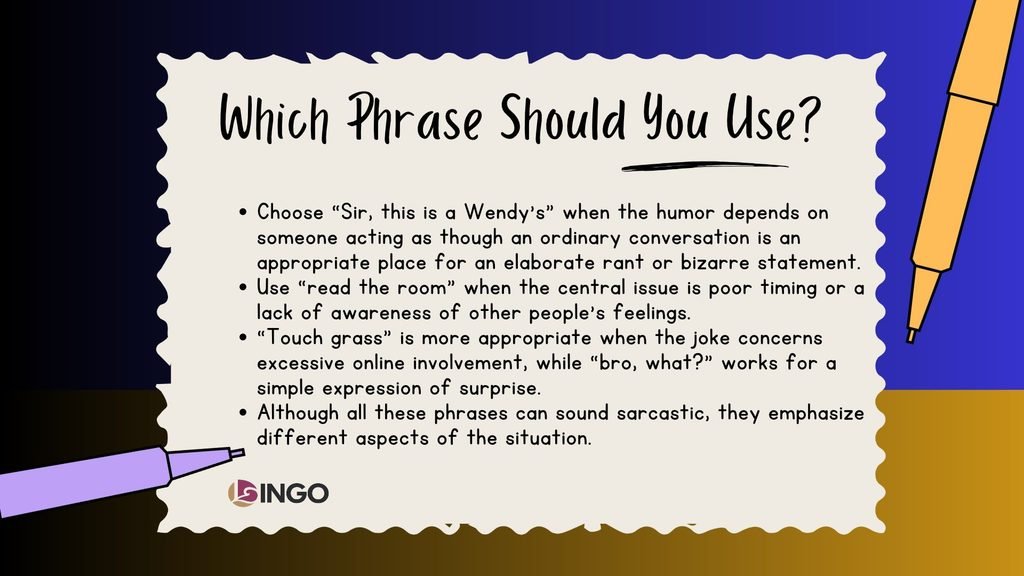
Choose “Sir, this is a Wendy’s” when the humor depends on someone acting as though an ordinary conversation is an appropriate place for an elaborate rant or bizarre statement.
Use “read the room” when the central issue is poor timing or a lack of awareness of other people’s feelings.
“Touch grass” is more appropriate when the joke concerns excessive online involvement, while “bro, what?” works for a simple expression of surprise.
Although all these phrases can sound sarcastic, they emphasize different aspects of the situation.
Mini Quiz:“Sir This Is a Wendy’s” Meme
1. What does “Sir, this is a Wendy’s” usually mean?
Answer: Someone is being irrelevant or overly dramatic.
2. Which American television comedy is associated with the joke behind the meme?
Answer: The Office.
3. What is the name of the episode associated with the joke?
Answer: “Chair Model.”
4. What is the main source of humor in the meme?
Answer: The contrast between a dramatic comment and an ordinary setting.
5. Which earlier variation of the joke appeared before the Wendy’s version became widely recognizable?
Answer: “Sir, this is an Arby’s.”
6. Which social media platform helped spread early versions of the catchphrase?
Answer: Twitter.
7. Which artist is associated with a Reddit comic that helped inspire a visual version of the meme?
Answer: SrGrafo.
8. What is the main purpose of the meme in online conversations?
Answer: To humorously point out that a comment is out of context.
9. When might someone use the meme in a group chat?
Answer: When someone sends an excessive rant about an unrelated topic.
10. Which phrase encourages someone to notice the social atmosphere?
Answer: “Read the room.”
11. Name one situation where the meme could be used playfully.
Answer: When a friend gives an overly dramatic speech about a fictional character.
12. Does the meme prove that someone’s statement is factually wrong?
Answer: No. It mainly comments on the context or tone.
13. Is “Sir, this is a Wendy’s” generally a sarcastic internet catchphrase?
Answer: Yes.
14. Does the meme always mean that the person being addressed is factually incorrect?
Answer: No.
15. Why is the meme easy to adapt?
Answer: Its basic structure works in many different situations.
16. What does “Ma’am, this is a Wendy’s” mean?
Answer: It is a variation of the original phrase with the same basic joke.
17. When might using the meme be inappropriate?
Answer: During a serious conversation about someone’s crisis or emergency.
18. How did the meme develop over time?
Answer: It developed through a television joke, early social media posts, and later meme formats.
19. Which phrase usually suggests spending less time online?
Answer: “Touch grass.”
20. Why does the Wendy’s meme work as a short reply?
Answer: It communicates a sarcastic reaction in just a few words.
21. What type of restaurant is Wendy’s?
Answer: An American fast-food restaurant chain.
22. What does the phrase suggest when someone makes an unrelated comment?
Answer: That the comment does not fit the conversation.
23. Can the meme be used between friends as a joke?
Answer: Yes, if everyone understands the humor.
24. What is one reason the meme became recognizable online?
Answer: It is short, flexible, and easy to understand.
25. What should you consider before using the meme?
Answer: The context, audience, and whether the joke might offend someone.
Frequently Asked Questions
1. What does “Sir, this is a Wendy’s” mean?
It is a sarcastic internet catchphrase used when someone says something irrelevant, excessive, strange, or inappropriate for the situation. It humorously suggests that the person should recognize the context of the conversation.
2. Where did the “Sir, this is a Wendy’s” meme originate?
The meme is commonly associated with a 2008 episode of The Office. Its online history developed through Twitter variations, including “Sir, this is an Arby’s,” and later expanded through Reddit comics and image templates.
3. Who created the “Sir, this is a Wendy’s” meme?
There is no single confirmed creator of every version. Early Twitter users helped establish the text-based catchphrase, while cartoonist SrGrafo played an important role in popularizing the visual meme format on Reddit.
4. Is “Sir, this is a Wendy’s” rude?
It can be. Friends often use it playfully, but it can also dismiss or embarrass someone. The tone, relationship, and subject of the conversation determine whether it sounds funny or insulting.
5. What does “Ma’am, this is a Wendy’s” mean?
It is a variation of the original catchphrase. It carries the same meaning but changes the form of address, allowing people to adapt the joke to different characters or situations.
6. Is “Sir, this is an Arby’s” the same meme?
Yes. It is an earlier variation of the same basic joke. Both phrases point out that someone’s statement or behavior seems out of place in an ordinary fast-food setting.
7. Can I use the meme in real-life conversations?
Yes. You can use it with friends or colleagues who understand internet humor, particularly when someone makes an exaggerated or unrelated comment. However, avoid using it to dismiss serious concerns or sensitive discussions.
8. Is the “Sir, this is a Wendy’s” meme still popular in 2026?
The phrase remains part of documented internet meme culture, but reliable, comprehensive statistics confirming its current popularity across platforms are not available here. Its continued recognition should not be confused with proof that it is currently trending.
Conclusion
The “Sir This Is a Wendy’s” meme is a classic internet catchphrase that humorously highlights conversations that have gone off track. Associated with a scene from The Office, early Twitter jokes, and Reddit comic templates, it developed into a versatile response to dramatic rants, irrelevant comments, and awkward social situations.
Its appeal comes from its simplicity: instead of arguing with someone, you can point out the mismatch between what they are saying and where the conversation is taking place.
Whether you encounter it in a social media comment, a group chat, or a funny meme, understanding its meaning helps you appreciate the joke and recognize when it is appropriate to use.
For more clear explanations of commonly confused English words and grammar rules, explore the other language guides on Lingorixa.
References

Maimoona Asghar is a grammar enthusiast and language writer who creates clear, practical content to help learners improve English grammar, writing, punctuation, and communication skills through easy-to-understand explanations and examples.