Have you ever wondered whether to write knaw or gnaw? These words can be confusing because they sound similar when spoken aloud. However, only one is the standard spelling for the English verb meaning to bite or chew something repeatedly.
Gnaw is the correct spelling. It means to bite or chew something persistently, gradually wear something away, or experience a feeling of worry that continues to bother you. The spelling knaw is not standard English when used with this meaning.
In this guide, you will learn the difference between knaw and gnaw, how to pronounce the correct word, how to use it in sentences, and how to remember its spelling.
What Is the Difference Between Knaw and Gnaw?
The main difference between knaw and gnaw is standard spelling. If you want to describe an animal chewing a bone or a worry that keeps bothering someone, use gnaw.
Gnaw: The Correct Spelling
Gnaw is a verb that describes repeatedly biting or chewing something. It can also refer to a feeling that gradually causes worry, discomfort, or doubt.
Examples:
- The puppy likes to gnaw on its toy.
- Rats can gnaw through wooden materials.
- Guilt continued to gnaw at his conscience.
- Hunger began to gnaw at the tired traveler.
The word works in both literal and figurative situations. In the first two examples, it describes physical chewing. In the last two, it describes an uncomfortable feeling that persists.
Knaw: The Nonstandard Spelling
Knaw is not the standard spelling of the verb gnaw. People commonly write it by mistake because the correct word begins with a silent letter.
Examples:
- Incorrect: The dog began to knaw the bone.
- Correct: The dog began to gnaw the bone.
- Incorrect: Doubt started to knaw at her mind.
- Correct: Doubt started to gnaw at her mind.
For modern everyday writing, use gnaw when referring to chewing or persistent worry.
What Does Gnaw Mean in English?

The word gnaw has two common uses: physical chewing and persistent emotional discomfort. Understanding both meanings will help you use it correctly.
The Literal Meaning of Gnaw
In its literal sense, gnaw means to bite or chew something repeatedly, often gradually wearing it down.
Examples:
- The mouse began to gnaw on a piece of cardboard.
- The dog gnawed the bone for several minutes.
- The beaver can gnaw through wood.
- The baby tried to gnaw on a teething toy.
This meaning often appears in descriptions of animals, teeth, bones, wood, and other objects that can be chewed.
The Figurative Meaning of Gnaw
In figurative language, gnaw describes an emotion or thought that continues to trouble someone.
Examples:
- Anxiety began to gnaw at his confidence.
- A feeling of regret continued to gnaw at her.
- The unanswered question gnawed at his mind.
- Doubt was gnawing away at their trust.
This use is common in storytelling, personal writing, and everyday conversations because it expresses a persistent feeling more vividly than simply saying someone is worried.
Why Gnaw Is Sometimes Confusing
The confusion comes mainly from pronunciation. In modern English, the initial g is silent, so gnaw sounds approximately like “naw.”
That makes it easy to guess the wrong spelling when writing the word for the first time. However, pronunciation does not always reveal how an English word should be spelled.
How to Pronounce Gnaw Correctly
The correct pronunciation of gnaw does not include a spoken g. The word is pronounced approximately like “naw,” although the exact vowel sound varies between British and American English.
Why Is the G Silent in Gnaw?
English retains many spellings that reflect older stages of the language. In words such as gnaw, the initial consonant combination is pronounced differently from how it might appear to a new learner.
Other examples of words with a silent initial g include:
- Gnat: A small flying insect.
- Gnome: A mythical or decorative figure.
- Gnash: To grind the teeth.
- Gnaw: To bite or chew repeatedly.
These words provide a useful spelling pattern to remember, although English spelling has exceptions.
A Simple Way to Remember the Pronunciation
Think of the phrase “gnaw on a bone.” Say the phrase naturally without pronouncing the g.
Then remember that the word still begins with the letter g when written.
Memory tip: The g is silent, but it is not missing. Write gnaw, not naw or knaw, when you mean to chew or cause persistent worry.
Knaw or Gnaw: Examples, Word Forms, and Usage
The easiest way to learn the correct spelling is to compare incorrect and correct sentences and practice the different forms of the verb.
Correct and Incorrect Sentence Examples
| Incorrect Usage | Correct Usage |
|---|---|
| The puppy began to knaw its toy. | The puppy began to gnaw its toy. |
| Rats can knaw through wires. | Rats can gnaw through wires. |
| Regret continued to knaw at him. | Regret continued to gnaw at him. |
| She knawed on a pencil. | She gnawed on a pencil. |
| Hunger was knawing at his stomach. | Hunger was gnawing at his stomach. |
The important point is that changing the sentence’s tense does not change the spelling rule. The word remains part of the gnaw family.
The Different Forms of Gnaw
| Word Form | Usage | Example |
|---|---|---|
| Gnaw | Base form | Dogs sometimes gnaw on bones. |
| Gnaws | Present tense with he, she, or it | The puppy gnaws on its toy. |
| Gnawed | Past tense | The mouse gnawed the cardboard. |
| Gnawing | Continuous form or adjective | The gnawing pain kept him awake. |
Use the form that matches the sentence’s tense and grammar. For example, write “She gnawed the pencil yesterday” but “She is gnawing the pencil now.”
A Real-Life Example: Using Gnaw in Everyday Writing
Imagine a student writing a short story about a boy who discovers that his favorite wooden toy has been damaged. While describing the scene, the student writes, “The little mouse began to knaw the wooden toy during the night.”
The sentence communicates the intended idea, but the spelling is incorrect. The student can correct it to: “The little mouse began to gnaw the wooden toy during the night.”
Later in the story, the boy becomes worried because he cannot find his missing toy. The student writes, “The thought of losing it continued to knaw at him.” This sentence also needs correction: “The thought of losing it continued to gnaw at him.”
These two examples show why understanding the word’s meaning matters. The first sentence describes physical chewing, while the second describes a feeling that repeatedly troubles someone’s mind. Both require the same spelling: gnaw.
The student can also improve the story by choosing the appropriate word form. For example, “The mouse gnawed the toy” describes an action in the past, while “The mouse was gnawing the toy” describes an action in progress. The spelling remains consistent across both forms.
This simple editing exercise demonstrates a useful writing habit: check both spelling and meaning before submitting schoolwork, publishing a blog post, or sending an important email. A dictionary can confirm the spelling, while reading the complete sentence helps ensure that the word fits its context.
Is There Any Difference Between Gnaw in British and American English?
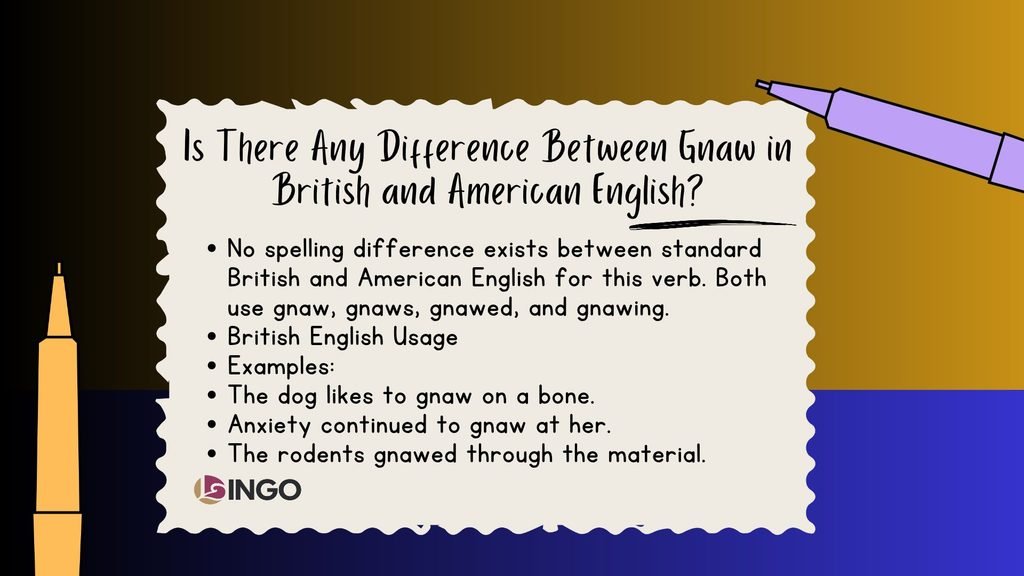
No spelling difference exists between standard British and American English for this verb. Both use gnaw, gnaws, gnawed, and gnawing.
British English Usage
Examples:
- The dog likes to gnaw on a bone.
- Anxiety continued to gnaw at her.
- The rodents gnawed through the material.
American English Usage
Examples:
- The puppy will gnaw on its toy.
- Doubt began to gnaw at his confidence.
- The mice gnawed through the cardboard.
The pronunciation may differ slightly by accent, but the spelling remains the same. You do not need to choose between knaw and gnaw based on the country where you are writing.
What Do Dictionaries and Current Data Tell Us?
Dictionary references are the most useful evidence for resolving a spelling question like this. Cambridge Dictionary defines gnaw as repeatedly biting or chewing something and documents its figurative use for worry. Oxford Learner’s Dictionaries also lists the verb and its forms, including gnaws, gnawed, and gnawing.
For a transparent, current-data perspective, it is important to distinguish spelling evidence from search statistics.
- 2025–2026 spelling evidence: Standard dictionary references recognize gnaw as the correct spelling for this verb.
- Search-volume statistics: No verified 2025–2026 search-volume figures for the exact query “knaw or gnaw” are established here. It would be misleading to invent a monthly search count or percentage.
- How to research search demand: Use google to compare interest in the two spellings, or consult an SEO keyword tool for estimated search volume. These tools measure search behavior, not whether a spelling is grammatically correct.
For a spelling decision, dictionary evidence is more relevant than the number of people searching for either version.
Mini Quiz:Knaw or Gnaw
Knaw or Gnaw: 25 Mini Quiz Questions With Answers
1. Which spelling is correct when describing a dog chewing a bone repeatedly?
A. Knaw B. Gnaw C. Gnow D. Naw
Answer: B. Gnaw — Gnaw is the standard spelling for biting or chewing repeatedly.
2. What does the word gnaw mean?
A. To swallow quickly B. To chew or bite repeatedly C. To run away D. To speak quietly
Answer: B. To chew or bite repeatedly — Gnaw describes repeated biting or chewing, often gradually wearing something down.
3. Which sentence uses gnaw correctly?
A. The puppy likes to gnaw on its toy. B. The puppy likes to knaw on its toy. C. The puppy likes to gnow on its toy. D. The puppy likes to naw on its toy.
Answer: A. The puppy likes to gnaw on its toy. — Gnaw is the correct spelling.
4. How is gnaw generally pronounced?
A. With a hard G sound B. Like now in every accent C. Approximately like “naw” D. With a K sound
Answer: C. Approximately like “naw” — The initial G is silent.
5. What is the past tense of gnaw?
A. Gnawing B. Gnaws C. Gnawed D. Knawed
Answer: C. Gnawed — For example, “The puppy gnawed on its toy.”
6. Which sentence uses gnaw figuratively to describe worry?
A. The rabbit gnawed on a carrot. B. Doubt began to gnaw at her mind. C. The mouse gnawed through the box. D. The dog gnawed its bone.
Answer: B. Doubt began to gnaw at her mind. — Gnaw can describe a persistent troubling thought.
7. Fill in the blank: The mouse tried to ___ through the cardboard.
A. Knaw B. Gnow C. Gnaw D. Know
Answer: C. Gnaw — Gnaw describes the mouse repeatedly biting the cardboard.
8. Which word also begins with a silent G?
A. Gnat B. Garden C. Gift D. Gather
Answer: A. Gnat — The G in gnat is silent, just like the G in gnaw.
9. Complete the sentence: The dog is ___ on its chew toy.
A. Gnaws B. Gnawed C. Gnawing D. Knawing
Answer: C. Gnawing — The correct present progressive form is “is gnawing.”
10. Which sentence is spelled correctly?
A. His guilt continued to gnaw at him. B. His guilt continued to knaw at him. C. His guilt continued to gnow at him. D. His guilt continued to gnawed at him.
Answer: A. His guilt continued to gnaw at him. — Gnaw is correctly spelled and used to express persistent emotional discomfort.
11. Which form completes the sentence? She ___ on a pencil when nervous.
A. Gnaw B. Gnaws C. Gnawed D. Gnawing
Answer: B. Gnaws — In the simple present tense, a singular subject such as she takes gnaws.
12. What does “gnaw away at someone’s confidence” mean?
A. To improve confidence immediately B. To gradually weaken confidence C. To explain confidence D. To forget something instantly
Answer: B. To gradually weaken confidence — The expression describes something that slowly damages confidence.
13. Complete the sentence: The puppy had ___ the corner of the cushion.
A. Knawed B. Gnawing C. Gnawed D. Gnaws
Answer: C. Gnawed — Gnawed is the correct past participle after had.
14. Which word means to be aware of or understand something?
A. Gnaw B. Know C. Gnawed D. Gnawing
Answer: B. Know — Know means to understand or be aware of something.
15. Which sentence correctly uses “gnaw on”?
A. The rabbit gnawed on a wooden toy. B. The rabbit gnowed on a wooden toy. C. The rabbit knawed on a wooden toy. D. The rabbit gnaw on a wooden toy yesterday.
Answer: A. The rabbit gnawed on a wooden toy. — Gnawed is the correct past-tense form.
16. Which sentence uses gnawing correctly?
A. A gnawing worry kept him awake. B. A knawing worry kept him awake. C. A gnowing worry kept him awake. D. A gnawed worry kept him awakeing.
Answer: A. A gnawing worry kept him awake. — Gnawing can describe a persistent, troubling worry.
17. Which pair contains two correctly spelled forms of the same verb?
A. Knaw, gnawed B. Gnaw, gnawed C. Gnow, gnowed D. Gnaw, knawing
Answer: B. Gnaw, gnawed — Gnaw is the base form, and gnawed is its past tense and past participle.
18. Which sentence demonstrates the figurative meaning of gnaw?
A. The beaver gnawed a branch. B. The dog gnawed its toy. C. Regret gnawed at him for days. D. The mouse gnawed the packaging.
Answer: C. Regret gnawed at him for days. — Gnaw describes persistent emotional distress in this sentence.
19. Complete the phrase: A ___ sensation of hunger.
A. Knawing B. Gnowing C. Gnawing D. Gnawed
Answer: C. Gnawing — Gnawing can describe a persistent feeling of hunger.
20. Why do some people misspell gnaw as knaw?
A. The word begins with a pronounced K. B. The initial G is silent. C. Gnaw is a plural noun. D. The word has no accepted spelling.
Answer: B. The initial G is silent. — Because the G is not pronounced, some writers guess the wrong spelling.
21. Which sentence uses the correct spelling?
A. The squirrel began to gnaw on the nut. B. The squirrel began to knaw on the nut. C. The squirrel began to gnow on the nut. D. The squirrel began to naw on the nut.
Answer: A. The squirrel began to gnaw on the nut. — Gnaw is the standard spelling.
22. What is the correct -ing form of gnaw?
A. Knawing B. Gnowing C. Gnawing D. Gnawed
Answer: C. Gnawing — Add -ing to gnaw to form gnawing.
23. Which sentence correctly uses gnaws?
A. The dog gnaws on its favorite toy. B. The dog gnawed on its favorite toy tomorrow. C. The dog knaws on its favorite toy. D. The dog gnawing on its favorite toy.
Answer: A. The dog gnaws on its favorite toy. — Gnaws is the correct simple present form for a singular subject.
24. Which word completes the sentence? The thought of failure continued to ___ at her.
A. Knaw B. Gnaw C. Gnow D. Knawed
Answer: B. Gnaw — The expression “gnaw at her” means to trouble her persistently.
25. What is the easiest way to remember the correct spelling?
A. Always spell it knaw. B. Remember that gnaw begins with a silent G, like gnat. C. Remove the first letter. D. Spell it according to the sound alone.
Answer: B. Remember that gnaw begins with a silent G, like gnat. — This spelling pattern helps you remember the correct form.
Frequently Asked Questions About Knaw or Gnaw
Q1: Is knaw or gnaw the correct spelling?
Gnaw is the correct spelling when you mean to bite or chew repeatedly, wear something away gradually, or describe a persistent feeling of worry. Knaw is not the standard spelling for this meaning.
Q2: Is knaw a real English word?
Knaw is not the standard modern spelling of the verb gnaw. Rare historical or dialectal uses have been recorded in other contexts, but you should use gnaw in ordinary modern English when referring to chewing or persistent worry.
Q3: What does gnaw mean?
Gnaw means to bite or chew something repeatedly. It can also describe a persistent feeling, such as guilt, anxiety, or doubt, that continues to trouble someone.
Q4: How do you pronounce gnaw?
Gnaw is pronounced approximately “naw.” The initial g is silent, although the precise vowel sound may vary between British and American accents.
Q5: What is the past tense of gnaw?
The past tense is gnawed.
Example: “The puppy gnawed on its toy for an hour.”
Q6: Can gnaw be used to describe feelings?
Yes. The word can describe emotions or thoughts that persistently trouble someone.
Example: “A feeling of regret continued to gnaw at him.”
Q7: Is gnaw spelled differently in British and American English?
No. Both British and American English use gnaw. The spelling does not change based on the variety of English.
Q8: How can I remember the correct spelling of gnaw?
Remember that gnaw belongs to a group of English words that begin with a silent g, such as gnat, gnome, and gnash. The g is not pronounced, but it must still be written.
Conclusion: Knaw or Gnaw Which Should You Use?
When choosing between knaw or gnaw, use gnaw. It is the standard English spelling for repeatedly biting or chewing something and for describing a persistent feeling of worry or discomfort.
Remember these three points:
- Gnaw is the correct standard spelling.
- The initial g is silent, so the word sounds approximately like “naw.”
- The past tense is gnawed, and the continuous form is gnawing.
Whether you are writing a school assignment, a professional email, a story, or a blog post, choosing the correct spelling makes your writing clearer and more credible.
For more clear explanations of commonly confused English words and grammar rules, explore the other language guides on Lingorixa.
References
Cambridge Dictionary entry for gnaw
Oxford Learner’s Dictionaries entry for gnaw.

Maimoona Asghar is a grammar enthusiast and language writer who creates clear, practical content to help learners improve English grammar, writing, punctuation, and communication skills through easy-to-understand explanations and examples.