Have you ever heard someone say “Oh My Lanta!” and wondered what it actually means? This unusual expression can sound confusing because “Lanta” is not normally used as an English word by itself.
The Oh My Lanta meaning is quite simple. It is a playful exclamation used to express surprise, shock, excitement, amazement, or disbelief. It is often understood as a lighthearted alternative to expressions such as “Oh my God,” “Oh my gosh,” or “Oh my goodness.”
The phrase is also strongly connected with the classic American sitcom Full House, where D.J. Tanner, played by Candace Cameron Bure, became closely associated with saying “Oh Mylanta.”
In this complete guide, you will learn what “Oh My Lanta” means, where it came from, how to use it correctly, what it means in texting, and which alternatives you can use in everyday English.
What Does “Oh My Lanta” Mean?
“Oh My Lanta” is a humorous expression used to show surprise, excitement, amazement, shock, or disbelief. It does not have a literal meaning because “Lanta” is not being used as an independent English noun in this expression.
You can think of it as a playful reaction similar to:
- “Oh my gosh!”
- “Oh my goodness!”
- “Wow!”
- “No way!”
- “Good grief!”
- “Oh my God!”
Wiktionary describes “oh my lanta” as a humorous, euphemistic American exclamation and connects its etymology with wordplay on Mylanta, a brand of over-the-counter medicine.
Oh My Lanta Meaning in Simple English
If someone says:
“Oh my Lanta! That is an enormous cake!”
they simply mean:
“Wow! That cake is enormous!”
The expression adds emotion and personality to the sentence.
What Emotions Can “Oh My Lanta” Express?
The meaning depends heavily on context and tone.
| Situation | Possible meaning |
|---|---|
| Unexpected good news | Excitement |
| Seeing something impressive | Amazement |
| Hearing shocking news | Shock |
| Hearing something unbelievable | Disbelief |
| Seeing something funny | Amusement |
| Discovering an unexpectedly high price | Surprise |
For example:
- “Oh my Lanta! I got the job!” — excitement
- “Oh my Lanta! Look at that view!” — amazement
- “Oh my Lanta! You paid how much?” — surprise
- “Oh my Lanta, I can’t believe that happened.” — disbelief
Where Did “Oh My Lanta” Come From?
The exact earliest origin of “Oh My Lanta” is not completely settled, so it is important not to present every popular internet claim as established fact.
The expression is generally explained as wordplay involving Mylanta, the brand name of an over-the-counter medicine. The wording then became especially recognizable through American popular culture and Full House.
The Mylanta Connection
The unusual part of the phrase is “Lanta.” It resembles the ending of Mylanta, which makes the expression sound humorous.
Rather than saying a more conventional exclamation, speakers use:
Oh + my + Lanta
The result is memorable because it sounds almost like a familiar phrase while being slightly unexpected.
However, claims that a specific Mylanta advertising campaign definitely created the expression should be treated cautiously. Historical discussions have noted that evidence for such a direct advertising origin is not conclusive.
Why Is It Called an Exclamation?
An exclamation is a word or phrase used to express a sudden or strong feeling.
For example:
- “Wow!”
- “Amazing!”
- “Oh no!”
- “Goodness!”
- “Oh my Lanta!”
“Oh My Lanta” belongs to this category because its primary purpose is to communicate emotion rather than provide factual information.
“Oh My Lanta” and Full House
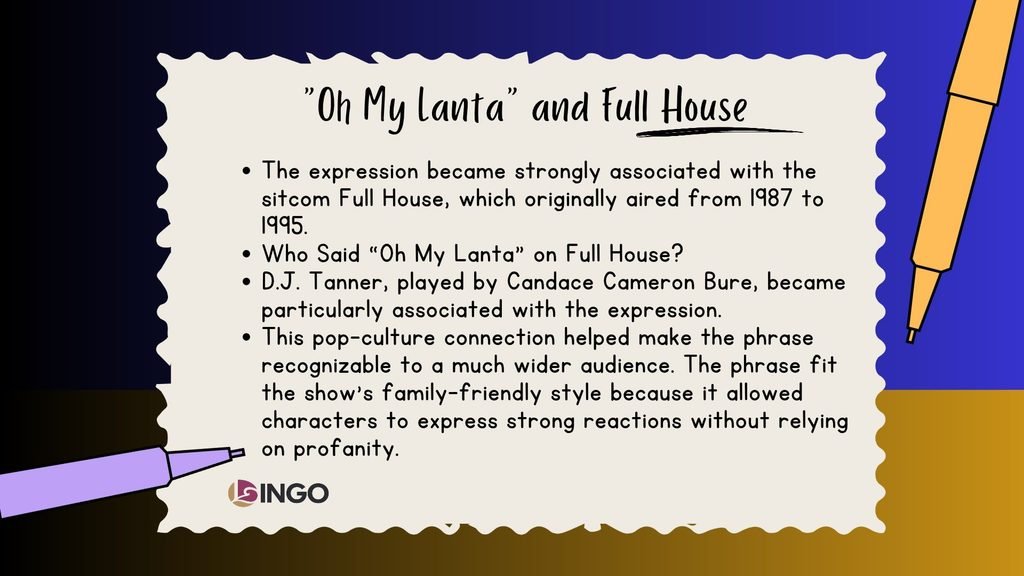
The expression became strongly associated with the sitcom Full House, which originally aired from 1987 to 1995.
Who Said “Oh My Lanta” on Full House?
D.J. Tanner, played by Candace Cameron Bure, became particularly associated with the expression.
This pop-culture connection helped make the phrase recognizable to a much wider audience. The phrase fit the show’s family-friendly style because it allowed characters to express strong reactions without relying on profanity.
The Full House connection is so strong that people sometimes assume D.J. Tanner invented the expression. That is an oversimplification. She helped popularize it, but the phrase’s linguistic history is associated with wordplay involving Mylanta.
Why Did the Phrase Become Memorable?
There are several reasons.
First, it sounds unusual. Second, it is easy to say. Third, it expresses emotion immediately. Finally, its repeated use in a popular sitcom gave it a recognizable pop-culture identity.
Full House remains highly recognizable among American audiences, which helps explain why expressions associated with the show can still be understood decades after its original run.
How to Use “Oh My Lanta” Correctly
“Oh My Lanta” is mainly appropriate in casual, humorous, conversational situations. It works particularly well when you want your reaction to sound playful rather than serious.
Using “Oh My Lanta” in Conversation
Here are some natural examples:
Example 1: Surprise
“Oh my Lanta! I didn’t know you were coming.”
Example 2: Excitement
“Oh my Lanta! We finally won!”
Example 3: Amazement
“Oh my Lanta, this house is beautiful.”
Example 4: Disbelief
“Oh my Lanta! Are you seriously telling me that?”
Example 5: Humor
“Oh my Lanta, that’s the biggest slice of pizza I’ve ever seen!”
Using “Oh My Lanta” in Texting
The phrase can also appear in texts, comments, and social media posts.
For example:
Friend: I just bought concert tickets!
You: Oh my Lanta!!! That’s amazing!
Another example:
“Oh my Lanta, this video is hilarious 😂”
Because texting is generally informal, the expression fits naturally in this environment.
When Should You Avoid It?
Although “Oh My Lanta” is harmless and playful, it is not suitable for every situation.
Avoid using it in:
- Academic essays
- Legal documents
- Formal reports
- Professional research
- Serious emergency communications
- Formal business correspondence
For instance, this sounds inappropriate in a serious workplace report:
“Oh my Lanta, we have a major problem with the project.”
A better professional version would be:
“We have identified a significant problem with the project.”
The difference is register. “Oh My Lanta” is informal and expressive, while professional writing usually requires direct and neutral language.
Oh My Lanta vs. Similar Expressions
Although several expressions can communicate surprise, they do not all have exactly the same tone.
Comparison Table
| Expression | Typical meaning | Tone |
|---|---|---|
| Oh My Lanta | Surprise, amazement, excitement | Playful |
| Oh my gosh | Surprise or shock | Casual |
| Oh my goodness | Surprise or concern | Polite |
| Oh my God | Strong surprise or emotion | Casual to strong |
| Wow | Surprise or admiration | Very casual |
| Good grief | Surprise, frustration, or disbelief | Mildly humorous |
| No way! | Disbelief or excitement | Casual |
Is “Oh My Lanta” the Same as “Oh My God”?
Not exactly.
They can perform a similar grammatical function, but their tone is different.
“Oh my God!” can express very strong surprise, shock, excitement, or disbelief.
“Oh My Lanta!” generally sounds more playful, humorous, nostalgic, or family-friendly.
Therefore, context matters more than a literal word-for-word translation.
Is “Oh My Lanta” the Same as “Oh My Gosh”?
These expressions are much closer in tone.
Both can be used as softer alternatives to stronger exclamations. However, “Oh My Lanta” has a more distinctive pop-culture flavor because of its association with Full House.
Case Study: How a TV Expression Became Everyday Language
Consider someone who grew up watching Full House during its original run or through later reruns.
They repeatedly hear D.J. Tanner use “Oh Mylanta” when reacting to unexpected situations. At first, the expression is simply part of the show’s dialogue. Because it is unusual, however, the viewer remembers it.
Years later, that person encounters an enormous restaurant bill and jokingly says, “Oh my Lanta!”
The person listening may understand the emotion immediately even if they have never watched Full House. Why? The surrounding words and tone make the intended meaning clear. The speaker is not literally talking about Mylanta. They are using a recognizable exclamation to communicate surprise.
This illustrates an important feature of informal language: expressions can develop cultural meaning beyond their individual words.
“Oh My Lanta” is especially interesting because its meaning is not obvious from “Lanta” itself. Its meaning comes from usage, repetition, humor, and cultural association. The Full House connection gave the expression a recognizable identity, while its resemblance to Mylanta helps explain the unusual wording.
The phrase therefore demonstrates how popular entertainment can help preserve or spread distinctive expressions. Even though Full House ended its original run in 1995, the show remains recognizable, allowing its memorable expressions to continue appearing in modern conversations and online discussions.
Oh My Lanta in 2025–2026: Is It Still Used?
“Oh My Lanta” is not among the most common modern English expressions, but it has not disappeared.
Contemporary examples continue to appear in online writing, reviews, comments, and social media. Its continued appearance demonstrates that the expression remains understandable as a humorous reaction.
What the Recent Data Tells Us
There is no authoritative public dataset that provides a precise annual count of “Oh My Lanta” uses in 2025 or 2026. Therefore, claims such as “the phrase increased by X% in 2026” should not be presented as fact without reliable search-volume evidence.
However, several useful observations can be made:
- Full House remains widely recognized.
- The phrase continues to appear in contemporary informal writing.
- Modern users can understand it as an expressive exclamation.
- Its strongest use remains informal, humorous, and pop-culture-oriented.
This makes “Oh My Lanta” a good example of how an older expression can remain recognizable even when it is not part of everyday formal English.
Mini Quiz:Oh My Lanta Meaning
1. What does “Oh My Lanta” generally express?
A. Surprise or amazement
B. A formal greeting
C. A request for help
D. A description of weather
Answer: A. Surprise or amazement
2. What kind of expression is “Oh My Lanta”?
A. An exclamation
B. A technical term
C. A grammatical tense
D. A formal title
Answer: A. An exclamation
3. “Oh My Lanta” is generally used in informal and playful situations.
A. True
B. False
Answer: A. True
4. Which television show is strongly associated with “Oh My Lanta”?
A. Friends
B. Full House
C. Seinfeld
D. The Office
Answer: B. Full House
5. Which Full House character became particularly associated with saying “Oh Mylanta”?
A. Michelle Tanner
B. Becky Donaldson
C. D.J. Tanner
D. Kimmy Gibbler
Answer: C. D.J. Tanner
6. What is the commonly suggested wordplay behind “Oh My Lanta”?
A. Atlanta
B. Mylanta
C. Lantana
D. Malanta
Answer: B. Mylanta
7. Which phrase is closest in everyday meaning to “Oh My Lanta”?
A. Oh my gosh!
B. Please sit down.
C. Thank you very much.
D. See you tomorrow.
Answer: A. Oh my gosh!
8. “Oh My Lanta” normally has a literal meaning referring to a place called Lanta.
A. True
B. False
Answer: B. False
9. Which situation is most appropriate for saying “Oh My Lanta”?
A. Reacting playfully to surprising news
B. Writing a legal contract
C. Writing a scientific definition
D. Submitting a formal business report
Answer: A. Reacting playfully to surprising news
10. What does “Oh My Lanta!” most likely communicate in “Oh My Lanta! We finally won!”?
A. Excitement
B. Boredom
C. Confusion
D. A formal apology
Answer: A. Excitement
11. Which spelling emphasizes the phrase’s connection to the brand-name wordplay?
A. Oh Mylanta
B. Oh My Lanter
C. Oh My Lantae
D. Oh Mai Lanta
Answer: A. Oh Mylanta
12. What is the usual tone of “Oh My Lanta”?
A. Playful and humorous
B. Strictly academic
C. Highly technical
D. Legally binding
Answer: A. Playful and humorous
13. Which emotions can “Oh My Lanta” express?
A. Surprise
B. Amazement
C. Excitement
D. A formal legal obligation
Answer: A, B, and C
14. Which sentence uses “Oh My Lanta” naturally?
A. Oh my Lanta, this cake is enormous!
B. Oh my Lanta, please sign the contract under clause seven.
C. Oh my Lanta is the legal name of this document.
D. Oh my Lanta defines the chemical reaction.
Answer: A. Oh my Lanta, this cake is enormous!
15. Why did “Oh My Lanta” become memorable through Full House?
A. It was repeatedly associated with a recognizable character.
B. It was the title of every episode.
C. It was the name of the television network.
D. It was the show’s official slogan.
Answer: A. It was repeatedly associated with a recognizable character.
16. “Oh My Lanta” is generally appropriate for a formal academic essay.
A. True
B. False
Answer: B. False
17. What does “Oh my Lanta, I can’t believe that happened” most likely express?
A. Disbelief
B. A routine greeting
C. A request for directions
D. A definition of Lanta
Answer: A. Disbelief
18. Which are reasonable alternatives to “Oh My Lanta” in casual conversation?
A. Oh my gosh!
B. Oh my goodness!
C. Wow!
D. The undersigned hereby acknowledges
Answer: A, B, and C
19. What should you generally use instead of “Oh My Lanta” in a formal professional report?
A. Neutral and direct wording
B. More slang expressions
C. More emojis
D. More exclamation marks
Answer: A. Neutral and direct wording
20. Which statement best describes the origin of “Oh My Lanta”?
A. It is generally explained as wordplay involving Mylanta.
B. It was definitely invented by D.J. Tanner.
C. It originated as a scientific formula.
D. It is an official geographic term.
Answer: A. It is generally explained as wordplay involving Mylanta.
21. What does “Oh My Lanta! Look at that view!” most likely express?
A. Amazement
B. A formal complaint
C. A request for permission
D. A definition of a landscape
Answer: A. Amazement
22. Which statement about “Lanta” in “Oh My Lanta” is most accurate?
A. It is not normally a literal standalone noun here.
B. It always means surprise.
C. It is a verb meaning to react.
D. It is a formal synonym for amazement.
Answer: A. It is not normally a literal standalone noun here.
23. The phrase “Oh My Lanta” can be used in texts and social media because those settings are often informal.
A. True
B. False
Answer: A. True
24. Which pop-culture figure has the strongest association with “Oh My Lanta”?
A. Sherlock Holmes
B. Harry Potter
C. D.J. Tanner from Full House
D. Walter White
Answer: C. D.J. Tanner from Full House
25. What is the best overall description of “Oh My Lanta”?
A. A playful informal exclamation
B. A formal academic phrase
C. A technical medical diagnosis
D. A grammatical rule
Answer: A. A playful informal exclamation
Common Questions About “Oh My Lanta”
Q1:Is “Oh My Lanta” a real phrase?
Yes. “Oh My Lanta” is an established informal exclamation used to communicate surprise, excitement, astonishment, or disbelief.
Q2:What does “Oh My Lanta” mean in texting?
In texting, “Oh My Lanta” usually means “Wow!” or “I can’t believe it!” The exact emotion depends on the context.
For example:
“Oh my Lanta, you actually did it!”
This communicates excitement or amazement.
Q3:Is “Oh My Lanta” from Full House?
The expression is strongly associated with Full House, where D.J. Tanner became known for saying “Oh Mylanta.” However, it is more accurate to say the show popularized the phrase rather than confidently claiming it invented it.
Q4:Is “Oh My Lanta” a swear word?
No. It is generally treated as a mild, humorous euphemistic expression rather than profanity.
Q5:What is the correct spelling: “Oh My Lanta” or “Oh Mylanta”?
Both forms can be seen. “Oh Mylanta” reflects the wordplay with the brand name Mylanta, while “Oh My Lanta” makes the phrase easier to read as a multiword exclamation.
Q6:Does “Lanta” mean anything by itself?
Not in this expression. “Lanta” is not normally being used as an independent English word. The humor comes from its connection to Mylanta.
Q7:Is “Oh My Lanta” formal English?
No. It is best considered informal, conversational English. You can use it in casual speech, texts, social media, and humorous writing, but formal documents generally call for more neutral wording.
Q8:What are some alternatives to “Oh My Lanta”?
Depending on the situation, you can say:
- “Oh my gosh!”
- “Oh my goodness!”
- “Wow!”
- “No way!”
- “Good grief!”
- “I can’t believe it!”
- “That’s incredible!”
Final Takeaway: Oh My Lanta Meaning
The Oh My Lanta meaning is a playful way to express surprise, excitement, shock, amazement, or disbelief. It is an informal exclamation rather than a phrase with a literal meaning.
Its unusual wording is generally connected to Mylanta, while its strong association with Full House particularly D.J. Tanner helped make it recognizable in American pop culture.
Today, “Oh My Lanta” works best when you want a reaction to sound lighthearted, humorous, and expressive. Use it in casual conversations, texts, comments, or nostalgic pop-culture references, but choose more neutral language for formal or professional situations.
For more clear explanations of commonly confused English words and grammar rules, explore the other language guides on Lingorixa.
References

Maimoona Asghar is a grammar enthusiast and language writer who creates clear, practical content to help learners improve English grammar, writing, punctuation, and communication skills through easy-to-understand explanations and examples.