Have you ever wondered whether you should say “I have a complaint” or “I want to complain”? If so, you are not alone. Complaint vs. complain is a common English grammar question because the two words look and sound closely related.
The key difference is simple: complaint is a noun, while complain is a verb. A complaint is the problem, objection, or expression of dissatisfaction; to complain is the action of expressing that dissatisfaction. Merriam-Webster defines complaint as an expression of dissatisfaction, pain, or protest, while complain is a verb meaning to express grief, pain, or discontent.
Once you understand this noun-versus-verb distinction, choosing the correct word becomes much easier.
In this guide, you’ll learn the difference between complaint and complain, see clear examples, discover common mistakes, and learn a simple rule you can remember whenever you write or speak English.
What Is the Difference Between Complaint and Complain?
The easiest way to understand complaint vs. complain is to identify the part of speech.
- Complaint = noun
- Complain = verb
A complaint is a thing, statement, or issue. Complain describes the action of expressing dissatisfaction.
Cambridge Grammar makes the same distinction: complaint is a noun referring to a statement that something is wrong or unsatisfactory, while complain is the verb used to say that something is wrong or unsatisfactory.
Complaint Is a Noun
Use complaint when you are talking about the actual expression of dissatisfaction, the problem being reported, or a formal objection.
Examples:
- I submitted a complaint about the poor service.
- The manager received several complaints from customers.
- Her main complaint was the long waiting time.
- We have no complaint about the quality.
- The company investigated the customer’s complaint.
Notice that you can use articles and adjectives before complaint:
- a complaint
- the complaint
- several complaints
- a formal complaint
- a serious complaint
That is a strong clue that complaint functions as a noun.
Complain Is a Verb
Use complain when you are describing the action of expressing dissatisfaction.
Examples:
- I want to complain about the service.
- She often complains about her workload.
- They complained to the manager.
- He is complaining about the noise.
- Customers have complained that the product arrived late.
Because complain is a verb, it can change according to tense and subject:
- complain
- complains
- complained
- complaining
Merriam-Webster lists these forms and defines complain primarily as a verb meaning to express dissatisfaction or discontent.
Complaint vs. Complain: Grammar Rules You Can Remember
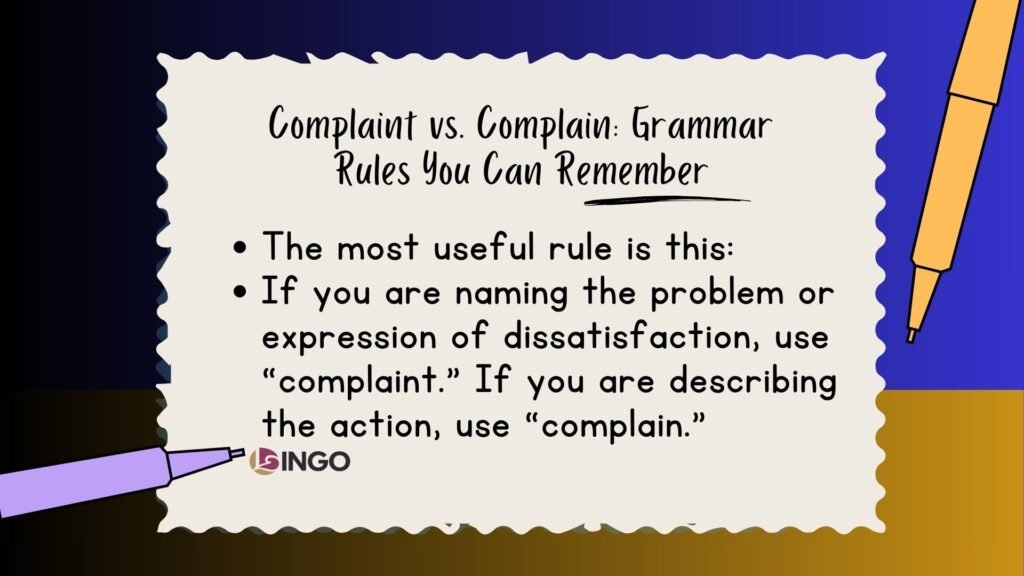
The most useful rule is this:
If you are naming the problem or expression of dissatisfaction, use “complaint.” If you are describing the action, use “complain.”
Use “Complaint” After Determiners
Because complaint is a noun, it can follow words such as a, the, my, your, this, and several.
Correct:
- I have a complaint.
- This is my complaint.
- We received three complaints.
- Her complaint was taken seriously.
Incorrect:
- I have a complain.
- We received three complain.
- This is my complain.
The last examples are incorrect because complain is a verb, not the noun needed in those sentence structures.
Use “Complain” After Subjects
When the sentence focuses on someone performing the action, complain is normally the appropriate choice.
Examples:
- I complain when something goes wrong.
- She complained about the delay.
- They complain too much.
- He is complaining about the price.
A useful pattern is:
Subject + complain + about + problem
For example:
The customer complained about the slow service.
You can also use:
Subject + complain + that + clause
The customer complained that the service was too slow.
A Simple Memory Trick
Think of the two words this way:
Complaint = the thing
Complain = the action
For example:
I made a complaint because I wanted to complain about the service.
The first word names the formal expression. The second describes what the person does.
How to Use Complaint and Complain Correctly
Knowing the definitions is useful, but seeing the words in realistic sentences makes the distinction much easier.
Examples With “Complaint”
Here are several natural examples:
- I filed a complaint about the damaged package.
- The hotel received a complaint from a guest.
- Her complaint was resolved within two days.
- We received several complaints about the new policy.
- The customer service team handles complaints professionally.
- His only complaint was that the room was too small.
In each sentence, complaint refers to something that can be received, filed, handled, resolved, or discussed.
Examples With “Complain”
Now compare them with sentences using complain:
- I complained about the damaged package.
- The guest complained to the hotel manager.
- She complained that her order was late.
- Several customers complained about the new policy.
- The customer complained to customer service.
- He complained that the room was too small.
Here, complain describes an action performed by a person.
Common Expressions With Complaint
Some common phrases include:
- make a complaint
- file a complaint
- submit a complaint
- receive a complaint
- handle a complaint
- investigate a complaint
- resolve a complaint
- customer complaint
- formal complaint
- written complaint
For example:
The company promised to investigate the complaint.
Common Expressions With Complain
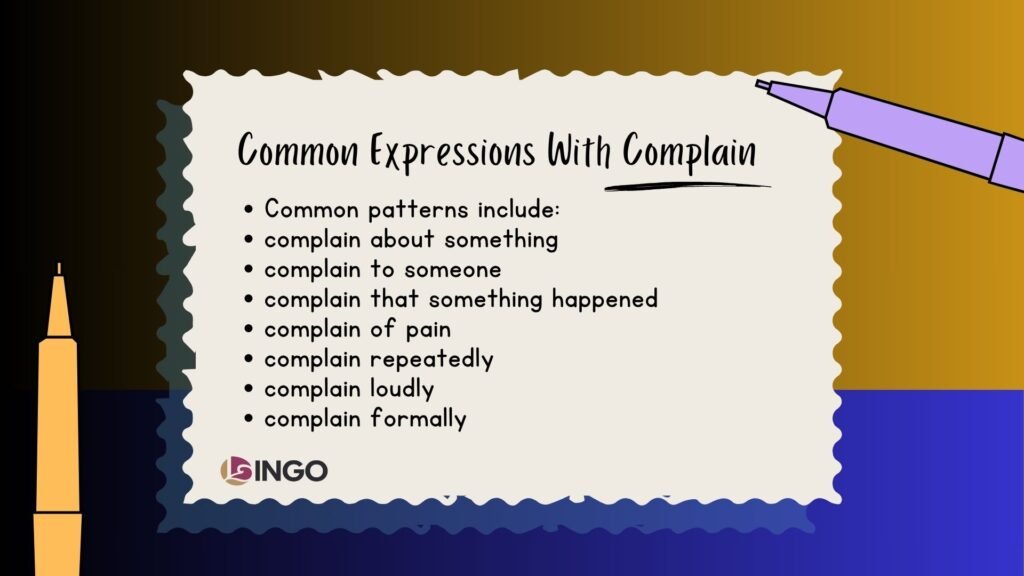
Common patterns include:
- complain about something
- complain to someone
- complain that something happened
- complain of pain
- complain repeatedly
- complain loudly
- complain formally
For example:
She complained to the manager about the poor service.
The preposition matters, too. We commonly say complain about something and complain to someone.
Complaint vs. Complain: Quick Comparison Table
| Feature | Complaint | Complain |
|---|---|---|
| Part of speech | Noun | Verb |
| Basic meaning | An expression of dissatisfaction | To express dissatisfaction |
| Example | I made a complaint. | I complained to the manager. |
| Common pattern | make/file/submit a complaint | complain about/to |
| Plural form | complaints | complains |
| Past form | — | complained |
| -ing form | — | complaining |
A quick test can help:
Can you put “a” before the word?
- a complaint ✅
- a complain ❌
Can you put “to” before a person and describe an action?
- complain to the manager ✅
- complaint to the manager ❌ when an action verb is required
Real-Life Case Study: Choosing the Right Word in a Customer Service Email
Imagine that Sarah orders a laptop online. The website promises delivery within three business days, but her package arrives after ten days. When she opens the box, she discovers that the laptop has a damaged screen.
Sarah decides to contact customer service.
Her first sentence might be:
“I would like to complain about my recent order.”
This is correct because complain is the action Sarah is taking.
She could then write:
“I would like to make a formal complaint about the damaged product and delayed delivery.”
Here, complaint is correct because she is naming the formal expression of dissatisfaction.
Later, the customer service representative might say:
“We have received your complaint and will investigate the matter.”
Sarah could also say:
“I complained to customer service because the product was damaged.”
All three sentences communicate essentially the same situation, but the grammatical roles are different.
This distinction becomes especially important in professional writing. Compare:
Less natural:
I want to make a complain about my order.
Correct:
I want to make a complaint about my order.
Or:
Incorrect:
I want to complaint about my order.
Correct:
I want to complain about my order.
The mistake happens because the speaker understands the general meaning but chooses the wrong grammatical form. Once you identify whether the sentence needs a noun or verb, the choice becomes straightforward.
Common Mistakes With Complaint and Complain
Even advanced English learners sometimes mix up these words because they share the same root.
Mistake 1: “I Want to Complaint”
This is one of the most common errors.
Incorrect:
I want to complaint about the service.
Correct:
I want to complain about the service.
Why? The phrase “want to” requires a base-form verb, and complain is the verb.
Mistake 2: “Make a Complain”
Another common error is using complain as though it were a noun.
Incorrect:
I want to make a complain.
Correct:
I want to make a complaint.
The fixed expression is make a complaint.
Mistake 3: “I Have a Complain”
Incorrect:
I have a complain about this product.
Correct:
I have a complaint about this product.
After “a”, you need the noun complaint.
Mistake 4: Confusing “Complaint” With “Complaining”
The words are related, but they serve different grammatical purposes.
Complaint is a noun:
His complaint was reasonable.
Complaining is the -ing form of the verb:
His constant complaining annoyed everyone.
The difference is subtle but important.
Mistake 5: Using “Complaint” as the Main Verb
Incorrect:
She complaint about the noise.
Correct:
She complained about the noise.
The past-tense verb is complained, not complaint.
2025–2026 Data: Why Precise Communication Still Matters
There is no reliable 2025–2026 statistic showing exactly how many people confuse complaint and complain, so it would be misleading to invent one. However, recent communication research shows why grammatical accuracy and clarity remain valuable in modern writing.
Grammarly’s 2025 report emphasizes the connection between communication and workplace productivity, particularly as organizations increasingly rely on written communication and AI-supported workflows.
More broadly, HubSpot’s 2025 research found that AI has become deeply integrated into content workflows. Its research reported that 43% of marketers used AI for content creation, while other major uses included research, learning, and data analysis.
HubSpot’s more recent data, updated in July 2026, reports that only 7% of marketers publish AI-generated content without revising it, highlighting the continuing importance of human review and editing.
For grammar learners, the lesson is practical: tools can help identify or generate language, but writers still need to understand whether a sentence requires a noun, verb, adjective, or another part of speech. Small distinctions such as complaint versus complain can affect clarity and professionalism.
Google’s current Search Central guidance also emphasizes helpful, reliable, people-first content and recommends creating material that provides genuine value rather than content produced merely to manipulate search rankings.
Complaint vs. Complain: A Step-by-Step Way to Choose
When you’re unsure which word to use, follow these four steps.
Step 1: Identify the Action
Ask yourself:
Is someone doing the complaining?
If yes, you probably need complain.
She decided to complain about the noise.
Step 2: Identify the Thing
Ask:
Am I talking about the actual complaint, objection, or issue?
If yes, use complaint.
The manager investigated the complaint.
Step 3: Look at the Words Around It
If you see:
- want to
- will
- should
- can
- did
- has
- is
check the grammar carefully.
For example:
I want to complain.
But:
I made a complaint.
Step 4: Use the “Thing vs. Action” Test
If you can replace the word with “an objection” or “a grievance,” complaint is probably correct.
If you can replace it with “express dissatisfaction,” complain is probably correct.
Example:
She submitted a complaint.
“An objection” works, so complaint is correct.
She complained about the delay.
“Expressed dissatisfaction” works, so complained is correct.
Mini Quiz: Complaint vs. Complain
1. I want to ___ about the poor service.
A) complaint
B) complain
C) complaining
D) complained
Answer: B) complain
2. She submitted a formal ___ to the company.
A) complain
B) complained
C) complaint
D) complaining
Answer: C) complaint
3. Which sentence uses complain correctly?
A) I made a complain about the delay.
B) I want to complain about the delay.
C) I received a complain yesterday.
D) Her complain was investigated.
Answer: B) I want to complain about the delay.
4. Which sentence uses complaint correctly?
A) They complaint about the noise.
B) They want to complaint about the noise.
C) They filed a complaint about the noise.
D) They are complaint about the noise.
Answer: C) They filed a complaint about the noise.
5. The customer ___ about the damaged product yesterday.
A) complaint
B) complain
C) complained
D) complaining
Answer: C) complained
6. Which word is a noun?
A) complain
B) complaint
C) complained
D) complaining
Answer: B) complaint
7. Which word is the base-form verb?
A) complaint
B) complaints
C) complain
D) complained
Answer: C) complain
8. We received three ___ from customers.
A) complain
B) complaint
C) complaints
D) complained
Answer: C) complaints
9. He always ___ about the weather.
A) complaint
B) complains
C) complaints
D) complained
Answer: B) complains
10. I have a ___ about the noise.
A) complain
B) complaint
C) complained
D) complaining
Answer: B) complaint
11. She complained ___ the long wait.
A) about
B) a
C) an
D) the
Answer: A) about
12. Which sentence correctly uses complain to?
A) I complained to the manager.
B) I complaint to the manager.
C) I complaining to the manager.
D) I complainted to the manager.
Answer: A) I complained to the manager.
13. Which phrase is correct?
A) make a complaint
B) make a complain
C) make an complained
D) make a complains
Answer: A) make a complaint
14. Choose the correct sentence:
A) She complaint about the price yesterday.
B) She complained about the price yesterday.
C) She complain about the price yesterday.
D) She complaints about the price yesterday.
Answer: B) She complained about the price yesterday.
15. He is ___ about the noise.
A) complaint
B) complain
C) complaining
D) complained
Answer: C) complaining
16. Which sentence uses complaint as the subject?
A) The complaint was resolved quickly.
B) The complain was resolved quickly.
C) The complained was resolved quickly.
D) The complaints was resolved quickly.
Answer: A) The complaint was resolved quickly.
17. Which sentence is correct?
A) The employee made a complaint about the schedule.
B) The employee made a complain about the schedule.
C) The employee make a complaint about the schedule.
D) The employee making a complaint about the schedule.
Answer: A) The employee made a complaint about the schedule.
18. Customers have ___ about the new policy.
A) complaint
B) complained
C) complains
D) complaining
Answer: B) complained
19. Which sentence correctly distinguishes the two words?
A) I made a complaint because I wanted to complain.
B) I made a complain because I wanted to complaint.
C) I complained a complaint because I wanted to complaint.
D) I complaint because I wanted a complain.
Answer: A) I made a complaint because I wanted to complain.
20. “I have a ___.” “I want to ___.”
A) complaint; complain
B) complain; complaint
C) complain; complain
D) complaint; complaint
Answer: A) complaint; complain
21. The store received several ___.
A) complain
B) complains
C) complaints
D) complained
Answer: C) complaints
22. You should ___ to the manager.
A) complaint
B) complain
C) complained
D) complaints
Answer: B) complain
23. Her ___ was taken seriously.
A) complain
B) complaint
C) complained
D) complains
Answer: B) complaint
24. Which sentence correctly uses both words?
A) The customer complained after submitting a complaint.
B) The customer complaint after submitting a complain.
C) The customer complain after submitting a complainted.
D) The customer complainted after submitting a complain.
Answer: A) The customer complained after submitting a complaint.
25. What is the easiest rule for remembering the difference?
A) Complaint is the action; complain is the thing.
B) Complaint is a noun; complain is a verb.
C) Both words are nouns.
D) Both words are verbs.
Answer: B) Complaint is a noun; complain is a verb.
Complaint vs. Complain: Frequently Asked Questions
Q1:Is “complaint” a noun or a verb?
Complaint is a noun. It refers to an expression of dissatisfaction, an objection, or a problem being reported. It can also have specialized legal and medical meanings.
Q2:Is “complain” a noun or a verb?
Complain is a verb. It means to express dissatisfaction, pain, or discontent. Its common forms include complains, complained, and complaining.
Q3:Is it correct to say “make a complaint”?
Yes. Make a complaint is a standard and natural English expression.
I would like to make a complaint about the service.
Q4:Is “make a complain” correct?
No. The correct expression is make a complaint because complaint is the noun.
❌ I want to make a complain.
✅ I want to make a complaint.
Q5:Is it “complain about” or “complaint about”?
When you are using the word as a verb, the correct phrase is complain about.
She complained about the noise.
However, complaint about can also be correct when complaint is functioning as a noun:
Her complaint about the noise was reasonable.
Q6:Can “complaint” be used in a legal context?
Yes. In legal contexts, complaint can refer to a formal pleading or document that begins certain legal proceedings. Merriam-Webster lists this as a specialized legal meaning.
Q7:What is the easiest way to remember complaint vs. complain?
Remember:
Complaint = noun = thing
Complain = verb = action
For example:
I made a complaint because I wanted to complain about the service.
Conclusion: Complaint vs. Complain Made Simple
The difference between complaint vs. complain comes down to one essential grammar rule: complaint is a noun, while complain is a verb.
Use complaint when you are naming an objection, problem, or expression of dissatisfaction:
I submitted a complaint.
Use complain when you are describing the action of expressing dissatisfaction:
I decided to complain about the service.
The quickest memory trick is “complaint = thing, complain = action.” Once you recognize the part of speech your sentence needs, the correct word becomes much easier to choose.
Whether you’re writing an email, submitting a customer complaint, speaking with a manager, or improving your English grammar, using these two words correctly will make your communication clearer and more professional.
For more clear explanations of commonly confused English words and grammar rules, explore the other language guides on Lingorixa.
Authoritative References

Maimoona Asghar is a grammar enthusiast and language writer who creates clear, practical content to help learners improve English grammar, writing, punctuation, and communication skills through easy-to-understand explanations and examples.