Have you ever wondered whether you should write “upmost” or “utmost” in a sentence? You are not alone. These two words look and sound similar, but they do not normally mean the same thing.
The correct choice depends on what you want to describe. Utmost usually means the greatest or highest possible degree, amount, or level, while upmost means being in the highest physical or positional place. In modern English, uppermost is generally the more natural choice when you mean “at the top.”
This guide explains upmost vs utmost, gives practical examples, compares the two words side by side, and shows you a simple trick for remembering which one to use.
Upmost vs Utmost: What Is the Difference?
The easiest way to understand the difference is to focus on degree versus position.
What Does “Utmost” Mean?
Utmost means the greatest, highest, or most extreme degree, amount, or level. It is commonly used when discussing importance, care, respect, concern, effort, or seriousness.
For example:
- Your safety is of utmost importance.
- Please handle the equipment with utmost care.
- She showed utmost respect for her teacher.
- We did our utmost to finish the project on time.
Merriam-Webster defines utmost as something of the greatest or highest degree, quantity, number, or amount. It can also refer to a farthest or most distant point.
What Does “Upmost” Mean?
Upmost is a real English word, but it is much less common. It means uppermost something situated in the highest position.
For example:
- The birds were sitting on the upmost branches.
- The flag was attached to the upmost part of the tower.
Cambridge Dictionary labels upmost as old-fashioned and defines it as being in the highest position.
In ordinary modern writing, uppermost or topmost will usually sound more natural.
Quick Rule to Remember
Think of it this way:
Utmost = greatest degree
Upmost = highest position
So:
utmost importance ✅
upmost floor ✅
upmost importance ❌ in standard modern usage
utmost floor ❌ when you specifically mean the physically highest floor
Merriam-Webster specifically notes that upmost is often mistakenly used where utmost is intended.
When Should You Use “Utmost”?
If you are talking about the greatest possible degree, amount, effort, seriousness, or importance, choose utmost.
Common Expressions With “Utmost”
Some combinations with utmost are particularly common:
- utmost importance
- utmost care
- utmost respect
- utmost concern
- utmost effort
- utmost caution
- utmost attention
- utmost priority
- do your utmost
- try your utmost
For example:
The company treats customer privacy with utmost importance.
Drivers should exercise utmost caution in heavy rain.
She did her utmost to help the new employee.
Cambridge Dictionary also gives do your utmost as an established expression meaning to try as hard as you can to accomplish something.
“Utmost” Can Also Be a Noun
Although many learners encounter utmost as an adjective, it can also function as a noun.
For example:
We will do our utmost to resolve the issue.
Here, utmost means the greatest possible effort or the best that someone can do.
Another example is:
The new system provides the utmost in reliability.
Therefore, if you mean “the most,” “the greatest,” or “the highest possible degree,” utmost is normally the word you need.
When Should You Use “Upmost”?
Upmost has a narrower meaning. It refers to something that is physically or positionally at the top.
Examples of “Upmost”
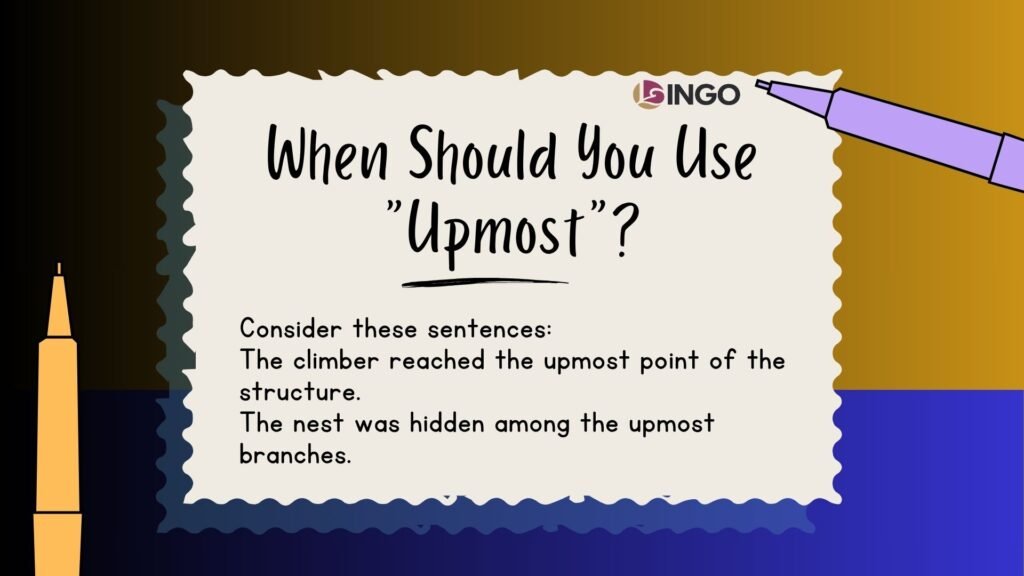
Consider these sentences:
The climber reached the upmost point of the structure.
The nest was hidden among the upmost branches.
The object was placed on the upmost shelf.
However, there is an important usage point: uppermost is generally preferred in contemporary English when describing the highest position. Merriam-Webster lists upmost as a synonym of uppermost, while Cambridge describes upmost as old-fashioned.
So, in polished writing, these are often better:
The books are on the uppermost shelf.
Snow covered the uppermost branches.
The apartment occupies the uppermost floor.
Don’t Confuse “Upmost” With “Uppermost”
The words are closely related, but uppermost is the more familiar modern choice.
Cambridge defines uppermost as being in the highest position and also notes that it can describe something having the most importance.
For example:
The uppermost floor has the best view.
Safety was uppermost in her mind.
This is different from the very common phrase:
Safety is of utmost importance.
The first sentence emphasizes what is highest in someone’s thoughts; the second emphasizes the greatest degree of importance.
Upmost vs Utmost: A Simple Comparison
| Word | Main meaning | Best use | Example |
|---|---|---|---|
| Utmost | Greatest or highest degree | Importance, effort, care, respect | “This is of utmost importance.” |
| Upmost | Highest physical position | Something located at the top | “The upmost branches were difficult to reach.” |
| Uppermost | Highest position or most prominent | Modern alternative to upmost | “The uppermost floor was closed.” |
| Topmost | Highest in position | Physical position | “The topmost shelf was dusty.” |
The key distinction is simple: utmost generally concerns degree, while upmost concerns position.
A Fast Decision Guide
Ask yourself:
- Am I talking about importance, effort, care, respect, or degree?
- Use utmost.
- Am I talking about something being physically at the top?
- Upmost can work, but uppermost is usually more natural.
- Am I writing a formal article, academic paper, business document, or professional email?
- Prefer utmost for “greatest” and uppermost/topmost for physical position.
This simple distinction eliminates most mistakes involving these words.
Real-World Usage Case Study: Why “Utmost” Is Usually the Right Choice
Consider the phrase “of utmost importance.” It appears frequently in formal, professional, academic, and public communication because utmost precisely communicates the idea of the highest possible level of importance.
Cambridge Dictionary specifically identifies “the utmost importance” as a standard collocation and provides examples showing how the phrase is used to emphasize that something is extremely important.
Merriam-Webster likewise identifies importance, concern, and respect among the words commonly modified by utmost. Its current dictionary examples include phrases such as “utmost concern” and “utmost priority.”
Now imagine editing a workplace announcement that says:
“Employee safety is of upmost importance.”
At first glance, the sentence may look reasonable because “up” suggests something high. However, the intended meaning is not that safety occupies a physical position at the top. The intended meaning is that safety has the greatest possible importance. Therefore, the appropriate correction is:
“Employee safety is of utmost importance.”
This illustrates why spelling alone is not enough. The word upmost visually resembles “up + most,” which can make it tempting to use whenever something is extremely important. Yet English usage distinguishes highest degree from highest position. When the meaning is “greatest,” utmost is the reliable choice.
2025–2026 Evidence Snapshot: What Current Dictionaries Show
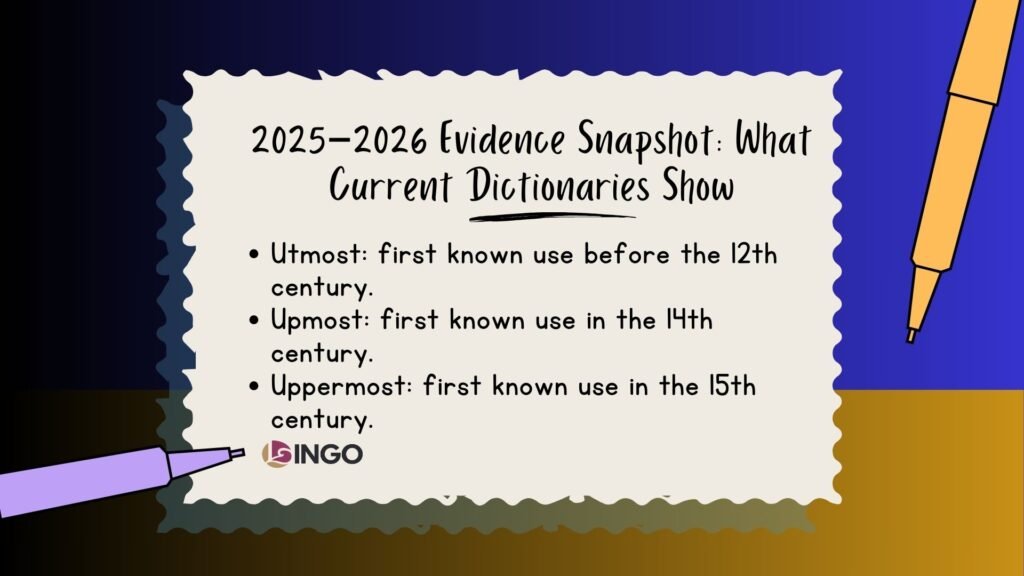
Current reference sources continue to support the distinction between these words.
Current Dictionary Evidence
As of 2026, Merriam-Webster defines utmost as meaning the greatest or highest degree, quantity, number, or amount. It also records upmost as meaning uppermost.
Cambridge Dictionary currently marks upmost as old-fashioned, while defining it as being in the highest position. By contrast, Cambridge defines utmost as emphasizing the greatest possible importance or seriousness and also uses it as a noun for the greatest possible amount or degree.
There is also useful historical data in the current Merriam-Webster entries:
- Utmost: first known use before the 12th century.
- Upmost: first known use in the 14th century.
- Uppermost: first known use in the 15th century.
A 2025 Merriam-Webster Word of the Day entry also defined utmost as describing something of the greatest or highest degree, number, or amount and illustrated the word with the familiar phrase “utmost importance.”
This current evidence matters because it shows that the distinction is not merely a matter of personal preference. Major English dictionaries continue to distinguish the meanings.
Common Mistakes With Upmost and Utmost
Mistake 1: “Upmost Importance”
❌ Your health is of upmost importance.
The intended meaning is “the greatest importance.”
✅ Your health is of utmost importance.
Mistake 2: “Utmost Shelf”
❌ The box is on the utmost shelf.
If you mean the shelf physically located at the top, utmost is not the natural choice.
✅ The box is on the uppermost shelf.
Mistake 3: Assuming “Up” Means “Most Important”
The spelling of upmost can make it seem logical to use it whenever something is extremely important. However, English vocabulary does not always work by combining the apparent meanings of individual letters or syllables.
For importance, use utmost:
Customer satisfaction is of utmost importance.
For physical position, use uppermost:
The documents are stored on the uppermost shelf.
Mistake 4: Using “Upmost” When “Uppermost” Sounds Better
Although upmost exists, it is uncommon and old-fashioned according to Cambridge.
For modern writing, uppermost is usually the safer choice when you mean “highest in position.”
Mini Quiz: Upmost vs Utmost
1. Your safety is of ____ importance to us.
A) Upmost
B) Utmost
C) Uppermost
D) Topmost
2. Which sentence uses utmost correctly?
A) The box is on the utmost shelf.
B) She showed the utmost respect.
C) The bird landed on the utmost branch.
D) He climbed to the utmost floor.
3. We handled the fragile equipment with ____ care.
A) Upmost
B) Uppermost
C) Utmost
D) Topmost
4. Which word means “highest in physical position”?
A) Utmost
B) Upmost
C) Ultimate
D) Extreme
5. The manager gave the issue his ____ attention.
A) Utmost
B) Upmost
C) Uppermost
D) Topmost
6. Which phrase is correct?
A) Of upmost importance
B) Of uppermost importance
C) Of utmost importance
D) Of topmost importance
7. Which sentence uses upmost in a positional sense?
A) Her safety was of upmost concern.
B) He showed upmost respect.
C) The nest was hidden among the upmost branches.
D) The project required upmost effort.
8. In “They did their utmost to help,” what does utmost mean?
A) Greatest possible effort
B) Highest physical location
C) Uppermost position
D) Final destination
9. Which modern word is generally preferred instead of upmost for the highest position?
A) Utmost
B) Uppermost
C) Maximum
D) Extreme
10. Which sentence is correct?
A) Customer trust is of utmost importance.
B) Customer trust is of upmost importance.
C) Customer trust is on utmost importance.
D) Customer trust is at utmost importance.
11. The climber reached the ____ point of the tower.
A) Utmost
B) Uppermost
C) Utmostly
D) Ultimate importance
12. Which phrase correctly describes a very high degree of caution?
A) Upmost caution
B) Uppermost caution
C) Utmost caution
D) Topmost caution
13. What is the safest choice when you mean “greatest possible”?
A) Utmost
B) Upmost
C) Uppermost
D) Topmost
14. Which sentence correctly uses “utmost respect”?
A) The professor is held in the utmost respect.
B) The professor is held in the upmost respect.
C) The professor is held on the utmost respect.
D) The professor is held at the utmost respect.
15. Which option correctly explains the difference?
A) Utmost = position; Upmost = importance
B) Utmost = greatest degree; Upmost = highest position
C) Utmost = lowest degree; Upmost = lowest position
D) Utmost and upmost always have identical meanings
16. Which sentence should be corrected to use utmost?
A) The flag flew from the uppermost pole.
B) The company places upmost importance on safety.
C) The books were on the uppermost shelf.
D) The bird rested on the topmost branch.
17. Which phrase refers to the greatest possible effort?
A) Do your utmost
B) Do your upmost
C) Do your uppermost
D) Do your topmost
18. We treated the complaint with ____ seriousness.
A) Upmost
B) Utmost
C) Uppermost
D) Topmost
19. Which option demonstrates the positional meaning associated with upmost?
A) She gave the matter upmost attention.
B) The uppermost window was open.
C) He showed upmost concern.
D) They made upmost effort.
20. Which sentence contains a common misuse of upmost?
A) The uppermost shelf was empty.
B) Safety is of upmost importance.
C) The topmost branch was broken.
D) The uppermost window was closed.
21. Please handle this document with the ____ care.
A) Utmost
B) Upmost
C) Uppermost
D) Topmost
22. Which sentence best describes the highest floor of a building?
A) The utmost floor has a balcony.
B) The uppermost floor has a balcony.
C) The utmost importance floor has a balcony.
D) The utmost effort floor has a balcony.
23. Her privacy is of ____ concern to the organization.
A) Upmost
B) Uppermost
C) Utmost
D) Topmost
24. A writer wants to say that something is “at the very top.” Which modern word is usually clearest?
A) Uppermost
B) Utmost
C) Utmost importance
D) Utmost effort
25. Final Challenge: Which sentence uses the words correctly?
A) Safety is of utmost importance, and the equipment is on the uppermost shelf.
B) Safety is of upmost importance, and the equipment is on the utmost shelf.
C) Safety is of uppermost importance, and the equipment is on utmost effort.
D) Safety is of topmost importance, and the equipment is on utmost respect.
Answer Key
- B | 2. B | 3. C | 4. B | 5. A
- C | 7. C | 8. A | 9. B | 10. A
- B | 12. C | 13. A | 14. A | 15. B
- B | 17. A | 18. B | 19. B | 20. B
- A | 22. B | 23. C | 24. A | 25. A
FAQs About Upmost vs Utmost
Is “upmost” a correct English word?
Yes. Upmost is a real English word meaning “uppermost” or “highest in position.” However, it is uncommon in contemporary English and is often used incorrectly in place of utmost.
Is it “utmost importance” or “upmost importance”?
The correct standard expression is “utmost importance.” It means the greatest possible importance.
Accuracy is of utmost importance.
Is “upmost” a synonym for “utmost”?
Not normally. Upmost means highest in position, while utmost usually means greatest or highest in degree or amount.
Which is correct: “utmost respect” or “upmost respect”?
Utmost respect is correct.
I have the utmost respect for my parents.
Here, utmost means the greatest possible degree of respect.
What is the difference between utmost and uppermost?
Utmost generally means greatest or highest in degree, while uppermost means highest in physical or figurative position.
This is of utmost importance.
The uppermost floor is closed.
Cambridge recognizes uppermost as the standard word for the highest position.
Is “upmost” old-fashioned?
Yes. Cambridge currently labels upmost as old-fashioned. In modern writing, uppermost or topmost is generally more natural when describing something at the top.
Can “utmost” be used as a noun?
Yes. For example:
We did our utmost to help.
In this sentence, utmost means the greatest effort possible. Cambridge also lists the expression “do your utmost.”
What is an easy trick to remember utmost vs upmost?
Remember:
Utmost = Ultimate degree
Upmost = Up/high position
If you mean greatest, choose utmost. If you mean at the top, think upmost/uppermost.
Conclusion: Upmost vs Utmost—Which One Should You Use?
The answer to “upmost vs utmost” becomes easy once you focus on meaning.
Use utmost when you mean the greatest, highest, or most extreme degree:
utmost importance
utmost care
utmost respect
utmost effort
Use upmost when you mean the highest physical position, although uppermost is usually the more natural modern choice.
The safest rule is:
Greatest degree = utmost. Highest position = uppermost.
Knowing this small distinction can make your emails, essays, articles, and professional writing more precise. If you are unsure, replace upmost with utmost when the sentence is about importance, effort, care, or degree.
For more clear explanations of commonly confused English words and grammar rules, explore the other language guides on Lingorixa.
References

Maimoona Asghar is a grammar enthusiast and language writer who creates clear, practical content to help learners improve English grammar, writing, punctuation, and communication skills through easy-to-understand explanations and examples.