
Have you ever stopped while writing an email or sentence because you weren’t sure whether to write “Here Is” or “Here Are”? You’re not alone. Both expressions are grammatically correct, but they serve different purposes.
The difference between here is and here are depends mainly on whether the noun being introduced is singular or plural. Use “here is” with singular and uncountable nouns, while “here are” generally goes with plural nouns.
For example:
- Here is your book.
- Here are your books.
Although this rule looks simple, certain sentence structures can make the choice confusing. In this guide, you’ll learn the difference between here is and here are, understand the grammar rules, explore everyday examples, and discover how to avoid common mistakes.
What Is the Difference Between Here Is and Here Are?
The main difference between here is and here are is subject-verb agreement. The verb must match the noun or subject being introduced.
“Here is” introduces one person, object, or thing. “Here are” introduces two or more people, objects, or things.
Consider these examples:
| Expression | When to Use It | Example |
|---|---|---|
| Here is | Singular noun | Here is your phone. |
| Here are | Plural noun | Here are your shoes. |
| Here is | Uncountable noun | Here is some information. |
| Here are | Multiple items | Here are the documents. |
When Should You Use Here Is?
Use here is when introducing one person, place, object, or thing.
Examples:
- Here is my sister.
- Here is the answer.
- Here is my new phone.
- Here is the information you requested.
- Here is a beautiful picture.
In each example, the expression introduces a singular or uncountable noun.
When Should You Use Here Are?
Use here are when introducing two or more countable items.
Examples:
- Here are your keys.
- Here are the students.
- Here are three important reasons.
- Here are the documents you requested.
- Here are my favorite books.
The plural nouns make “are” the appropriate verb.
When to Use Here Is or Here Are: Essential Grammar Rules
Understanding a few basic grammar rules will help you choose the correct expression without hesitation.
Rule 1: Use Here Is With Singular Nouns
A singular noun refers to one person, place, object, or idea. When introducing a singular noun, use “here is.”
Examples:
- Here is my sister.
- Here is the correct spelling.
- Here is your coffee.
- Here is an interesting story.
Incorrect: Here are my sister.
Correct: Here is my sister.
The noun “sister” refers to one person, so the singular verb “is” is required.
Rule 2: Use Here Are With Plural Nouns
Plural nouns refer to more than one person, place, object, or thing. Therefore, use “here are.”
Examples:
- Here are my friends.
- Here are the new employees.
- Here are your tickets.
- Here are five different options.
Incorrect: Here is my friends.
Correct: Here are my friends.
Because “friends” is plural, “are” is the correct choice.
Rule 3: Use Here Is With Uncountable Nouns
Uncountable nouns describe things that are not normally counted individually. They usually take singular verbs.
Examples include information, advice, furniture, water, money, and equipment.
Correct examples:
- Here is some useful advice.
- Here is the information you need.
- Here is your luggage.
- Here is the equipment for the project.
Incorrect: Here are some information.
Correct: Here is some information.
Remember that uncountable nouns can sometimes be measured or divided into units, but the nouns themselves generally take singular agreement.
Rule 4: Pay Attention to the Noun After the Expression
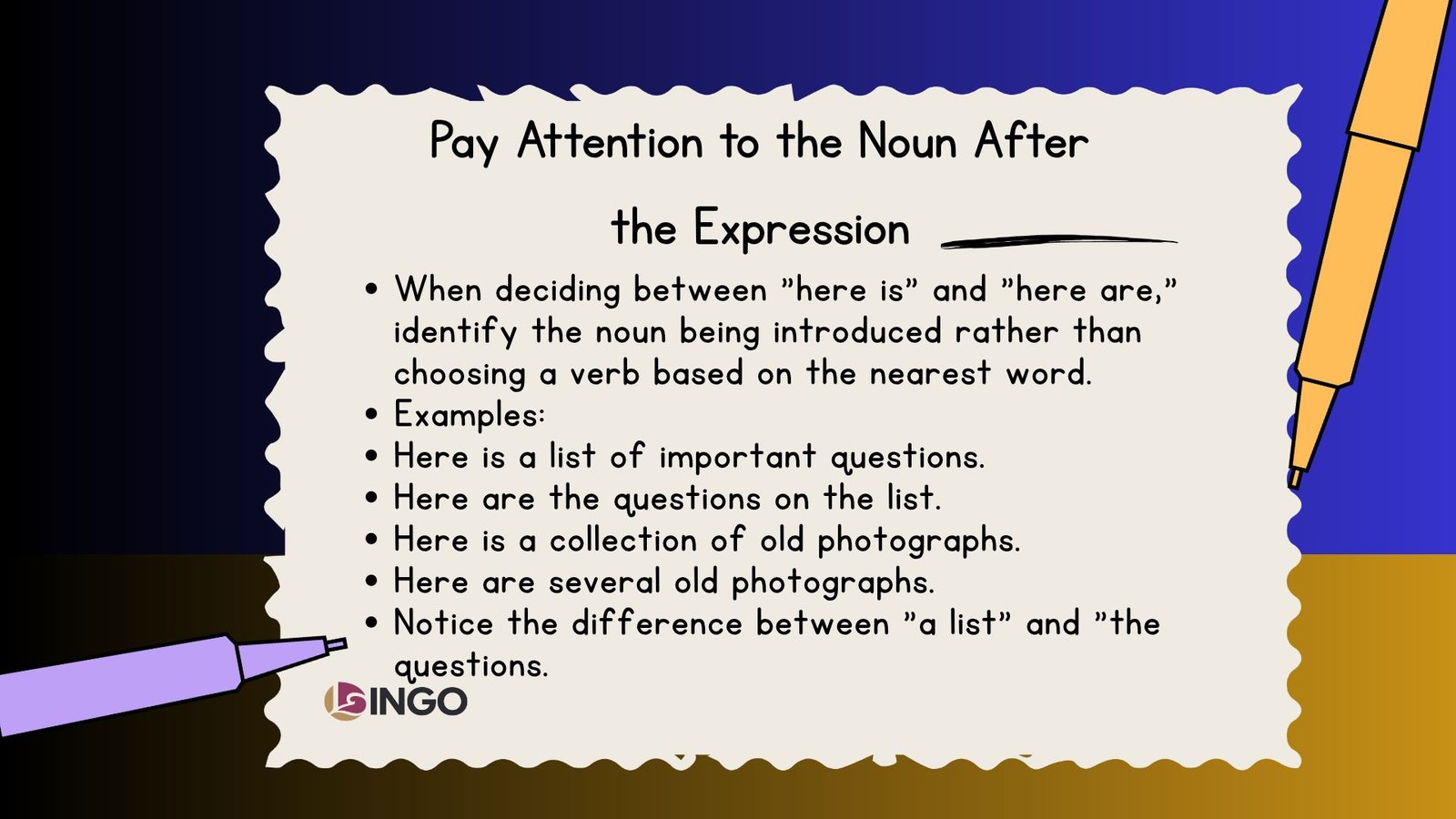
When deciding between “here is” and “here are,” identify the noun being introduced rather than choosing a verb based on the nearest word.
Examples:
- Here is a list of important questions.
- Here are the questions on the list.
- Here is a collection of old photographs.
- Here are several old photographs.
Notice the difference between “a list” and “the questions.” The noun being introduced determines the verb.
Here Is vs Here Are: Common Situations and Examples
Some situations make this grammar choice less obvious. Understanding how these expressions work in everyday communication will help you avoid mistakes.
Here Is or Here Are With Multiple Items
When introducing several separate items, use “here are.”
Examples:
- Here are your books and notebooks.
- Here are the files and folders.
- Here are my phone and charger.
However, if you introduce one combined collection or group, “here is” may be appropriate.
Examples:
- Here is a set of kitchen utensils.
- Here is a collection of travel photographs.
- Here is a box of chocolates.
The difference depends on the main noun being introduced.
Here Is or Here Are in Emails
Both expressions are common in professional and informal emails.
Use “here is” when sharing one document, link, or piece of information.
Examples:
- Here is the report you requested.
- Here is the link to our meeting.
- Here is the updated proposal.
Use “here are” when sharing several items.
Examples:
- Here are the meeting notes.
- Here are the requested documents.
- Here are the available appointment times.
Choosing the correct expression makes professional communication clearer and more polished.
Here Is or Here Are in Everyday Conversation
People use these expressions frequently when showing, sharing, or presenting something.
Examples:
- Here is your lunch.
- Here are your glasses.
- Here is the bus.
- Here are the children.
- Here is your change.
- Here are the pictures from our trip.
The same subject-verb agreement rule applies in both spoken and written English.
Common Mistakes to Avoid When Using Here Is and Here Are
Even experienced English speakers sometimes make mistakes with these expressions. Most errors happen because writers focus on the words immediately following the phrase instead of identifying the main noun.
Mistake 1: Using Here Is With Plural Nouns
Incorrect: Here is the documents.
Correct: Here are the documents.
“Documents” is plural, so the verb must also be plural.
Mistake 2: Using Here Are With Uncountable Nouns
Incorrect: Here are some advice.
Correct: Here is some advice.
“Advice” is an uncountable noun and normally takes a singular verb.
Mistake 3: Confusing a Group With Its Individual Members
Incorrect: Here are a collection of photographs.
Correct: Here is a collection of photographs.
The main noun is “collection,” which is singular. The plural noun “photographs” does not change the agreement.
Mistake 4: Choosing the Verb Based on the Nearest Noun
Incorrect: Here is the list of available options are.
Correct: Here is the list of available options.
The main noun is “list,” not “options.” Therefore, “is” is appropriate.
Real-Life Example: Choosing the Correct Expression in a Workplace Email
Imagine that an office manager needs to send an email to a colleague named Sarah. The email includes a project report, three meeting documents, and some additional information.
The manager initially writes:
“Here are the project report, the meeting documents, and the information you requested.”
At first glance, this sentence might seem reasonable because it introduces several things. However, the manager should examine the structure more carefully.
The sentence contains a mixture of singular, plural, and uncountable nouns. The most natural solution is to separate the information into two sentences:
“Here is the project report you requested. Here are the meeting documents and additional resources.”
This version is clearer because “the project report” is singular, while “the meeting documents and additional resources” refers to multiple items.
The example demonstrates why understanding the main noun matters. Instead of automatically choosing “here are” whenever a sentence contains several words or items, identify what the expression introduces.
In professional writing, small grammatical decisions can improve readability, reduce confusion, and make messages easier to understand.
Is There Any Difference Between Here Is and Here’s?
“Here’s” is the contracted form of “here is.” Both have the same basic meaning, but they are used differently depending on the sentence.
Examples:
- Here is your package.
- Here’s your package.
- Here is the answer.
- Here’s the answer.
In everyday conversation, English speakers frequently use “here’s” because it sounds natural and conversational.
Can You Use Here’s With Plural Nouns?
You may sometimes hear expressions such as:
- Here’s your keys.
- Here’s the documents.
- Here’s the results.
These constructions occur in informal speech, but they are generally not recommended in standard formal writing.
For standard grammar, prefer:
- Here are your keys.
- Here are the documents.
- Here are the results.
When writing professional emails, academic assignments, or formal documents, following standard subject-verb agreement is the safest choice.
Here Is or Here Are: Quick Comparison and Easy Checklist
If you still find these expressions confusing, use the following comparison table to remember the difference.
| Sentence | Correct or Incorrect |
|---|---|
| Here is my friend. | Correct |
| Here are my friends. | Correct |
| Here is your information. | Correct |
| Here are your information. | Incorrect |
| Here is the answer. | Correct |
| Here are the answers. | Correct |
| Here is a group of students. | Correct |
| Here are the students. | Correct |
| Here are my books. | Correct |
| Here is my books. | Incorrect |
A Simple Three-Step Method
Follow these steps whenever you are unsure which expression to use.
Step 1: Identify the main noun.
Look at the person, object, or thing you are introducing.
Step 2: Determine whether the noun is singular or plural.
Ask yourself whether you are talking about one item or multiple items. Also check whether the noun is uncountable.
Step 3: Choose the correct expression.
- Singular noun = Here is.
- Plural noun = Here are.
- Uncountable noun = Here is.
For example:
- Here is a notebook. (Singular)
- Here are two notebooks. (Plural)
- Here is some water. (Uncountable)
This simple method can help you make the correct choice in everyday writing and conversation.
Subject-Verb Agreement: What Grammar Resources Say
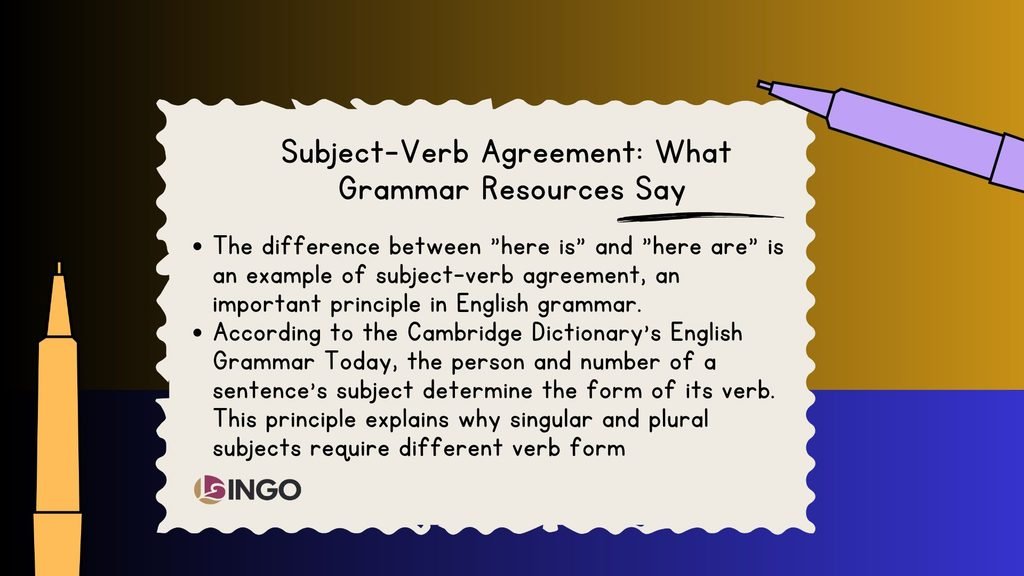
The difference between “here is” and “here are” is an example of subject-verb agreement, an important principle in English grammar.
According to the Cambridge Dictionary’s English Grammar Today, the person and number of a sentence’s subject determine the form of its verb. This principle explains why singular and plural subjects require different verb forms.
The British Council also explains that countable nouns have singular and plural forms. For example, one book becomes two books, and one student becomes several students.
What Do Recent Grammar Statistics Show?
There is an important distinction between grammar research and usage statistics.
As of November 2026, there is no reliable, widely recognized 2025–2026 statistic specifically measuring how frequently English writers confuse “here is” with “here are.”
Therefore, assigning a percentage to this particular mistake would be misleading.
However, established grammar resources continue to teach subject-verb agreement as a fundamental writing principle. Cambridge, the British Council, and Purdue OWL provide explanations of singular nouns, plural nouns, countable nouns, and uncountable nouns.
These resources support the practical rule used throughout this guide: identify the noun being introduced before choosing “is” or “are.”
Mini Quiz:Here Is or Here Are
1. _____ your new notebook.
A. Here are
B. Here is
C. Here am
D. Here be
Answer: B. Here is
2. _____ my favorite books.
A. Here is
B. Here am
C. Here are
D. Here be
Answer: C. Here are
3. _____ some useful information.
A. Here are
B. Here is
C. Here am
D. Here be
Answer: B. Here is
4. _____ the documents you requested.
A. Here is
B. Here am
C. Here are
D. Here be
Answer: C. Here are
5. _____ your brother.
A. Here are
B. Here is
C. Here am
D. Here be
Answer: B. Here is
6. _____ three reasons to learn English.
A. Here is
B. Here are
C. Here am
D. Here be
Answer: B. Here are
7. _____ some good advice for you.
A. Here are
B. Here be
C. Here is
D. Here am
Answer: C. Here is
8. _____ my new shoes.
A. Here is
B. Here are
C. Here am
D. Here be
Answer: B. Here are
9. _____ the answer to your question.
A. Here are
B. Here am
C. Here is
D. Here be
Answer: C. Here is
10. _____ the students waiting outside.
A. Here is
B. Here are
C. Here am
D. Here be
Answer: B. Here are
11. Which sentence is grammatically correct?
A. Here are my sister.
B. Here is my sister.
C. Here am my sister.
D. Here be my sister.
Answer: B. Here is my sister.
12. Which sentence is correct?
A. Here is the keys.
B. Here are the keys.
C. Here am the keys.
D. Here be the keys.
Answer: B. Here are the keys.
13. _____ a beautiful picture on the wall.
A. Here are
B. Here am
C. Here is
D. Here be
Answer: C. Here is
14. _____ my parents and grandparents.
A. Here is
B. Here are
C. Here am
D. Here be
Answer: B. Here are
15. _____ the equipment for the project.
A. Here are
B. Here is
C. Here am
D. Here be
Answer: B. Here is
16. Which expression is correct for multiple emails?
A. Here is the emails.
B. Here are the emails.
C. Here am the emails.
D. Here be the emails.
Answer: B. Here are the emails.
17. _____ a collection of old photographs.
A. Here are
B. Here is
C. Here am
D. Here be
Answer: B. Here is
18. _____ two bottles of water.
A. Here is
B. Here am
C. Here are
D. Here be
Answer: C. Here are
19. Which sentence is correct?
A. Here are some furniture.
B. Here is some furniture.
C. Here am some furniture.
D. Here be some furniture.
Answer: B. Here is some furniture.
20. _____ the results of the examination.
A. Here is
B. Here are
C. Here am
D. Here be
Answer: B. Here are
21. Which sentence is correct for a professional email?
A. Here are the report you requested.
B. Here is the report you requested.
C. Here am the report you requested.
D. Here be the report you requested.
Answer: B. Here is the report you requested.
22. _____ several options to choose from.
A. Here is
B. Here am
C. Here are
D. Here be
Answer: C. Here are
23. Which sentence uses the correct subject-verb agreement?
A. Here is my friends.
B. Here are my friends.
C. Here am my friends.
D. Here be my friends.
Answer: B. Here are my friends.
24. _____ the information about the meeting.
A. Here are
B. Here is
C. Here am
D. Here be
Answer: B. Here is
25. Choose the correct sentence.
A. Here are a list of grammar rules.
B. Here is a list of grammar rules.
C. Here am a list of grammar rules.
D. Here be a list of grammar rules.
Answer: B. Here is a list of grammar rules.
Frequently Asked Questions (FAQs)
Q1: Is It Here Is or Here Are?
Both expressions are grammatically correct. Use “here is” with singular and uncountable nouns, and “here are” with plural nouns.
Examples:
- Here is your bag.
- Here are your bags.
Q2: Is Here Is Singular or Plural?
“Here is” is used with singular nouns and uncountable nouns.
Examples:
- Here is my brother.
- Here is the information.
- Here is your breakfast.
Q3: Is Here Are Always Used for Plural Nouns?
In standard English, “here are” is generally used when introducing plural nouns.
Examples:
- Here are the students.
- Here are my shoes.
- Here are the available options.
Q4: Should I Say Here Is the Details or Here Are the Details?
The correct expression is “Here are the details.”
The word “details” is plural, so it requires the plural verb “are.”
Incorrect: Here is the details.
Correct: Here are the details.
Q5: Is It Here Is Some Information or Here Are Some Information?
The correct expression is “Here is some information.”
“Information” is an uncountable noun, so it takes a singular verb.
You can also say:
- Here are some important facts.
- Here are several pieces of information.
Q6: Can I Use Here Is in a Professional Email?
Yes. “Here is” is perfectly acceptable in professional emails when introducing a singular document, link, report, or piece of information.
Examples:
- Here is the updated report.
- Here is the requested document.
- Here is the meeting schedule.
For multiple documents, use “here are.”
Q7: Is Here’s Correct Grammar?
Yes. “Here’s” is the contraction of “here is.”
For example:
- Here’s your coffee.
- Here’s the information.
However, in formal writing, avoid using “here’s” with plural nouns when standard subject-verb agreement requires “here are.”
Conclusion: Here Is or Here Are?
Choosing between “here is” or “here are” becomes easy when you understand subject-verb agreement.
The main rule is simple: use “here is” when introducing a singular or uncountable noun, and use “here are” when introducing plural nouns.
Remember these examples:
- Here is your book.
- Here are your books.
- Here is some information.
- Here are the important details.
Always identify the main noun before choosing the verb. This small habit will help you avoid common grammar mistakes and make your English writing clearer and more professional.
Whether you’re writing emails, preparing assignments, creating blog posts, or having everyday conversations, using the correct expression will improve your communication.
For more clear explanations of commonly confused English words and grammar rules, explore the other language guides on Lingorixa.
References

Maimoona Asghar is a grammar enthusiast and language writer who creates clear, practical content to help learners improve English grammar, writing, punctuation, and communication skills through easy-to-understand explanations and examples.

