
Choosing between for me and for myself can be confusing, especially when both expressions seem natural in everyday conversation. You might hear someone say, “This gift is for me,” while another person says, “I bought this gift for myself.” Both expressions are correct, but they serve different grammatical purposes.
The main difference between for me and for myself is that me is an object pronoun, while myself is a reflexive pronoun. We use “for me” when referring to ourselves as the recipient or beneficiary of an action. We use “for myself” when the pronoun refers back to the subject “I” or adds emphasis to personal involvement.
Understanding this simple distinction will help you avoid common grammar mistakes and write more naturally. Let’s explore their meanings, rules, examples, and practical differences.
What Is the Difference Between For Me and For Myself?
The expressions for me and for myself are both grammatically correct. However, they are not interchangeable in every sentence.
“For me” uses the object pronoun me. It identifies the person receiving something or benefiting from an action.
“For myself” uses the reflexive pronoun myself. It generally refers back to the subject “I” or emphasizes that something is intended for your own use or benefit.
Consider these examples:
- This present is for me.
- I bought this present for myself.
In the first sentence, someone is giving you a present. In the second sentence, you are buying something for your own benefit.
Quick Comparison
| Expression | Grammatical Function | Example |
|---|---|---|
| For me | Object pronoun | She prepared lunch for me. |
| For myself | Reflexive pronoun | I prepared lunch for myself. |
The correct choice depends on the subject and meaning of your sentence.
When Should You Use For Me?
Use for me when you are talking about yourself as the recipient of an action, gift, service, or benefit.
The word me is the object form of the first-person singular pronoun “I.” It commonly follows prepositions such as for, to, with, and about.
You do not need to use “myself” simply because you are talking about yourself. In many situations, “me” is the natural and grammatically correct choice.
1. When Someone Does Something for You
Use “for me” when another person performs an action that benefits you.
Examples:
- My mother cooked dinner for me.
- Sarah bought a beautiful dress for me.
- My teacher explained the lesson for me.
- Could you save a seat for me?
- My friend completed the application for me.
In these sentences, someone else performs the action, and you receive the benefit.
2. When Expressing Your Personal Opinion
“For me” can also introduce your personal opinion, experience, or perspective.
Examples:
- For me, learning English is enjoyable.
- For me, honesty is more important than money.
- This decision is difficult for me.
- For me, this is the best solution.
Here, “for me” means from my point of view or according to my experience.
3. When Identifying the Recipient of Something
Use “for me” when something is intended for you or belongs to you as the recipient.
Examples:
- Is this package for me?
- There is a message for me.
- Someone left a cup of coffee for me.
- This invitation is for me.
These sentences identify who should receive something.
When Should You Use For Myself?
Use for myself when you are referring back to the subject “I” or emphasizing that something is intended for your own benefit.
“Myself” is a reflexive pronoun. Reflexive pronouns refer back to the person or thing performing the action.
For example:
“I made breakfast for myself.”
The subject is “I,” and the person receiving the breakfast is the same person. Therefore, “myself” is appropriate.
1. When You Do Something for Your Own Benefit
Use “for myself” when you perform an action for your personal benefit.
Examples:
- I bought a new laptop for myself.
- I prepared a healthy meal for myself.
- I reserved a hotel room for myself.
- I made some extra time for myself.
- I saved a little money for myself.
In each example, the subject “I” and the person benefiting from the action are the same.
2. When You Want to Emphasize Personal Responsibility
“Myself” can emphasize that you personally completed an action without relying on another person.
Examples:
- I completed the entire project myself.
- I organized the event myself.
- I wrote the report myself.
- I repaired the computer myself.
This use highlights personal involvement or responsibility.
3. When You Mean Alone or Without Assistance
The expression “by myself” commonly means alone or without anyone’s help.
Examples:
- I live by myself.
- I completed the assignment by myself.
- I traveled to London by myself.
- I learned to cook by myself.
Although “by myself” and “for myself” are different expressions, both contain the reflexive pronoun “myself.”
For Me vs For Myself: Grammar Rules and Examples
Understanding the grammatical roles of me and myself makes choosing between them much easier.
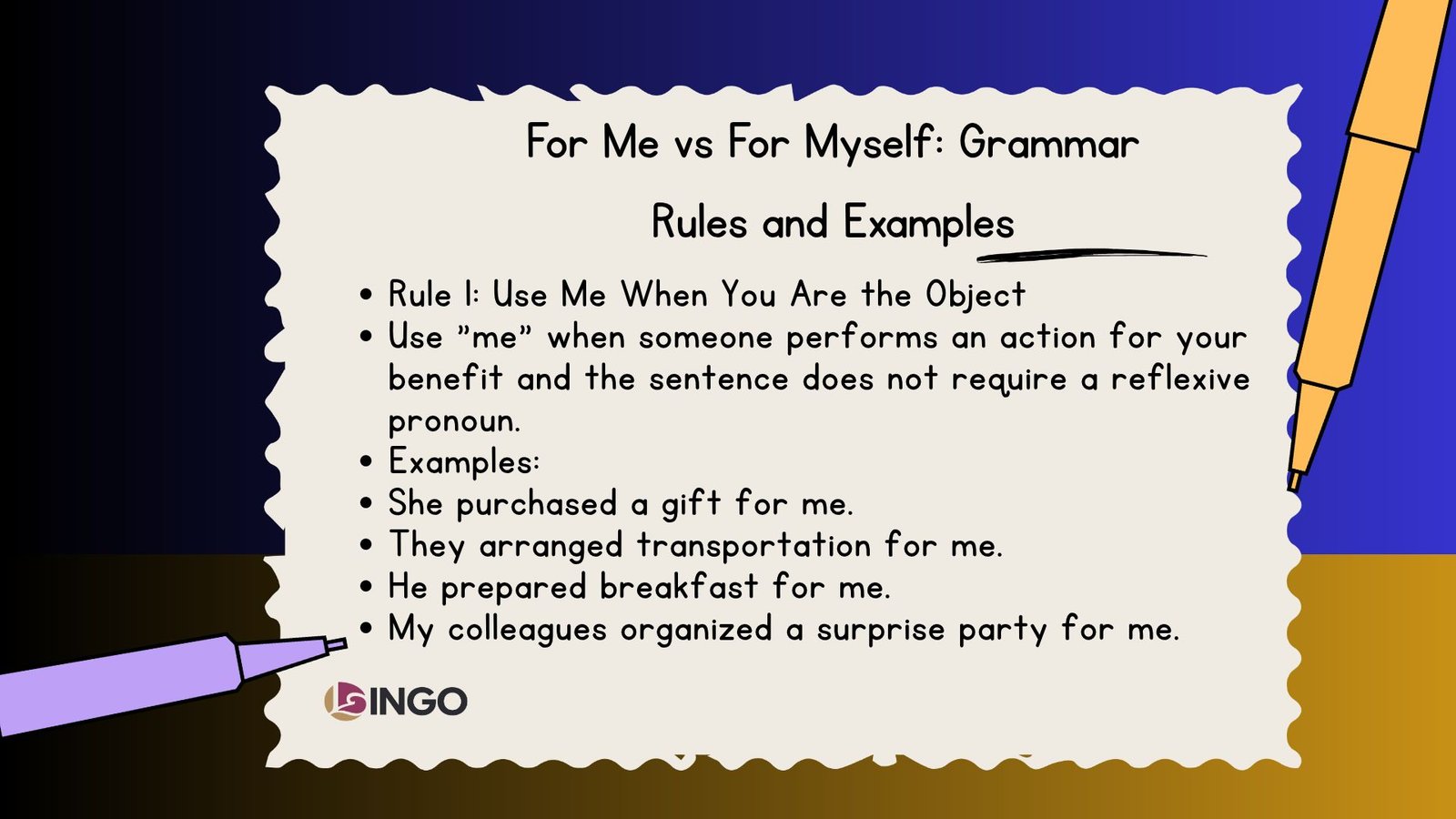
Rule 1: Use Me When You Are the Object
Use “me” when someone performs an action for your benefit and the sentence does not require a reflexive pronoun.
Examples:
- She purchased a gift for me.
- They arranged transportation for me.
- He prepared breakfast for me.
- My colleagues organized a surprise party for me.
These sentences are correct because you are the recipient of someone else’s action.
Rule 2: Use Myself When the Subject and Object Refer to the Same Person
Use “myself” when the subject “I” performs an action that affects or benefits the same person.
Examples:
- I bought a gift for myself.
- I made a cup of tea for myself.
- I prepared dinner for myself.
- I created a study schedule for myself.
The subject and recipient are the same person.
Rule 3: Use Myself for Emphasis
You can also use “myself” to emphasize your personal involvement.
Examples:
- I will handle this matter myself.
- I personally checked the documents myself.
- I completed the assignment myself.
This construction makes it clear that you personally performed the action.
Rule 4: Do Not Use Myself as a Replacement for Me
One common mistake is using “myself” because it sounds more formal or professional.
Incorrect: Please send the documents to myself.
Correct: Please send the documents to me.
Incorrect: She invited myself to the meeting.
Correct: She invited me to the meeting.
The subject of these sentences is not “I,” so there is no reason to use the reflexive pronoun “myself.”
For Me or For Myself: Comparison Table
The following table explains when to use each expression in everyday English.
| Situation | Correct Expression | Example |
|---|---|---|
| Someone gives you something | For me | This book is for me. |
| You buy something for your own use | For myself | I bought this book for myself. |
| Someone prepares food for you | For me | She cooked dinner for me. |
| You prepare food for yourself | For myself | I cooked dinner for myself. |
| Expressing an opinion | For me | For me, English is interesting. |
| Doing something personally | Myself | I completed the work myself. |
| Receiving an invitation | For me | Is this invitation for me? |
| Making personal arrangements | For myself | I made arrangements for myself. |
A Simple Way to Remember
Ask yourself one question:
Am I talking about myself as the recipient, or am I referring back to myself as the subject?
- If you are simply the recipient, use me.
- If you are referring back to the subject “I,” use myself.
- If you want to emphasize personal involvement, you can also use myself.
This simple test will help you make the right choice in most everyday situations.
Real-Life Example: Choosing Between For Me and For Myself
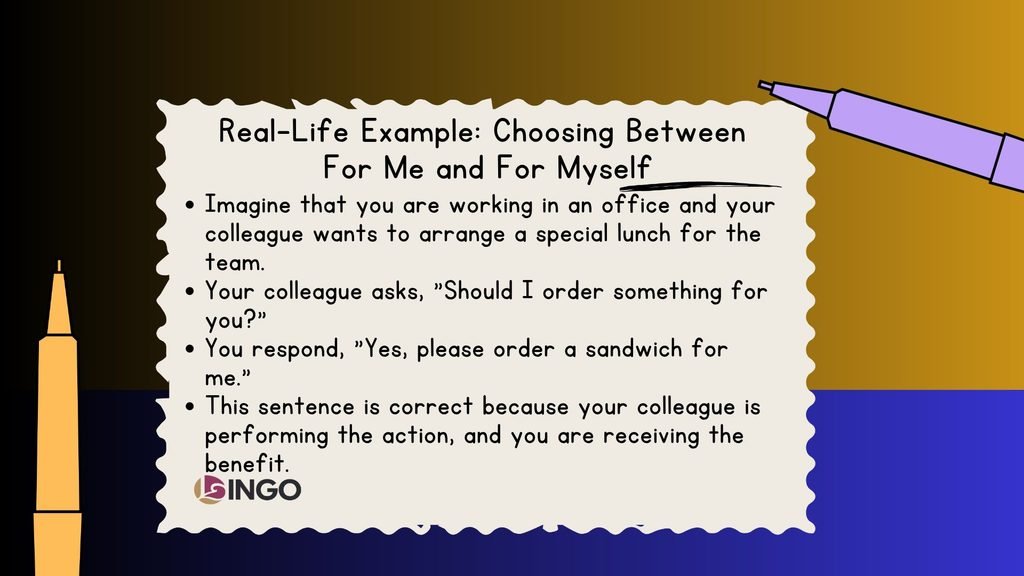
Imagine that you are working in an office and your colleague wants to arrange a special lunch for the team.
Your colleague asks, “Should I order something for you?”
You respond, “Yes, please order a sandwich for me.”
This sentence is correct because your colleague is performing the action, and you are receiving the benefit.
Later, you decide to prepare your own lunch for the following day. You might say:
“I prepared a sandwich for myself because I wanted to save money.”
This sentence is also correct. You are the person preparing the sandwich, and you are also the person who will eat it.
Now imagine that your manager asks who completed an important presentation. You can respond:
“I completed the presentation myself.”
Here, “myself” emphasizes that you personally completed the task.
These three situations demonstrate why choosing the correct expression depends on the grammatical structure and intended meaning.
A similar distinction appears in other everyday situations:
- My friend bought a coffee for me.
- I bought a coffee for myself.
- I made the coffee myself.
Although these sentences discuss the same person, each one communicates a slightly different idea.
The best way to develop confidence is to pay attention to who performs the action, who receives the benefit, and whether you want to emphasize personal involvement.
Common Mistakes When Using For Me and For Myself
Even experienced English speakers sometimes confuse object pronouns and reflexive pronouns. Here are some mistakes to avoid.
Mistake 1: Using Myself to Sound More Formal
Incorrect: Please contact myself if you have any questions.
Correct: Please contact me if you have any questions.
“Myself” does not automatically make a sentence more professional. In standard English, “me” is the appropriate object pronoun here.
Mistake 2: Using Me When a Reflexive Pronoun Is Needed
Incorrect: I bought a birthday present for me.
Correct: I bought a birthday present for myself.
The first sentence can occur in certain contexts, but when you mean that you bought something for your own benefit, “myself” is the natural choice.
Mistake 3: Confusing For Myself With By Myself
These expressions have different meanings.
- I bought a laptop for myself. (The laptop is intended for my use.)
- I completed the task by myself. (I completed it without assistance.)
Do not use them interchangeably.
Mistake 4: Using Myself as the Subject
Incorrect: Myself will attend the meeting.
Correct: I will attend the meeting myself.
“Myself” cannot normally replace “I” as the subject of a sentence. Use “I” as the subject and add “myself” when emphasis is needed.
What Do Grammar References Say? 2025–2026 Evidence
The distinction between “me” and “myself” is based on established English grammar rules rather than a newly introduced language trend.
The Cambridge English Grammar Today reference explains that reflexive pronouns refer back to subject forms of personal pronouns. It also describes their use for emphasis and when an action is performed without assistance.
The British Council’s English grammar reference provides similar guidance. It explains that reflexive pronouns are appropriate when the subject and object refer to the same person. It also distinguishes expressions such as “by myself” from ordinary object-pronoun constructions.
The Chicago Manual of Style further explains that reflexive pronouns can correctly follow prepositions when they refer back to the subject of the sentence.
An important statistical clarification: There is no established, authoritative 2025–2026 statistic measuring how often English speakers choose “for me” instead of “for myself” specifically. Therefore, presenting a percentage or claiming one expression is more popular based on an annual survey would be misleading.
Instead, the reliable evidence comes from established grammar references and their consistent explanations of reflexive and object pronouns.
For accurate usage, consult:
- Cambridge Dictionary – Reflexive Pronouns.
- British Council – Reflexive Pronouns.
- The Chicago Manual of Style – Pronouns.
Mini Quiz:For Me or For Myself
1. She bought a beautiful gift ______.
A. For me
B. For myself
Answer: A. For me
2. I prepared breakfast ______.
A. For me
B. For myself
Answer: B. For myself
3. Is this letter ______?
A. For me
B. For myself
Answer: A. For me
4. I decided to buy a new phone ______.
A. For me
B. For myself
Answer: B. For myself
5. My friend saved a seat ______.
A. For me
B. For myself
Answer: A. For me
6. I made a cup of coffee ______.
A. For me
B. For myself
Answer: B. For myself
7. Could you please bring some water ______?
A. For me
B. For myself
Answer: A. For me
8. I want to make more time ______.
A. For me
B. For myself
Answer: B. For myself
9. My teacher explained the topic ______.
A. For me
B. For myself
Answer: A. For me
10. I bought a birthday cake ______.
A. For me
B. For myself
Answer: B. For myself
11. Someone left a message ______.
A. For me
B. For myself
Answer: A. For me
12. I prepared a healthy meal ______.
A. For me
B. For myself
Answer: B. For myself
13. Is there a package ______?
A. For me
B. For myself
Answer: A. For me
14. I reserved a hotel room ______.
A. For me
B. For myself
Answer: B. For myself
15. My sister ordered lunch ______.
A. For me
B. For myself
Answer: A. For me
16. I saved some money ______.
A. For me
B. For myself
Answer: B. For myself
17. He wrote a special note ______.
A. For me
B. For myself
Answer: A. For me
18. I created a personal study schedule ______.
A. For me
B. For myself
Answer: B. For myself
19. This invitation is ______.
A. For me
B. For myself
Answer: A. For me
20. I purchased a laptop ______.
A. For me
B. For myself
Answer: B. For myself
21. My colleague arranged transportation ______.
A. For me
B. For myself
Answer: A. For me
22. I decided to cook dinner ______.
A. For me
B. For myself
Answer: B. For myself
23. She brought some flowers ______.
A. For me
B. For myself
Answer: A. For me
24. I bought some new clothes ______.
A. For me
B. For myself
Answer: B. For myself
25. My parents organized a surprise party ______.
A. For me
B. For myself
Answer: A. For me
Frequently Asked Questions (FAQs)
Q1: Is It Correct to Say For Me or For Myself?
Both expressions are grammatically correct, but they have different uses. Use “for me” when referring to yourself as the recipient or beneficiary. Use “for myself” when referring back to the subject “I.”
Q2: Should I Say This Is for Me or This Is for Myself?
“This is for me” is the standard and natural expression when identifying yourself as the recipient of something.
For example: “This birthday present is for me.”
“Myself” would generally be unnecessary in this construction because there is no appropriate subject reference requiring a reflexive pronoun.
Q3: Is For Myself Grammatically Correct?
Yes. “For myself” is grammatically correct when the reflexive pronoun refers back to the subject “I.”
Example: “I saved some money for myself.”
Q4: Can I Use Myself Instead of Me?
Not in every situation. “Myself” is a reflexive or intensive pronoun, while “me” is an object pronoun.
For example:
- Correct: She called me.
- Incorrect: She called myself.
Use “me” when the sentence requires an ordinary object pronoun.
Q5: Is It Correct to Say I Did It for Myself?
Yes. This is a completely correct sentence.
It means that you performed an action for your own benefit or personal reasons.
Example: “I started exercising because I wanted to do something positive for myself.”
Q6: What Is the Difference Between For Myself and By Myself?
“For myself” means something is intended for your own benefit or use.
Example: “I purchased a new phone for myself.”
“By myself” means alone or without assistance.
Example: “I completed the project by myself.”
Q7: Is For Me More Natural Than For Myself?
It depends on the sentence. “For me” is natural when you are the recipient of something. “For myself” is natural when you are referring back to the subject “I.”
Neither expression is universally better than the other.
Q8: Can I Start a Sentence With For Me?
Yes. You can start a sentence with “For me” when expressing a personal opinion or perspective.
Example: “For me, spending time with family is extremely important.”
This is a natural and grammatically correct construction.
Conclusion: For Me or For Myself – Which One Should You Choose?
The difference between for me and for myself becomes simple once you understand their grammatical functions.
Use “for me” when you are talking about yourself as the recipient of an action, gift, or benefit. Use “for myself” when the reflexive pronoun refers back to the subject “I” or emphasizes that something is intended for your own benefit.
Remember these examples:
- She bought a present for me.
- I bought a present for myself.
- I wrapped the present myself.
All three sentences are correct because each expression has a different grammatical purpose.
The best way to improve your English is to practice these expressions in everyday conversations and writing.
For more clear explanations of commonly confused English words and grammar rules, explore the other language guides on Lingorixa.
References
Read the Cambridge Dictionary article

Maimoona Asghar is a grammar enthusiast and language writer who creates clear, practical content to help learners improve English grammar, writing, punctuation, and communication skills through easy-to-understand explanations and examples.

