
Have you ever paused while writing the word lying and wondered whether it should be spelled lieing instead? You’re not alone. This spelling confusion is common because English has several unusual rules for adding endings to verbs.
So, when choosing between lieing or lying, the correct spelling is lying. The word lieing is a misspelling in standard English.
Whether you’re talking about someone telling an untruth or describing a person resting horizontally, the spelling remains the same: lying.
In this guide, you’ll learn why lying is correct, how the spelling rule works, what the word means, and how to use it correctly in everyday conversations and professional writing.
Is It Lieing or Lying? The Correct Spelling Explained
The correct spelling is lying, not lieing. It is the present participle of the verb lie, formed by changing the final letters ie into y before adding -ing.
For example:
- Correct: She is lying on the sofa.
- Incorrect: She is lieing on the sofa.
- Correct: He is lying about what happened.
- Incorrect: He is lieing about what happened.
Both examples demonstrate the same spelling rule.
The word lying has two common meanings:
- Resting or reclining: Being in a horizontal position.
- Telling an untruth: Saying something false with the intention to deceive.
Although the meanings differ, the spelling does not change.
Why Is Lying the Correct Form?
English has a specific spelling rule for verbs ending in -ie. When adding the suffix -ing, the final ie changes to y.
The pattern looks like this:
- Lie + ing = Lying
- Die + ing = Dying
- Tie + ing = Tying
Therefore, writing lieing ignores the standard spelling rule.
Is Lieing Ever an Accepted Spelling?
No. In standard modern English, lieing is not an accepted spelling.
You may occasionally encounter it in informal online writing, social media posts, or spelling mistakes. However, dictionaries recognize lying as the correct present participle of lie.
For school assignments, professional emails, articles, and other formal writing, always use lying.
Understanding the Spelling Rule: Why Lie Becomes Lying
One reason people write lieing is that they assume adding -ing is always as simple as attaching the suffix to the original verb.
However, English spelling has several patterns that change the appearance of words when suffixes are added.
The ie-to-y rule is one of them.
The IE-to-Y Spelling Rule
When a verb ends in -ie, replace those two letters with y before adding -ing.
Here are some examples:
| Base Verb | Correct -ing Form |
|---|---|
| Lie | Lying |
| Die | Dying |
| Tie | Tying |
This pattern makes the spelling easier to understand once you recognize it.
More Examples of Similar Spelling Changes
Consider these sentences:
- The plant is dying because it needs water.
- She is tying her shoelaces.
- The baby is lying in the crib.
Notice how the original ie changes to y in every example.
However, not every verb ending in the letter y follows this pattern.
For instance:
- Cry → Crying
- Try → Trying
- Study → Studying
- Play → Playing
These words already end in y, so the letter stays unchanged when adding -ing.
A Simple Way to Remember the Rule

Remember this easy formula:
IE + ING = YING
Whenever you see a verb ending in -ie, change ie to y before adding -ing.
For example:
- Lie → Lying
- Die → Dying
- Tie → Tying
This simple memory trick can help you avoid common spelling errors.
What Does Lying Mean? Understanding Its Two Main Uses
The word lying has two major meanings in everyday English. Understanding the difference helps you identify its meaning from the context of a sentence.
1. Lying Means Resting or Being in a Horizontal Position
The first meaning describes someone or something positioned horizontally, usually on a bed, floor, sofa, or another surface.
For example:
- My brother is lying on the bed.
- The cat is lying under the table.
- She was lying on the beach when I called her.
- The book is lying on the kitchen counter.
In these examples, lying describes a physical position rather than dishonesty.
2. Lying Means Telling Something Untrue
The second meaning refers to deliberately saying something false to deceive another person.
For example:
- He is lying about his age.
- Stop lying to your parents.
- I know she is lying about what happened.
- The witness was lying during the interview.
In these sentences, lying describes dishonest behavior.
How Can You Identify the Correct Meaning?
Look at the surrounding words and the situation.
If the sentence describes someone resting, sleeping, or being positioned somewhere, lying refers to physical placement.
If the sentence involves honesty, truth, excuses, or deception, it refers to telling an untruth.
The spelling remains identical in both situations.
Lieing vs Lying: Comparison Table and Common Mistakes
A quick comparison makes the difference easy to remember.
| Feature | Lieing | Lying |
|---|---|---|
| Spelling status | Incorrect | Correct |
| Dictionary recognition | Not standard | Standard English |
| Grammar role | Incorrect formation | Present participle |
| Meaning | No standard meaning | Resting or telling an untruth |
| Example | She is lieing. | She is lying. |
Common Mistakes to Avoid
Even though lying is a simple word, it is often confused with other verb forms.
Here are some mistakes worth remembering:
Mistake 1: Writing Lieing Instead of Lying
Incorrect: He is lieing on the couch.
Correct: He is lying on the couch.
Mistake 2: Confusing Lying With Laying
Incorrect: She is laying on the floor.
Correct: She is lying on the floor.
When describing someone resting horizontally, lying is generally the correct choice.
Mistake 3: Confusing Lying With Lied
Incorrect: Yesterday, he was lied about his results.
Correct: Yesterday, he lied about his results.
Lied is the past tense of lie when it means telling an untruth.
Mistake 4: Using Lieing in Professional Writing
Incorrect: The employee was lieing about the report.
Correct: The employee was lying about the report.
Always proofread words with unusual spelling patterns before submitting important documents.
Real-Life Example: How One Small Spelling Mistake Changes Your Writing
Imagine a university student named Sarah who is preparing an English assignment about honesty and communication.
While writing her introduction, she types the following sentence:
“People sometimes start lieing when they are afraid of the consequences of telling the truth.”
Sarah reads the sentence several times but doesn’t notice anything unusual. Her word processor also fails to highlight the error immediately.
Later, her teacher reviews the assignment and points out that lieing is incorrect. Sarah initially feels confused because she knows that the original verb is lie and assumes that adding -ing should produce lieing.
Her teacher explains the ie-to-y spelling rule and gives her three examples:
- Lie → Lying
- Die → Dying
- Tie → Tying
Sarah realizes that the final ie changes to y before the -ing suffix is added.
She corrects her sentence:
“People sometimes start lying when they are afraid of the consequences of telling the truth.”
The corrected version looks more professional and follows standard English spelling conventions.
Sarah also notices another important detail. The word lying can describe both dishonesty and physical positioning. For example, “She is lying on the sofa” describes someone’s position, while “She is lying about her results” describes dishonesty.
This experience teaches Sarah that spelling rules are not simply about memorizing individual words. Understanding how suffixes work makes it easier to spell many other English words correctly.
The lesson applies to students, bloggers, professional writers, and anyone who wants to communicate clearly.
2025–2026 Spelling and Grammar Insights: What the Reference Data Shows
English spelling rules remain important in 2025 and 2026, particularly for students, digital writers, and people learning English as a second language.
However, there is no reliable, widely published 2025–2026 statistic specifically measuring how often people misspell lying as lieing. It would be misleading to invent a percentage or claim that one spelling error has a verified search frequency.
Instead, established dictionary and educational references provide useful evidence about the correct spelling.
What Established Grammar References Confirm
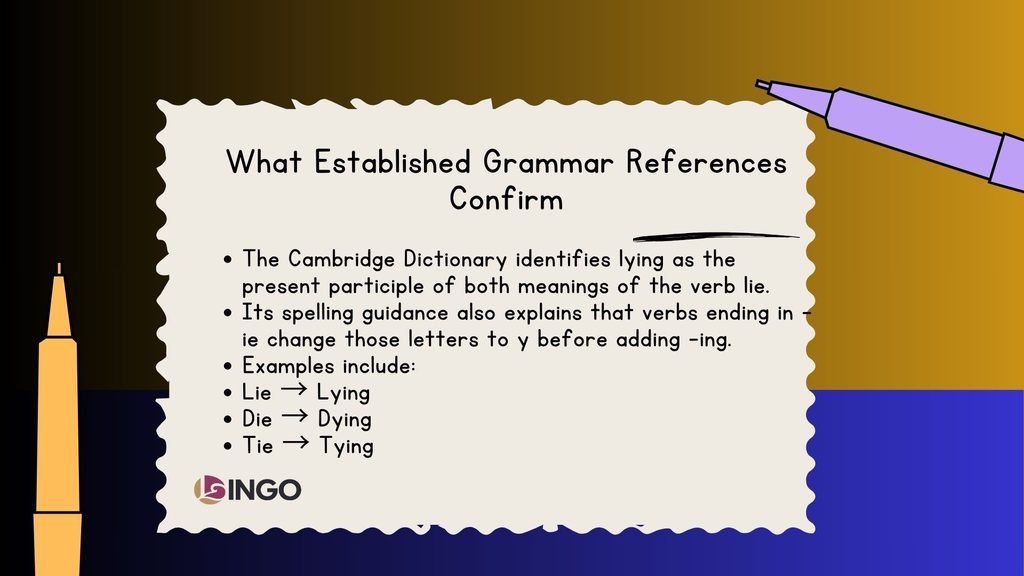
The Cambridge Dictionary identifies lying as the present participle of both meanings of the verb lie.
Its spelling guidance also explains that verbs ending in -ie change those letters to y before adding -ing.
Examples include:
- Lie → Lying
- Die → Dying
- Tie → Tying
The Cambridge grammar guide provides a clear explanation of this spelling pattern.
Purdue University’s Online Writing Lab (OWL) also emphasizes the importance of recognizing spelling patterns and checking confusing letter combinations during proofreading.
Why These Findings Matter for Modern Writers
In modern digital communication, spelling mistakes can affect how readers understand and evaluate written content.
For example:
- Students need correct spelling in academic assignments.
- Bloggers should maintain consistent spelling throughout published articles.
- Professionals should proofread emails and reports.
- English learners benefit from understanding spelling patterns rather than memorizing individual words.
A dictionary check and a basic understanding of suffix rules can prevent unnecessary mistakes.
The main takeaway for 2025–2026 is simple: lying is the standard spelling, and lieing should be avoided in all forms of standard English writing.
Mini Quiz:Lieing or Lying
Choose the correct answer for each question.
1. Which spelling is correct?
- A) Lieing
- B) Lying
- C) Liying
- D) Lyeing
2. What is the present participle of “lie”?
- A) Lied
- B) Lay
- C) Lying
- D) Lieing
3. Is “lieing” an accepted standard English spelling?
- A) Yes
- B) No
4. Choose the correct sentence.
- A) She is lying on the sofa.
- B) She is lieing on the sofa.
- C) She is lay on the sofa.
- D) She is lied on the sofa.
5. What happens to “ie” when adding “-ing” to “lie”?
- A) It stays unchanged.
- B) It changes to “y.”
- C) It changes to “e.”
- D) It is doubled.
6. Which word follows the same spelling rule as “lying”?
- A) Playing
- B) Running
- C) Dying
- D) Walking
7. Complete the sentence: He is _____ about his age.
- A) Lieing
- B) Lying
- C) Layed
- D) Lied
8. Which verbs change “ie” to “y” before adding “-ing”? (Select all that apply.)
- A) Lie
- B) Die
- C) Tie
- D) Play
9. Which sentence uses “lying” to describe dishonesty?
- A) The dog is lying near the door.
- B) The child is lying under the blanket.
- C) The witness is lying about the incident.
- D) The book is lying on the desk.
10. What is the past tense of “lie” when it means telling an untruth?
- A) Lay
- B) Lied
- C) Lying
- D) Layed
11. True or False: In “The baby is lying in the crib,” lying describes the baby’s physical position.
12. What is the correct “-ing” form of “tie”?
- A) Tieing
- B) Tying
- C) Tiying
- D) Tieding
13. Choose the correct sentence.
- A) I was lieing on the grass.
- B) I was laying on the grass.
- C) I was lying on the grass.
- D) I was lied on the grass.
14. What does “lying” mean in “Stop lying to your friends”?
- A) Resting horizontally
- B) Telling something untrue
- C) Sleeping quietly
- D) Moving slowly
15. Complete the sentence: The plant is _____ because it lacks water.
- A) Dieing
- B) Dying
- C) Died
- D) Dyeing
16. Which sentences use “lying” correctly? (Select all that apply.)
- A) He is lying about his homework.
- B) The cat is lying beside the window.
- C) She is lieing on her bed.
- D) They are lay on the floor.
17. Complete the sentence: Yesterday, she _____ on the beach.
- A) Lay
- B) Lied
- C) Lying
- D) Lieing
18. Which sentence contains a spelling mistake?
- A) She is tying her shoes.
- B) He is dying.
- C) The man is lieing to his boss.
- D) The child is crying loudly.
19. What is the present participle of “lie” when it means to recline?
- A) Lied
- B) Lay
- C) Lying
- D) Laid
20. Which phrase is correctly spelled?
- A) A lieing person
- B) A lying person
- C) A liying person
- D) A lyeing person
21. Complete the sentence: The documents were _____ on the table.
- A) Lieing
- B) Lying
- C) Lied
- D) Layed
22. Which suffix is added after changing “ie” to “y” in “lying”?
- A) -ed
- B) -er
- C) -ing
- D) -est
23. Choose the correct sentence.
- A) He lay about his age.
- B) He lied about his age.
- C) He lying about his age.
- D) He lieing about his age.
24. Why is “lieing” incorrect?
- A) It uses the wrong tense.
- B) It ignores the ie-to-y spelling rule.
- C) It changes the meaning completely.
- D) It uses an unnecessary prefix.
25. Complete the sentence: I caught him _____ about the missing money.
- A) Lieing
- B) Lying
- C) Lay
- D) Layed
Frequently Asked Questions About Lieing or Lying
Q1: Is It Lieing or Lying?
Lying is the correct spelling. Lieing is a common spelling mistake. When adding -ing to a verb ending in -ie, change ie to y first.
Q2: Why Is Lying Spelled With a Y?
The word follows the English ie-to-y spelling rule. The final ie in lie changes to y before the suffix -ing is added.
Therefore, lie + ing becomes lying.
Q3:Is Lieing a Real Word?
No. Lieing is not a standard English word. The accepted spelling is lying, whether it describes resting horizontally or telling something untrue.
Q4: What Is the Present Participle of Lie?
The present participle of lie is lying.
Examples:
- She is lying on the grass.
- He is lying about his qualifications.
Q5: Is Lying the Same as Lay?
No. Although these words are related, they have different grammatical uses.
- Lie: To rest or be positioned horizontally.
- Lying: The present participle of lie.
- Lay: The past tense of lie when describing a horizontal position, or the present tense of lay when meaning to put something down.
For example:
- I lie on the bed every evening.
- I was lying on the bed.
- Yesterday, I lay on the bed.
Q6: What Is the Past Tense of Lying?
The past tense depends on the meaning of the original verb.
When lie means to tell something untrue, its past tense is lied.
Example: He lied about his age.
When lie means to rest horizontally, its past tense is lay.
Example: She lay on the sofa yesterday.
Q7: What Are Some Words That Follow the Same Rule as Lying?
Several English verbs follow the same ie-to-y spelling pattern when adding -ing.
Examples include:
- Die → Dying
- Tie → Tying
- Lie → Lying
Remembering these examples makes the spelling rule easier to apply.
Conclusion: Lieing or Lying—Which One Should You Use?
When choosing between lieing or lying, always use lying. It is the correct present participle of the verb lie, whether you’re describing someone resting horizontally or someone telling an untruth.
The reason is simple: English changes the final ie to y before adding the -ing suffix.
Remember these three examples:
- Lie → Lying
- Die → Dying
- Tie → Tying
Understanding this small spelling rule can improve your everyday writing, academic assignments, professional communication, and published content.
For more clear explanations of commonly confused English words and grammar rules, explore the other language guides on Lingorixa.
References

Maimoona Asghar is a grammar enthusiast and language writer who creates clear, practical content to help learners improve English grammar, writing, punctuation, and communication skills through easy-to-understand explanations and examples.

