Have you ever wondered whether to write shinning or shining when describing sunlight, stars, or something bright? These two words look almost identical, so it is easy to confuse them. However, the extra letter n changes the word’s meaning.
In the comparison of shinning vs shining, shining is the correct spelling when you mean giving off or reflecting light, looking bright, or performing exceptionally well. Shinning is also a real English word, but it refers to climbing something by gripping it with your hands and legs.
Understanding the difference will help you avoid common spelling mistakes in emails, school assignments, blog posts, and everyday communication. In this guide, you will learn the meanings, spelling rules, practical examples, and correct usage of both words.
Shinning vs Shining: Which Spelling Is Correct?
The correct spelling depends on the meaning you want to express. Both words exist, but they come from different verbs and cannot be used interchangeably.
What Does Shining Mean?
Shining is the present participle of the verb shine. It describes something that gives off light, reflects light, appears bright, or stands out because of its excellence.
Examples include:
- The sun is shining brightly this morning.
- The stars were shining in the clear night sky.
- Her polished shoes were shining after cleaning.
- He is shining in his new role at work.
In each sentence, shining refers to brightness or outstanding performance.
What Does Shinning Mean?
Shinning is the present participle of the verb shin. In this less common usage, shin means to climb something by gripping it with your arms and legs.
Examples include:
- The boy was shinning up a tree.
- The worker was shinning up a pole.
- The sailor was shinning up the mast.
Although shinning is a valid word, it is uncommon in everyday English. In many situations, the simpler word climbing communicates the meaning more clearly.
Quick Comparison Table
| Feature | Shining | Shinning |
|---|---|---|
| Base verb | Shine | Shin |
| Main meaning | Giving off or reflecting light | Climbing using the limbs for support |
| Spelling pattern | Drop the final e and add -ing | Double the final n and add -ing |
| Common usage | Very common | Uncommon |
| Example | The moon is shining. | He is shinning up a pole. |
Quick answer: Use shining for light, brightness, or excellence. Use shinning only when describing the specific climbing action.
Why Is It Shining Instead of Shinning?
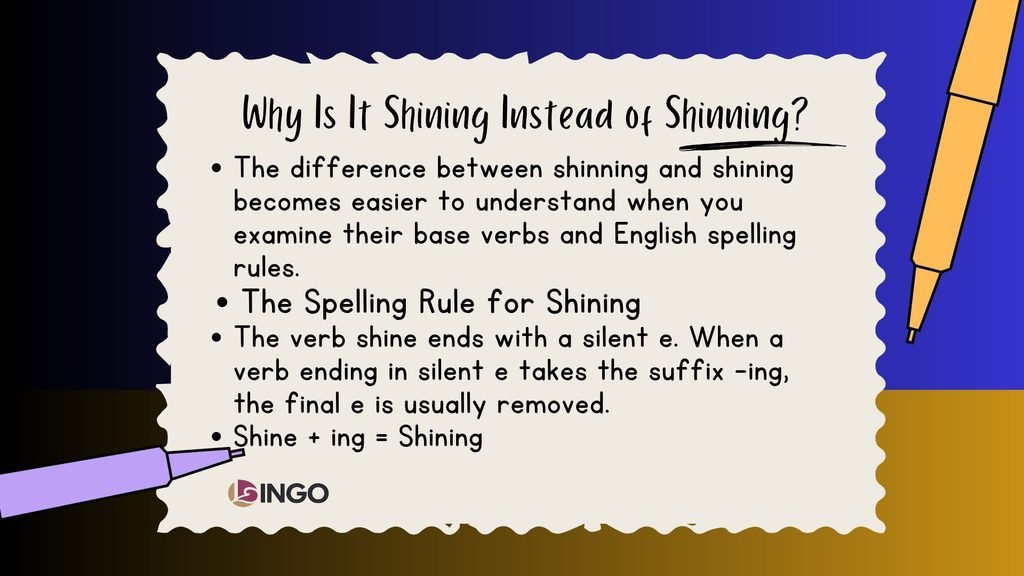
The difference between shinning and shining becomes easier to understand when you examine their base verbs and English spelling rules.
The Spelling Rule for Shining
The verb shine ends with a silent e. When a verb ending in silent e takes the suffix -ing, the final e is usually removed.
The formation is straightforward:
Shine + ing = Shining
Here are some other examples of the same spelling pattern:
| Base verb | Correct -ing form |
|---|---|
| Make | Making |
| Write | Writing |
| Drive | Driving |
| Take | Taking |
| Shine | Shining |
Therefore, shineing and shinning are not the standard spellings when you mean producing or reflecting light.
Why Does Shinning Have Two Ns?
The word shinning comes from the verb shin, not shine. Because shin ends in a consonant preceded by a short vowel, its final consonant doubles when the suffix -ing is added.
Shin + ing = Shinning
You can see a similar pattern in these examples:
- Run → running
- Sit → sitting
- Swim → swimming
- Stop → stopping
- Shin → shinning
The key is to identify the original verb before adding the suffix. Once you know whether the base word is shine or shin, choosing the correct spelling becomes much easier.
An Easy Way to Remember the Difference
Use this simple memory trick:
- Shining = shine = light or excellence.
- Shinning = shin = climbing.
For example, if you are describing sunlight entering a room, write, “The sunlight is shining through the window.”
If you are describing someone climbing a pole using their hands and legs, shinning may be appropriate.
How to Use Shining and Shinning in Sentences
Knowing the definition of each word is helpful, but seeing the words in real-life situations makes the distinction easier to remember.
Examples of Shining in Everyday English
The word shining has both literal and figurative meanings.
Literal meaning: light or brightness
- The sun is shining over the mountains.
- The stars are shining above the quiet village.
- Her silver necklace was shining under the lights.
- The freshly cleaned windows were shining in the morning sun.
Figurative meaning: excellence or success
- She is shining in her new position.
- His dedication is shining through his work.
- The student gave a shining example of leadership.
- Her talent was shining during the competition.
These sentences demonstrate how shining can describe physical brightness as well as exceptional qualities or performance.
Examples of Shinning in Context
Shinning is used in a much narrower context involving climbing.
- The child was shinning up a tree when his father called him down.
- The climber practiced shinning up a wooden pole.
- The sailor was shinning up the mast to inspect the rigging.
However, these sentences may sound unusual to readers unfamiliar with the verb shin. In ordinary writing, consider replacing it with climbing unless the specific meaning of shinning is important.
Common Mistakes to Avoid
Here are several examples showing how to choose the right word.
| Incorrect or intended usage | Better or correct usage | Reason |
|---|---|---|
| The sun is shinning. | The sun is shining. | The sun gives off light. |
| The stars are shinning. | The stars are shining. | Stars appear bright. |
| Her shoes are shinning. | Her shoes are shining. | The shoes reflect light. |
| He was shining up the pole. | He was shinning up the pole. | The intended action is climbing. |
| She is shinning in her career. | She is shining in her career. | The sentence describes success. |
Remember that the words are not interchangeable simply because they look and sound similar.
Shinning vs Shining: Real-Life Example and Case Study
Consider a student named Daniel who is preparing an English assignment about a memorable camping trip. He wants to describe the night sky, the morning sunlight, and an activity involving a tall wooden pole.
In his first draft, he writes:
“The stars were shinning brightly above our campsite. When morning arrived, the sun was shinning through the trees. Later, my friend was shining up a wooden pole during a climbing activity.”
Although the meaning is understandable, two sentences use the wrong spelling for the intended meaning, while the third uses the wrong verb for the climbing action.
Daniel reviews the base verbs and corrects his paragraph:
“The stars were shining brightly above our campsite. When morning arrived, the sun was shining through the trees. Later, my friend was shinning up a wooden pole during a climbing activity.”
Now the spelling matches the intended meaning in all three sentences.
The first two examples describe light, so shining is appropriate. The final sentence describes climbing, so shinning can be correct, although climbing up a wooden pole might sound more natural to many readers.
This example illustrates an important lesson: a spelling checker may not catch every word-choice mistake. Since shinning is a legitimate English word, a digital tool might accept it even when the writer intended shining.
The most reliable approach is to review the sentence’s meaning, identify the base verb, and confirm that the spelling fits the context. This technique works for many commonly confused English words, not just shinning and shining.
Shinning vs Shining: Grammar, Usage, and Current Language Data
The distinction between these words is based on standard English spelling and meaning, not a recent change in grammar. Understanding their usage is more valuable than memorizing a trend or an isolated statistic.
What Current Data Can Tell Us
As of 2026, there is no verified, widely accepted statistic specifically measuring how often English writers confuse shinning with shining. It would therefore be misleading to assign a percentage to this particular spelling mistake without a reliable dataset.
Instead, dictionary entries and established spelling conventions provide a sound basis for understanding the difference.
For example:
- Standard dictionary usage identifies shining as a form of shine.
- The verb shin has a separate meaning related to climbing, producing the form shinning.
- English spelling conventions explain why shine becomes shining, while shin becomes shinning.
These facts provide a reliable foundation for writers, students, teachers, and English learners.
Why This Difference Matters in 2025–2026
Clear writing remains important in digital communication, academic work, and online publishing. However, it is important to distinguish general writing advice from measured statistics about a specific spelling error.
For website owners and content creators, choosing the correct word helps maintain readability and credibility. For students, it supports accurate grammar and vocabulary. For everyday writers, it makes messages easier to understand.
A useful proofreading checklist is:
- Identify the meaning you want to express.
- Determine whether the base verb is shine or shin.
- Apply the correct spelling rule.
- Read the entire sentence to confirm that the word makes sense.
- Consult a reputable dictionary if you are unsure.
Mini Quiz:Shinning vs Shining
1. The sun is _____ brightly today.
- A) Shinning
- B) Shining
- C) Shineing
- D) Shined
2. Which spelling is correct when describing stars giving off light?
- A) Shinning
- B) Shineing
- C) Shining
- D) Shyning
3. The boy was _____ up a tree.
- A) Shining
- B) Shineing
- C) Shinned
- D) Shinning
4. Her polished shoes were _____ in the sunlight.
- A) Shinning
- B) Shining
- C) Shineing
- D) Shyning
5. What is the base verb of shining?
- A) Shin
- B) Shinned
- C) Shine
- D) Shinning
6. What is the base verb of shinning?
- A) Shine
- B) Shin
- C) Shone
- D) Shiny
7. Choose the correct sentence.
- A) The moon is shinning brightly.
- B) The moon is shineing brightly.
- C) The moon is shining brightly.
- D) The moon is shyning brightly.
8. Which word means climbing a pole by gripping it with the limbs?
- A) Shining
- B) Shinning
- C) Shone
- D) Shiny
9. She is _____ in her new job.
- A) Shinning
- B) Shineing
- C) Shining
- D) Shyning
10. What happens to the final e in shine when adding -ing?
- A) It doubles.
- B) It remains unchanged.
- C) It is replaced by y.
- D) It is dropped.
11. The stars were _____ in the night sky.
- A) Shinning
- B) Shining
- C) Shineing
- D) Shined
12. Which sentence uses shinning correctly?
- A) The sun is shinning over the hills.
- B) Her smile is shinning brightly.
- C) The sailor was shinning up the mast.
- D) The stars are shinning tonight.
13. The student’s talent was _____ during the competition.
- A) Shinning
- B) Shining
- C) Shineing
- D) Shyning
14. Which word is most appropriate for describing a bright, reflective surface?
- A) Shinning
- B) Shin
- C) Shining
- D) Shinned
15. Complete the sentence: The worker was _____ up the wooden pole.
- A) Shining
- B) Shineing
- C) Shinning
- D) Shone
16. Which spelling follows the pattern run → running?
- A) Shineing
- B) Shining
- C) Shinning
- D) Shyning
17. Choose the correct sentence.
- A) The sunlight is shining through the window.
- B) The sunlight is shinning through the window.
- C) The sunlight is shineing through the window.
- D) The sunlight is shyning through the window.
18. Which word is more common in everyday English when describing light?
- A) Shinning
- B) Shining
- C) Shin
- D) Shinned
19. The climber was _____ up the tree carefully.
- A) Shining
- B) Shineing
- C) Shinning
- D) Shone
20. What is the correct spelling of the present participle of shine?
- A) Shyning
- B) Shinning
- C) Shineing
- D) Shining
True or False
21. Shining can describe someone performing exceptionally well.
- A) True
- B) False
22. Shinning is the correct spelling when describing sunlight.
- A) True
- B) False
23. The verb shin becomes shinning when -ing is added.
- A) True
- B) False
24. Shineing is the standard spelling of the present participle of shine.
- A) True
- B) False
25. Shinning and shining always have exactly the same meaning.
- A) True
- B) False
Answer Key
- B — Shining
- C — Shining
- D — Shinning
- B — Shining
- C — Shine
- B — Shin
- C — The moon is shining brightly.
- B — Shinning
- C — Shining
- D — It is dropped.
- B — Shining
- C — The sailor was shinning up the mast.
- B — Shining
- C — Shining
- C — Shinning
- C — Shinning
- A — The sunlight is shining through the window.
- B — Shining
- C — Shinning
- D — Shining
- A — True
- B — False
- A — True
- B — False
- B — False
Frequently Asked Questions About Shinning vs Shining
1. Is it shinning or shining?
Shining is correct when referring to light, brightness, or excellence. Shinning is a separate word describing a particular type of climbing action.
Example: “The sun is shining brightly.”
2. Is shinning a real word?
Yes. Shinning is the present participle of shin, a verb meaning to climb by gripping an object with the hands and legs. It is uncommon in everyday English.
3. Why is shining spelled with one n?
Because shining comes from shine. The final silent e is removed before adding -ing, producing shine → shining.
4. Why is shinning spelled with two ns?
Because it comes from shin. When -ing is added to this short verb, the final consonant doubles: shin → shinning.
5. Is it correct to say the sun is shinning?
No, not when describing sunlight. The standard sentence is “The sun is shining.” The word shinning refers to climbing, not emitting or reflecting light.
6. Can shining describe a person’s success?
Yes. Shining can describe someone performing exceptionally well or demonstrating a positive quality.
Example: “She is shining in her new role.”
7. What is the difference between shining and shiny?
Shining is commonly used as a verb form or participial adjective, while shiny is an adjective describing something that reflects light or has a bright appearance.
Examples:
- The polished floor is shining.
- The polished floor looks shiny.
Both sentences are correct, but their grammatical structures differ.
8. How can I remember shinning vs shining?
Remember the base verbs: shine → shining for light and excellence, and shin → shinning for climbing. Checking the meaning first will help you choose correctly.
Conclusion: Choose the Correct Spelling With Confidence
Understanding shinning vs shining is simple once you recognize that the words come from different verbs.
Use shining when describing sunlight, stars, reflective surfaces, or a person’s outstanding performance. Use shinning only when referring to the less common climbing action associated with the verb shin.
The easiest rule to remember is shine becomes shining, while shin becomes shinning. This distinction helps you write accurately without relying entirely on spellcheck tools.
Whether you are preparing an assignment, writing a professional email, or publishing an SEO article, choosing the right word makes your message clearer and more polished.
For more clear explanations of commonly confused English words and grammar rules, explore the other language guides on Lingorixa.
References
https://dictionary.cambridge.org/dictionary/english/shine
https://www.merriam-webster.com/dictionary/shine

Maimoona Asghar is a grammar enthusiast and language writer who creates clear, practical content to help learners improve English grammar, writing, punctuation, and communication skills through easy-to-understand explanations and examples.